This is one example of what may become an even greater problem as Arctic permafrost melts in a warming world. The Arctic is warming at a rate three times faster than the rest of the planet. Preserved within it are microbes and viruses to which modern animals and humans have never been exposed. The reindeer that died is one of many that succumbed to anthrax in the early 20th century.
The agent that caused Spanish influenza, the 1918 pandemic, resulting in more deaths than all those who died on battlefields in World War One, was recently discovered very much alive in corpses buried in Alaskan permafrost. It is likely that permafrost will yield other pathogens as it melts with the biggest concerns smallpox and bubonic plague. Why? Because those diseases were endemic in animal and human populations in Siberia in the 18th and 19th century and can be found in remains buried in Arctic permafrost. One known event, a smallpox epidemic in the 1890s in Siberia wiped out 40% of the people in one town. Their bodies were buried in the permafrost by a river which 120 years later because of flooding from warming is now experiencing erosion.
The unknown diseases of prehistoric populations buried in the Arctic permafrost remain as much a threat as those diseases we do know. Sampling at burial sites has produced viral fragments of both known and unknown origin.
What other bacteria should we fear? Any microbe that can enter a spore hibernation phase requires us to be vigilant. Anthrax is just one that becomes dormant like this, capable of surviving tens of thousands of years. Tetanus and botulism also form spores and will likely be found in the remains of animals and humans as the permafrost melts. And don’t forget the viruses. The latter are far more likely to survive for long periods of hibernation and emerge as infectious agents capable of harming plants and animals.

And as the Arctic melts encouraging tourism, mining and other commercial activities, more humans will transit the polar region or decide to live there. The isolated incident of the Yamal Peninsula anthrax outbreak may become far more commonplace as our Arctic presence grows.
Just how far back in time can viruses and bacteria buried and frozen in the permafrost impact us today?
States Jean-Michel Claverie, an evolutionary biologist at Aix-Marseille University, “The possibility that we could catch a virus from a long-extinct Neanderthal suggests that the idea that a virus could be eradicated from the planet is wrong, and gives us a false sense of security….This is why stocks of vaccine should be kept, just in case.” Claverie found DNA from giant viruses in radiocarbon-dated samples emerging from the Siberian permafrost in 2014 that date back 30,000 years. And in another study, scientists revived bacteria trapped in Antarctic ice core samples dating back 8 million years.
Claverie’s recommendation on retaining vaccines for diseases we once considered extinct makes a lot of sense. But what about diseases caused by microbes to which we and other modern living things have never been exposed?
Climate change is turning out to be far more than a concern about a hotter Earth, rising sea levels, the death of coral reefs, changing weather, and animal and plant extinctions. We now add the threat of prehistoric pathogens which may emerge from what was thought of as permanently frozen ground dating back to the last Ice Age.
]]>We humans are good at war and inflicting destruction upon this planet and our species. But what we are not good at is seeing the insidious nature of our technological impact on the climate of our planet. The evidence lies all around us but we choose to ignore it.
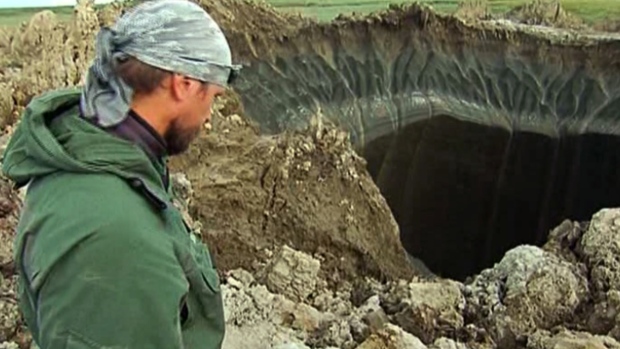
The latest, a 30-meter (approximately 100-feet) wide hole opened up in the Yamal Peninsula in Siberia in mid-July (see image above). A second smaller hole nearby has also been reported. Are these sinkholes caused by changes to groundwater levels, or by human activity underground such as mining that could destabilize the ground above? No say those researchers who are studying the phenomenon. Preliminary results indicate that this hole is a methane-created. Melting of permafrost because of abnormally warmer summers over the last two years is to blame. The scientists point to Yamal Peninsula average temperatures over the last two summers averaging 5 Celsius (9 Fahrenheit) warmer. The temperature of permafrost at 20 meters (66 feet) below the surface during this same period has risen by 2 Celsius (3.8 Fahrenheit).
The Yamal Peninsula weather pattern isn’t unique. The polar regions of the Earth, particularly in the Northern Hemisphere, are rapidly warming. In past blog postings here I have described the threat that this warming brings to permafrost area found in abundance across Northern Canada and Russia. Melting is accompanied by sudden changes in the physical landscape (a hole for example). But worse, melting means the release of methane gas, stored in the frozen biomass.
This is a bomb bigger than anything we humans have dropped in a war and it is waiting to go off with implications for global warming that could prove to be more long-term and catastrophic. Methane is 20 times more potent as a greenhouse gas than carbon dioxide. The only saving grace when compared to carbon dioxide is, methane oxidizes within then years so the potency is short term.
Measurements from the crater which is estimated to be 70 meters (230 feet) deep, show levels of methane gas at 9.6%, well above the 0.000179% in the normal atmosphere. The hole continues to change as the rim slowly melts sloughing off water and debris which is filling the base with an estimated 20 meters (70 feet) of water.
The methane in the Yamal Peninsula, in frozen form, is similar to the frozen gas hydrates which Japan last year mined from the ocean floor south of Tokyo. Mining gas hydrate ocean reserves may be viable but the explosive nature of the gas when released makes this a dangerous enterprise at present. But mining gas hydrates from permafrost would be practically impossible and its explosive nature may not be controllable by us with any current or planned technology.
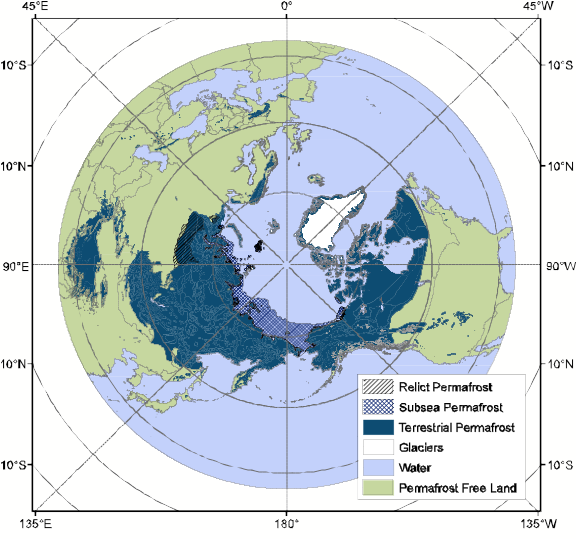
For communities near the hole a sudden release of methane could lead to an explosion, particularly if the gas in sufficient concentration should be in contact with an open fire or exposed electrical wires. If a significant methane release, somewhere between 30 to 85% loss of near-surface permafrost, were to happen in the 24% of the northern hemisphere classified as permafrost (seen in the map below), the methane contained within it, not including the carbon dioxide which is also found in the permafrost biomass, would lead to a global temperature spike between 3 and 6 Celsius (5.4 to 10.8 Fahrenheit) degrees. The melting would impact wetlands and lakes on the surface of the permafrost and alter the habitat for resident life and migratory birds. Human communities built on permafrost would undergo dramatic alterations. Infrastructure such as buildings, roads, and utilities would be badly damaged.