So far there are no guidelines on the nature of the innovation a team can produce. This fits with IBM’s Watson strategy overall, which is to put the artificial intelligence technology to the test in a wide range of industries. Watson is being used in healthcare, education, finance, human resource management, travel planning, law, retailing, meteorology, security, agriculture and publishing, just to name a few of the areas where its AI is being applied.
Peter Diamandis, one of the founders of the X Prize states, “I’m sick and tired of the dystopian vision of artificial intelligence…AI is one of the most important inventions we will create to solve humanity’s grand challenges, to understand the potential the future provides for us.” I guess Diamandis is reacting to Elon Musk and Steven Hawking and those who fear that AI will wipe out 50% of all human employment on the planet by 2030.
Watson was first unveiled by IBM in a contest with the two biggest human winners of the TV trivia show, Jeopardy. The AI wiped the floor with its human challengers. The technology uses natural language processing and machine learning to analyze unstructured data such as news articles, research reports, social media postings, and business systems. Its natural language processing lets it understand grammar and context. It can evaluate all possible meanings of a statement to determine its purpose. And it presents answers based on found evidence.
How does Watson start to learn? Its human handlers load it with unstructured information (articles, documents, books, reports, memos, email, etc.). Then Watson is trained through an iterative process to match questions and answers. As new information is added Watson stays current.
How does Watson answer a question? Watson uses a scoring algorithm as it searches through unstructured data and then ranks all possible answers to a query.
The XPrize contestants will be able to join the Watson Ecosystem receiving APIs from IBM that will let them tackle the problems they want to solve.

What makes this prize different from any of the previous ones is the use of crowdsourcing to identify what three issues need to be addressed under the banner of what is being described as the grand challenges facing the oceans of the world. Scientists, business leaders, the general public, government officials and philanthropists will all have a say in what problem each prize will address. Will it be over fishing? Will it be a way to stop coral bleaching? Will it be pollution? Will it be coming up with technology to clean the plastic filled gyres at mid-ocean locations across the planet? Or will it come up with an overall strategy for addressing the 46,000 pieces of plastic per square kilometer that can be found in ocean waters everywhere today?
The ocean has already been the subject of previous prize competitions. In 2011 a $1.4 million prize was given to a team that demonstrated the ability to cleanup oil spills at 4 times the rate and capacity of any existing technology. And in September 2013 a new $2 million prize, the Wendy Schmidt Ocean Health X Prize was announced to develop affordable, robust and accurate ocean pH sensors to study the impact of carbon being sequestered by the ocean causing increasing acidification.
Why introduce crowdsourcing into the XPrize equation? Dr. Peter Diamandis, Chairman and CEO of X Prize is also a big backer of crowdfunding sites like Kickstarter and IndieGoGo. So it is no surprise that he would add crowdsourcing to engage the larger public in fostering innovation through competitions with large prizes. I suspect that once the three challenges have been identified that crowdfunding donations will be used to add money to the prize pool.

So what is found in our global society today that can be described as an ecology of innovation? As a futurist who studies technological and scientific achievements, it is clear to me that one can define today a distinct, innovation ecology.
Here are some examples:

The Internet is the ubiquitous platform upon which this new ecology is built. It, along with global communication facilitated by cellular networks, connects all of human society today like never before. With a Wikipedia, a Google or a Bing it is hard to imagine not finding answers to almost any question you pose. Of course in the free flow of information also comes misinformation.
That’s where education plays a powerful role in an ecology of innovation. And today we are seeing more of those in our global society who have been denied access to learning finally making strides. I’m speaking of girls who in so many cultures have often been ignored as a resource capable of driving innovation. Today more and more of them are getting educational opportunities very much facilitated by access to inexpensive smartphones and the Internet as well as formal education.
Another is the notion of prizes, the offering of cash rewards to individuals or organizations that develop a specific technology or scientific accomplishment in pursuit of a defined goal set by those making the offer. This old 18th century idea continues to be renewed here in the 21st and is fostering innovation in space, aviation, transportation, biomedicine and environmental science. Even NASA and DARPA have announced prize competitions to encourage innovation within the private sector to meet the goals of the space program and the Pentagon.

Probably the recent phenomenon of crowdsourcing and crowdfunding through the Internet is the best example of an ecology of innovation. Sites like Indiegogo and Kickstarter are an inventor’s paradise, connecting those who create innovation with early adopters who are prepared to invest to see the technology get to market. The results have been astonishing to the point where crowdsourcing funding for pure science now exists at Petridish.

But it is the use of the word ecology that keeps making me think of the environment and the planet we live on. Of all areas of pursuit today we need our modern society focused on addressing the environmental challenges we face in the 21st century. We need as a society to create the innovation necessary to ensure our survival as a species. We live in interesting times, in a period when we know that we may be subject to significant environmental disruptions as the century unfolds and face challenges human society has never experienced before. Critical thinking, innovation, and invention will be ours and the planet’s salvation.

That’s because the Internet and mobile telephone networks have made the sharing of collective knowledge ubiquitous. For many parts of the world this level of connectivity and abundance of shared knowledge is uncomfortable, particularly those areas under authoritarian rulers. In some cases religious leaders have felt threatened to the point of demonstrating Luddite behaviour. For those trying to hold back the rushing of water over their crumbling dams let me assure you the volume and speed will only increase as the years go by.
We are witnessing an unparalleled disruption as technology spreads around the planet. This is making us even rethink the definition of nations because an Internet-linked humanity is breaking down borders as ideas get freely shared. Today we have the mechanisms in place for group think, global problem solving, and all the benefits that entails. As the century unfolds we will see a very different world arise.
Group problem solving comes in a number of flavors. There is the free. There is learning at a small premium. Then there are challenge sites that reward participation in problem solving. Above that you find sites that invite you to help achieve a goal by contributing cash, and finally there are prizes for solving big problems while taking all the risks.
Knowledge Sharing
The Internet has been structured around free dissemination of information. Those who try to monetize information, such as online versions of print newspapers, or private encyclopedia publishers, have had little success in being able to sell information knowledge. That’s because they are competing against free online information services, knowledge aggregation sites and search tools. Two of the most notable knowledge gatherers and dispensers are Wikipedia and Google Search. Combine them and you can find out everything about almost anything. Even the knowledge search tools are experimenting. One of these, Wolfram|Alpha, describes itself as a computational knowledge engine, not a search tool, and states that its goal is to make“all systematic knowledge computable and broadly accessible.” Wolfram|Alpha offers a free and premium service, the latter costing $2.99 per month.
Crowdsourcing
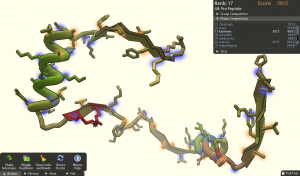
Try to solve a problem? Crowdsource it. In a recent article authored by Murray Rosenbaum, a 15-year old student, writes in the Huffington Post about Foldit, a game created by scientists at University of Washington to help them understand the predictability of protein structures and their role in diseases. Proteins, one of which is the subject of a recent posting on this blog site, are the messengers that deliver instructions from DNA in our cells. Predicting the structure of proteins can help us to understand how we can design ways to combat diseases such as cancer, Alzheimer’s and HIV/AIDS.
Those who play Foldit (see image below) are actually predicting the design of proteins, particularly those which currently have no known structure. Gamers do not need to have prior knowledge of biology to play. The scientists report that the gamers are proving to be great at unlocking protein designs and predicting the way they fold (proteins like to fold rather than stay stretched out). And that is helping the scientists to advance cures.
Since it was rolled out more than 600,000 have played the game. And most recently Foldit added a new puzzle focused on finding answers to creating clean energy using a hydrogenase catalyst. Gamers are asked to build molecular structures that when placed near the centre of the catalyst encourage hydrogen formation from water.
Not to be outdone by the researchers at University of Washington, even DARPA has gotten into the act using crowdsourcing to help it design and manufacture an amphibious tank. For a list of crowdsourcing projects visit that free knowledge aggregation site – Wikipedia. The list is extensive.
Crowdfunding
My first experience with crowdfunding came when I joined Kiva several years ago. Kiva is a micro lender focused on loans to entrepreneurs in the Developing World. Projects are listed and described on the website and investors choose to contribute $25 towards the total amount requested. When the loan value is reached the money is sent and managed by a local micro-lender on behalf of Kiva. So far I’ve made 33 loans for projects in 20 countries with no defaults.
Whereas Kiva sets a specific target and vests the money once that target is reached, other crowdfunding sites allow pledgers to exceed the investment target. A few weeks ago I wrote about one, the GravityLight, (as seen below) a product that has raised $382,000 using a crowdfunding site called Indiegogo. The initial goal was $55,000. The deadline is tomorrow, January 15.

Probably the best known of the current crowdfunding sites is Kickstarter with virtually thousands of projects seeking funding. When I visited Kickstarter today it listed all kinds of projects from the arts to publishing. I focused on the 91 technology projects each seeking funding and read about one of the most recent successes, Form 1, a high-resolution 3D printer. This project received almost $3 million from 2,068 backers, 3000% over the requested investment target. In return the pledgers will receive gifts with those contributing $2,299 or more getting a Form 1 3D printer.
And crowdfunding is even coming to the scientific research community. Check out Petridish.org a site that is helping scientists raise money for laboratory experiments and research projects with the biggest pledgers receiving rewards like having a beetle named after them.
X Prizes
Offering a purse or prize for a successful outcome goes back to the 18th century when the parliament of the United Kingdom rewarded cash for the development of navigation aids for long sea voyages. That’s how longitude was invented.
In the 19th century the French Academy offered an engineering prize to the developer of a chemical process for extracting soda from seawater. The 100,000 francs paid out to the chemist who made the discovery fathered the beginnings of modern chemical engineering.
Lindbergh’s solo flight across the Atlantic in 1927 was in pursuit of the Orteig Prize, a $25,000 award from a New York hotelier. In achieving his feat Lindbergh opened a door to commercial aviation.
Today lots of organizations offer prizes but the X Prize remains the one with the most panache because it made the biggest splash in 2004. The 10 million awarded to the developers of SpaceShipOne for its successful suborbital flight was the largest prize ever awarded for a technological feat. And the fallout from the first commercial suborbital flight has led to the beginnings of a private enterprise push to space.
A second X Prize competition in 2010 produced three winners who built vehicles capable of achieving 2.35 liters per 100 kilometers (100 miles per gallon) over a 160 kilometer (100 mile track). The vehicles belonging to Edison2, Li-on Motors and X Tracer can be seen from left to right in the images below.

Today there are many X Prizes on the go and many more being formulated. Here are just a few of them:

The authors acknowledge we live in “turbulent times” but the book focuses not on hand wringing, dire predictions, but on a positive future driven by rapid innovation leading to abundance. As I have stated in earlier blogs we are bombarded with warnings about sustainability and a bleak future. But we are the authors of our own defeat, as well as the inventors of our future success.
Here are some examples of what I mean:
In the 1970s it was predicted by experts that we would run out of oil in the early decades of the 21st century. Yet today we are awash in the stuff with no limit in sight.
In 1900 the average human life span globally was about 40. Today we are approaching 80, a doubling.
In the 1980s I was involved with a company that was documenting 90-baud transmission rates over land lines for countries in Africa. This technology represented the best we could do for Sub-Saharan countries that lacked modern telecommunications infrastructure. Yet today Africa has skipped land line infrastructure entirely and moved to mobile phones and mobile data networks. The growth has been astronomical since 2000, when mobile users represented 2% of Africa’s population. By 2009 penetration had grown to 28%, a growth factor of 14. And by next year, 2013, forecasters predict that 70% of Africa’s population will have access to mobile technology.
In the 1980s no one had heard of micro loans. Banks didn’t loan money to small business in places like Africa, Central and South America or South Asia. But today we have organizations like Kiva.org providing micro-funding for tens of thousands of Developing World entrepreneurs in increments of $25.
Techno-philanthropists didn’t exist in the 1980s either. But today people like Bill and Melinda Gates are pouring billions into projects to end diseases like malaria, or provide new educational models that use the power of the Internet and mobile devices to personalize learning beyond bricks and mortar classrooms.
For the authors of this book abundance is just around the corner. They see a world in 2050 with nine billion of us having access to clean water and clean air, nutritious food, affordable housing, personalized education, best practice medical care, and energy that comes from non-polluting sources capable of meeting our needs for centuries to come.
How will we get there?
The authors see us already rapidly ascending an accelerating path to achieve abundance for all humans on the planet. And much of what I write at this blog site speaks to this progress in so many fields of science and technology. For both the authors of “Abundance” and I believe that we have within our means the ability to create a very bright future for humanity and the rest of life on this planet.
Diamandis and Kotler set the stage with their modified Maslow hierarchy called the Abundance Pyramid (see below) and then go on to illustrate the advances we are making in all of these areas through technological innovation.

The Story of the Spirit of St. Louis
Diamandis, as I mentioned earlier, organized the Ansari X Prize that led to Burt Rutan’s sub-orbital SpaceShipOne achievement. He and Kotler write about the inspiration behind the X Prize. It’s an interesting story. Diamandis was inspired by the story behind Charles Lindbergh’s solo flight across the Atlantic Ocean in 1927. It begins with a French shepherd, Raymond Orteig, who emigrated to America before the First World War. He started as a waiter and worked his way up to eventually become a hotelier in New York City. Orteig’s hotel hosted aviators after the war and the stories they told inspired him to propose an idea to the Aero Club of America in 1919. His offer, a $25,000 prize for the first aviator to cross the Atlantic Ocean, non-stop, either from Paris to New York or the other way. He put an expiry date on the prize – five years. But with no takers after five years, he extended his offer for another five.
What you may not know is that Lindbergh, a fairly novice aviator when compared to others who attempted to win the $25,000, was preceded by several who failed in their attempts. Two perished taking off in overweight airplanes in 1926. In 1927 four more died making the attempt. Lindbergh, “the flying fool” according to the media of the time, succeeded where these others failed. And in winning Orteig’s prize launched trans-Atlantic air travel, the modern era of commercial aviation, and an industry worth today $300 billion dollars annually.

The Spirit of Competition Has No Limits
The lesson of Lindbergh is the inspiration that today is providing the fuel for solving all kinds of technological challenges. We have seen an eruption of incentive prizes to challenge individuals and companies to find new ways of doing things.
When I finished the book I started thinking about all the problems and challenges we face that through a prize might lead to novel solutions. Here’s a list of some of my prize ideas:
I invite you, my readers, to come up with and share lists of your own. Who knows, maybe this exercise in crowdsourcing will lead to some amazing breakthroughs here in the 21st century.
]]>As the 20th century came to an end the outward urge to send humans to places like the Moon, near-Earth asteroids, and Mars, no longer were seen as imperatives of national policy. The big discoveries came from robot spacecraft, orbiters and mobile landers as they circled distant planets, journeyed to asteroids, or landed on and began exploring Mars.
Human occupation of space remained bound to low-Earth orbit. The International Space Station (ISS), conceived in the 1990s, assembled starting in 1998 and completed in 2011, represents the sole human-inhabited outpost in near-Earth space today. As impressive as it is, weighing 420,000 kilograms (925,00 pounds), and measuring 109 meters (357 feet) from end-to-end, the ISS lacks the cachet of the Apollo Program.

The post-Apollo human era in space had been dominated by two very different space programs by the former ideological rivals. The American-built Space Shuttle program began in 1981 and ended in 2011. The Soviet MIR space station took ten years to build starting in 1986, became Russia’s program falling the collapse of the Soviet Union, and after completion in 1996 remained occupied continuously until 2001.
To date over 500 humans have travelled beyond Earth’s atmosphere, most into low-Earth orbit. Of these, 27 flew beyond Earth orbit and 12 walked on the surface of the Moon. In comparison our human population has grown from 3 billion at the time of Yuri Gagarin’s first human in space flight to 7 billion plus today.
Futurists of the 1960s predicted human space voyages to Jupiter and beyond. Arthur C. Clarke’s, 2001: A Space Odyssey, reflected in its timeline the outward spirit of adventure that came from early human space flight achievements. Those futurists envisioned lunar colonies, human voyages to near-Earth asteroids and Mars. But that’s not what happened. Instead the high tide of human space exploration ended with Apollo and the Moon landings. Space remained an important area for human activity but the romance of humans travelling beyond Earth was gone even though more countries were involved with space. Today, in fact, we have approximately 60 nations with formal space agencies and programs. Ten agencies have launch capability. And of these only three can launch humans into near-Earth orbit.
The European Space Agency has been a partner in the development of the ISS and has sent a number of its members to the space station on the American Space Shuttle and Russian Soyuz spacecraft. Other countries have also joined in among the 500 who have experienced space.
Recently China has launched its own human Shenzhou space flight program sending its first taikonaut (the Chinese equivalent to astronaut or cosmonaut, the American and Russian terms) into orbit in 2003. A second successful launch with two taikonauts in a multiple-day flight occurred in 2005 and a three-man crew followed with a spacewalk by one taikonaut in 2008.

In 2011, China launched their first space station module, Tiangong and followed this with a successful unmanned Shenzhou-8 launch and docking of the two. China has announced its plans to build a 54,000 kilogram (120,000 pound) space station by 2020.
Not to be forgotten is the stirring of new players with space launch capability and ambitions to put humans in orbit. Inspired by the Ansari X Prize, a $10 million award given to the first company to launch humans into suborbital flight twice over a two week period, the cheque was awarded to Scaled Composites and their spacecraft, SpaceshipOne. Scaled Composites were one of 25 companies who set out to win the award. Many of them continue to build their technologies with the goal to commercialize human spaceflight. SpaceShipTwo, the successor to the X Prize victor, is planning to launch commercial suborbital flights through its partner Virgin Galactic in 2015.

SpaceX, a company that did not participate in the X Prize, has developed its own rocket launchers and capsules and is scheduled in May 2012 to send an unmanned cargo carrier to the ISS. Called Dragon, the spacecraft has been designed for both manned and unmanned low-Earth orbit missions.

As we can see the end of the first decade of the 21st century our adventure into space continues to have very little of the human in it. But that is about to change. Where we have truly experienced the thrill of new discovery has been through robotic space exploration, the subject of our next installment on space and humanity in the 21st century.
]]>