Both cold and warm extremes place an added burden and additional risk for our species. The scientific literature tracking morbidity and mortality numbers is telling us we are increasingly in danger from both.
A recent article in The Lancet Public Health examines temperature related to mortality in 30 European countries and 854 cities. Age-specific data was looked at from five groups divided by ranges from 20 to 44, 45 to 64, 65 to 74, 75 to 84, and 85 and above. Extremes in temperature weather cold or hot impact the elderly more than young adults. In southern European cities, extreme cold is cited as causing 8.3 times more deaths in the elderly than extreme heat largely attributed to respiratory tract infections and complications.
If you don’t live in the U.S. south and southwest you probably are having a warmer than normal summer. But what is happening in Dallas, Houston, Austin, Amarillo, San Antonio, Corpus Christi, Waco, Albuquerque, Phoenix, Las Vegas, Tucson, and many other cities across the U.S. South presently represents a disturbing future trend as anthropogenic climate change progresses.
In the last week and for the next two, most of Texas is seeing or will see daytime highs above 43 Celsius (110 Fahrenheit) with heat indices reaching 45 Celsius (113 Fahrenheit) or higher. The heat index combines temperature and humidity.
The same highs are being recorded in Phoenix. Phoenix has seen 43 Celsius (110 Fahrenheit) or higher temperatures for 50 days in 2024. Temperatures at mid-day in Albuquerque are hitting 37.8 Celsius (100 Fahrenheit). Albuquerque sits at an average elevation of over 1,730 metres (approximately 5,700 feet) above sea level. It is the highest elevation for any large U.S. city.
Daytime temperatures are one thing, but the nighttime highs from Kansas to the Gulf of Mexico and from Louisiana to Arizona are also at record levels with temperatures between 23 and 32 Celsius (75 and 90 Fahrenheit).
For the elderly, the ill, and the very young, these high-temperature lows represent the greatest danger. Without air conditioning, the body gets no relief from the extreme day and night heat.
The cause points to a record of 14 months of global temperature highs caused by the current El Niño boosted by anthropogenic climate change. Even as the El Niño wanes the map seen below produced by NOAA’s Climate Prediction Center shows that other than parts of Southwestern Alaska, and the Pacific Northwest and California coast, seasonal temperatures through to November are expected to be leaning to above average.

Death from excessive heat came to a Baltimore municipal employee on August 2, 2024. A sanitation worker passed out while at work and died in hospital. The worker’s death was described by those who work in occupational safety and health as preventable. This death from heat can be expected to happen more frequently as rising temperatures from climate change combine with the heat island effect in large urban centres.
Exposure to heat for outside workers in places where temperatures exceed daytime highs of 30 Celsius (86 Fahrenheit) with heat indices of 37 (98.6 Fahrenheit) or higher are becoming summer norms. The daytime temperature in Baltimore that day reached 36.1 Celsius (97 Fahrenheit).
A May 2022 article in Time Magazine described a JAMA study that predicted a staggering increase in unsafe outdoor workdays by 2050 representing cumulative work losses of earnings at USD 55.4 billion annually. The article noted that protection standards in the U.S. remained piecemeal at best and outdated or inadequate at worst if they existed at all.
The World Health Organization (WHO) tracks heat-related deaths across the globe. It notes that the human body has existing heat stores and when exposed to high external temperatures, high humidity, low wind and high thermal radiation combined with clothing makes it difficult to regulate internal temperature resulting in heat exhaustion and heat stroke. The WHO notes that heat extremes worsen health risks from diabetes, heart, kidney and lung disease. It exacerbates conditions like asthma.
Exposure to extreme heat from climate change the WHO notes has been growing exponentially all over the planet. Heat-related mortality for those 65 years of age or older has increased by approximately 85% between 2000 and 2021. Here are some other statistics:
The health impacts of excessive heat are known, predictable and preventable, notes the WHO which has produced guidelines for public health institutions to identify and manage extreme heat risks. What occurred in Baltimore need not have happened if the city had instituted effective heat risk policies and procedures.
]]>In the WHO media release it notes that “on the basis of limited evidence for cancer in humans” aspartame was possibly linked to hepatocellular carcinoma, a liver cancer. It went on to state that there was “limited evidence for cancer in experimental animals and limited evidence related to the possible mechanisms for causing cancer” related to aspartame consumption. Further noted in its conclusion was that there is “no sufficient reason to change…established acceptable daily intake of 0-40 mg/kg body weight for aspartame.”
That made me want to look at just how much aspartame was I consuming in two glasses of diet cola each day. How much aspartame is in a 340-gram (12-ounce) bottle of Diet Coke or in other branded diet colas? I went looking to find out if aspartame was the only artificial sweetener in these drinks. What I found is represented in the following chart which shows the presence of two artificial sweeteners in diet colas.
| Beverage | Aspartame (mg) | Acesulfame K (mg) |
|---|---|---|
| Diet Coke | 188 | 0 |
| Coke Zero Sugar | 87 | 47 |
| Diet Pepsi | 124 | 32 |
| Diet Pepsi Lime | 125 | 32 |
Remember when Donald Trump was president and the Diet Coke big red button was featured on his Oval Office desk? It was reported that he was consuming 8 to 10 Diet Cokes per day. Did that level of consumption make him vulnerable to cancer? Not based on the WHO guidelines. Even with his weight, the possible cancer risk was low.
I then looked at the other sweetener that showed up in diet colas. Did the WHO have similar data and instructions about acesulfame potassium which is the main ingredient in artificial sweeteners like Splenda, Equal and Nutrasweet? The WHO’s general advice on sweeteners can be found in a May 2023 WHO release that cautions against using any of them, not because of cancer risk, but rather because they do “not confer any long-term benefit in reducing body fat in adults or children.”
The WHO’s recommendation on sweets is to consider eating foods with naturally occurring sugars like fruit. It advises us to drink more unsweetened beverages because our cravings for sweet things are putting us at risk for Type 2 diabetes and cardiovascular diseases.
Our craving for sugar goes back to our human ancestors. Richard Johnson, a professor at the University of Colorado Department of Medicine has written a book entitled The Sugar Fix. In it, he hypothesizes that in our ancestral past, we faced a climate and environmental crisis that introduced fructose as a food source to help stave off starvation. This caused an adaptation to crave natural sugars which triggered the chemical dopamine in our brains. Dopamine is known as a feel-good chemical, and since then, we have been hooked on sweets.
Interesting to note, the WHO provides guidance on sugar in our diet. It recommends we do not exceed 10 teaspoons per day at all stages of life with the ascribed benefits being better weight control and less tooth decay.
The aspartame alert made headlines around the world in the last week. A New York Times article read “The WHO Says Aspartame Is Possibly Carcinogenic.” NPR, Canada’s CBC, Reuters, Bloomberg, other news services and social media ran with the “possibly carcinogenic” headline. What they didn’t do is dig deeper to look at the science as well as the WHO’s general recommendations regarding sweeteners, both natural and artificial.
For a person who has always battled with weight gain, seeing artificial sweeteners being added to a growing list of things bad for us, I found myself doing what the newspapers and news services didn’t do. Why? Because I have been trying to manage my weight after dealing with the consequences of the COVID-19 pandemic which led to isolation and reduced activity. In our building, the gym was in lockdown. After getting COVID which caused heart complications and multiple hospitalizations, my health didn’t get better. Instead, I gained 15 kilograms (more than 30 pounds) from a lack of activity and a dopamine craving for things sweet.
Now I am using portion control to manage calorie intake and in our new apartment have been taking advantage of the pool and gym regularly. I continue to drink artificially sweetened sodas in moderation. I weigh the risks. Am I more likely to get cancer, or Type 2 diabetes from the weight gain of the last 3 plus years?
I’m happy to say that the weight is coming off at a steady and manageable rate. And although I have increased my water intake, I still crave sweets in my diet and fulfil that need with an occasional Diet Coke.
My conclusions about the aspartame and cancer headlines are this. When you read about anything in the news these days it is in your interest to learn more. Dig into the details. Because in our social media age, a couple of hundred words in a tweet or thread should not be the sole source of understanding and knowledge.
The World Health Organization (WHO) defines zoonosis as an infection that jumps to humans from vertebrate animals. In other words, not from a mosquito or tick. Zoonoses (the plural for zoonosis) are increasingly becoming a primary human disease source. The WHO calls them a growing public health problem because of our increasing encroachment into natural environments.
And when a zoonosis transfers to humans, in entering a new environment it begins to mutate to become a pandemic or endemic. Such has been the case with COVID-19, Ebola, SARS, and now monkeypox.
But it isn’t just our encroachment into nature that is fueling the spread of zoonotic diseases. Climate change is acting as an accelerant. How so?
An Inside Climate News article written by Victoria St. Martin and published on June 7th quotes a research study which states that zoonotic disease spread is something “we can’t put…back in the bottle.”
The study published in the journal Nature was headed up by Georgetown University’s Colin Carlson, an assistant professor of biology. Carlson states, “We know that species are on the move….we know that probably has relevance to other viruses….what does that mean for human health? What does it mean for pandemics?”
So why are species on the move? Because climate change is altering the conditions for their survival. Drought, extreme heat, floods, wildfires, and more environmental disruptions associated with climate change is leading the way. Even in the oceans of the world as they continue to warm, temperate fish species are moving poleward as tropical and subtropical species move away from equatorial regions. On land, the same is happening.
The Nature study notes there are at least 10,000 virus species in vertebrate animals with the capacity to infect humans. The vast majority continue to circulate in their hosts. But Carlson’s predictions based on migration from, and increasing human encroachment to tropical rainforests, in particular, will lead to, within the next 50 years, as many as 4,000 of these leaping to humans.
Carlson’s research team looked at viral sharing in the wild and how geographic range shifts from climate change will put more than 3,100 mammal species in much closer contact with human populations. The hotspots are where we are most abundant, in Africa and Asia. The research shows that the vast majority of these zoonotic diseases will come from bats comingling with humans. And as we already know that’s the story behind the emergence of COVID-19 and the global pandemic that is now into its third year.
If all of this seems new to you, let me mention rabies. Rabies was probably the most recognizable zoonotic disease before COVID-19 arrived on the scene. Caused by the Lyssavirus, it leaped from dogs to humans through the former’s saliva. It could only be transmitted when a rabid dog bit a human, not from being licked. Today rabies is endemic to every continent except Antarctica and causes tens of thousands of deaths annually with 95% of the cases in Asia and Africa. Although it is preventable through canine vaccinations, the disease remains endemic to this day.
The latest zoonotic viral disease to make headlines is monkeypox. Caused by an Orthopoxvirus that is known as the cause of smallpox and cowpox, it was first identified in laboratory monkeys in 1958. In 1970, the first human case was reported in The Democratic Republic of the Congo. Later cases appeared in several West and Central African countries.
The natural reservoir for monkeypox, states the US Centers for Disease Control and Prevention, remains unknown. The suspects include African rodents and several monkey species.
Unlike COVID-19, monkeypox is not an airborne spreader. It requires direct contact with an infection source. Open sores, bites, and intimate contact between humans, as well as the handling of infected wild animals, have likely facilitated the current outbreak across the globe. And although monkeypox will mutate, current research doesn’t indicate it will alter its form of transmission.
Are all zoonotic diseases spread directly from vertebrate animals to humans? No. Many require an insect intercessor. Lyme Disease was originally thought to be caused by a bacteria, Borrelia, found in wild deer populations. But were the deer the original host? Or were they infected by a tick that is known today to be the source of human infections? Several bird species carry Borrelia infections. But it is more likely that these birds, the deer, and we humans have all gotten it from an invertebrate source.
Where does climate change come into the picture for Lyme Disease? The range of the ticks is spreading as winters become less extreme in mid-latitude zones across North America and Europe. The carriers are black-legged ticks that now can overwinter in places where in the past the cold would have killed them. Originally called deer ticks, a misnomer, these invertebrates are increasing their range in North America and Europe causing an uptick (forgive the pun) in Lyme’s spread.
]]>The WHO report referenced in Part 1 is not limited to describing mental health threats. It also includes approaches that health agencies and governments can make to address the psychosocial impacts. The acronym MHPSS which stands for Mental Health Psychosocial Support is referenced throughout the recommendations that follow:
Members of the Caribbean community have made an effort to address the need for psychological help in the face of climate change. It is a response to devastating hurricanes such as Maria which caused extensive damage to Caribbean island nations in 2017.
Hurricanes have been around well before climate change became a reality. There is compelling evidence, however, that hurricanes are getting stronger in the face of climate change. This is producing more devastating storms that pummel places like Puerto Rico, Cuba, The Dominican Republic, Haiti, Guadeloupe, and other Caribbean island nations as Maria did in 2017.
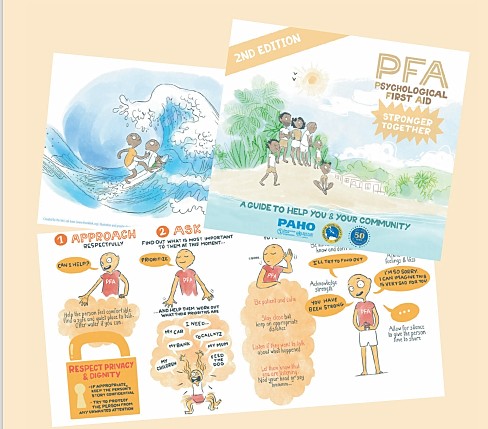
In response, the Caribbean Development Bank in partnership with the Pan American Health Organization developed an MHPSS awareness and preparedness campaign to encourage citizens of these impacted islands to reduce the stigma and seek mental well-being assistance. A guide to providing psychological help can be seen in the sample illustrations below.
It notes growing evidence that climate change is affecting mental health, and that countries need to dramatically accelerate their overall responses.
It describes potentially irreversible effects on mental well-being leading to anxiety and panic attacks, solastalgia (the lived experience of negatively perceived environmental change), eco-anxiety (worries and fears about climate change that affect daily living leading to difficulty sleeping, panic attacks, inability to focus on relationships, school or your job), and ecological grief.
It points to the need for further research and the gathering of real-world data to create holistic and coordinated responses that encompass mental along with physical well-being.
It further notes that financial commitments from all relevant government departments and agencies, the healthcare industry, and others such as the banking sector are needed to address mental health well-being.
The last sentence of the report concludes as follows: “This is the only way to achieve justice for all those who are affected.”
]]>But now consider what the World Health Organization (WHO) is telling us is the real number, nearly 21 million based on adding excess death counts. That’s close to 15 million more than official reports; 4 million more than all the people of The Netherlands; equivalent to the population of Sri Lanka, or all the people living in Austria, Switzerland and Croatia combined.
And it has all happened because of a virus that caught the world unprepared.
The WHO report released today states that total deaths as reported by national health authorities attributable to COVID-19 don’t take into account excess mortality, or as it describes, “the mortality above what would be expected based on the non-crisis mortality rate.”
Excess mortality is not a measure that can easily be gleaned from across the planet. Why not? Because not all countries measure mortality at the same pace and in the same way. Data reporting techniques differ. Some countries don’t even measure at all. This makes calculating excess mortality problematic.
Within regions, there are accuracy challenges. The WHO collects data from Africa, The Americas, The Eastern Mediterranean, Europe, Southeast Asia, and the Western Pacific. Often data is withheld such as in Russia, China, North Korea, and recently, Tanzania.
All countries are asked to supply official COVID-19 death counts. The WHO and others compare these numbers with normal death counts. To determine excess mortality, the WHO looks at increases over and above the norm to come up with a COVID-19 estimate. And that’s the number this latest WHO report shared today, coming in at just under 15 million.
The WHO are not on their modelling COVID-19 statistics. Others dispute the WHO’s numbers. For example, The Economist, the British news magazine using data from John Hopkins University, and an artificial intelligence machine-learning algorithm, recently estimated excess death numbers at 21 million (see graph at the top of this posting), which means total COVID-19 deaths have surpassed 27 million. That’s almost the population of Belgium and The Netherlands combined.
But let’s stick with the 15 million excess for now and what makes up the variables that produced the number. The WHO calls these data variables covariates and attributes them to several factors such as war, climate change, extreme weather events, famine and food scarcity, vector-borne and systemic disease, age, and sex. Most covariates remain constant over time, and so can be ruled out when looking at excess mortality.
Then there is the way death statistics get reported from different countries. Some countries have tracked COVID-19 differently. Some report monthly death rates and some provide no data at all as in the case of the government of Tanzania, which in 2021, stopped reporting COVID-19 deaths because the leader of the country was in denial. The same is true for North Korea which has denied the disease has ever breached its borders. Fortunately, these two are more the exception than the rule.
The modelling the WHO is using has tried to look at how age and sex determine excess mortality attributable to COVID-19. Here too there are variables among nations. Countries that have provided criteria-specific age and sex data show that age matters more than sexual identity. And because there is enough information on these covariates from those countries that do provide this type of detail, the WHO can estimate numbers from countries not reporting on these specific data points. In summary, whereas there is little to differentiate excess death rates based on sex, there is an 18 times more likely rate of excess mortality among people 70-years or older.
The definition of what is a COVID-19-related death is also included in WHO calculations. These include deaths directly attributable to the virus, deaths from medical conditions complicated by it, and cases where the presence of COVID-19 in the general population delayed or stopped treatment of other medical conditions or illnesses leading to death.
In a New York Times article published today, Dr. Prabhat Jha, an epidemiologist at St. Michael’s Hospital here in Toronto expressed concern about the data and our ability to understand what the world has been going through these last two years. He states, “It’s absolutely staggering what has happened with this pandemic, including our inability to accurately monitor it…It shouldn’t happen in the 21st century.” Dr. Jha was one of the WHO experts calculating the excess mortality associated with the virus.
What the WHO data shows, as do other excess death rate studies, is that the majority of deaths from COVID-19 occurred in 2021: 10 million of the 15 million in total. Of those 4.7 million happened in India compared to the 481,080 deaths reported; 1.1 million in Russia compared to 310,000, and more than one million over official totals in Indonesia. In the United States, excess death totals were more than double the reported deaths at 820,000 making the actual COVID-19 number 1.75 million by the end of 2021.
The Times article mentions that numbers the WHO has determined are seen by other reporting organizations to be more conservative. It cites reports released by The Economist and Institute for Health Metrics and Evaluation for comparison.
Why is knowing the actual death count from COVID-19 so important? It is not because of a maudlin interest in the impact the virus has had on humanity and the planet. Dr. Samira Asma, Assistant Director-General for Data and Analytics, at the WHO gives a good rationale in the New York Times article. He states “When we underestimate, we may underinvest, and when we undercount, we may miss targeting the interventions where they are needed most.”
What Dr. Asma doesn’t say is that in a world where climate change and our encroachment on nature make us more susceptible to new viruses, more reliable and timely reporting of real-world data is vital to avoid a future outbreak. We don’t need another global pandemic causing 21 million unneeded deaths.
]]>What is particulate matter? The Canadian government defines it as airborne particles that can be solid or liquid. Particulate matter comes from natural and human sources. The natural ones can be seen when volcanoes erupt spewing ash and other aerosols high into the atmosphere. But far more dangerous because of the sheer volume, is human-produced particulate matter coming from smokestacks, tailpipes, power plants, recently tilled fields, tires running across asphalt and concrete roads, and other human activities that release fine particles into the wind. The lighter and smaller the particle, the greater the threat. That’s because fine particulate matter is easier to inhale. It’s also easier to enter the pores of leaves in plants, and easier as liquid aerosols to bind to our buildings and bridges and other infrastructure where its acidic nature causes corrosion.
A particle of 2.5 micrometres (equivalent to 0.00009843 inches) or less is a public health threat. The U.S. Environmental Protection Agency tracks aerosol pollution at this size and on its site notes that particulate matter smaller than 2.5 micrometres has been declining for two decades. The Lancet study contradicts this finding noting that globally levels of airborne particulate matter have changed very little in twenty years. And where’s the greatest rise? In the cities of Southeast Asia.
The Lancet study notes that “85% of urban inhabitants globally lived in urban areas exceeding the 2005 WHO guideline in both 2000 (1·99 billion people) and 2019 (2·5 billion). Only 16% of all urban areas globally ever met 2005 WHO guidelines between 2000 and 2019.” Africa, the Americas, and Europe have been most successful in bringing down aerosol pollutants in cities. But particulate matter concentrations in urban areas globally are still averaging three times the safety threshold established by the WHO. That should have all of us living in cities sitting up and taking notice.
The most common strategy governments employ when urban pollution in the form of smog gets bad is to instruct people to limit outside activity, stay indoors, and keep windows and doors shut.
How effective is this? Not all that effective in the end considering that particulate matter 2.5 micrometres or smaller can find its way into indoor environments where it is as much a threat as it is in the air outside. But cities have the means to reduce dangerous particulate matter levels in the air by implementing a range of strategies that include:
Concerning the last point, an interesting BBC report last year looked at what were the best trees to plant to reduce air pollution. It turned out that botanists and climatologists agreed on evergreen conifers. Why? Because most conifers don’t go into winter hibernation and drop their leaves, the exception in this part of the world being the tamarack or larch. And also, the density of conifer needles makes for a more effective trap for airborne pollutants.
So if you are a city planner out to create new urban forests choose pine and fir over oak and maple. And if you must add deciduous trees to the mix, the BBC quotes one study that says London Plane, Silver Maple and Honey Locust are among the few that can help deal with urban pollutants by screening them from the atmosphere.
And one more bit of advice to city planners like the ones here in Toronto. If expanding our urban forest in the face of snow and ice in the winter, cut down on using road salt to melt things because the trees we need to clean the air are the ones most salt sensitive.
]]>Among the numbers being given to us are these: cases have surpassed 248 million globally and administered vaccines have reached almost 6.9 billion. Of all the numbers described here, only the last one is accurate. That’s because COVID-19 deaths have and continue to be seriously underestimated. And so do the number of cases because of serious misreporting and data gaps from many countries.
So what is the actual number of those who have succumbed to COVID-19?
In 2020, the WHO noted that mortality numbers for that year were much higher than what would normally have been predicted. In its conclusions it made the following statement:
“We are likely facing a significant undercount of total deaths directly and indirectly attributed to COVID-19.”
At the time the official death count was 1.813 million. But higher than normal mortality numbers based on data gathered suggested the real number to be 3 million, a 65% difference.
How were excess mortality numbers calculated?
The Technical Advisory Group on COVID-19 for the WHO was tasked with correcting the calculations. The group members include demographers, epidemiologists, data and social scientists, and statisticians from across the world.
They looked at observed deaths for a year and data trends for deaths if COVID-19 were absent. They noted where there were data gaps. And they modelled the data from reliable sources such as the information coming from the Americas, and Europe to come up with an estimate of about 60% for the former and 50% for the latter in underreporting deaths.
Where were the data gaps?
The WHO noted in its analysis that Africa, the Eastern Mediterranean, Southeast Asia, and the Western Pacific were areas of the planet with insufficient data to project underreported deaths. What the WHO didn’t note was a similar lack of accurate data from places like Russia, and China, two countries believed to have seriously underreported COVID-19 cases and deaths. In the case of Russia, inexplicable rises in pneumonia and lung ailments causing death were likely COVID-19 related.
But be that as it may, the 65% underreporting of deaths, which the WHO says was its lower estimate for 2019, if projected to today would mean actual mortality numbers for COVID-19 should be more than 8.289 million, or 13.8% of projected global deaths for this year.
How do COVID-19 numbers compare to other leading causes of death?
COVID-19 deaths would be second to heart disease in 2019 which was the leading cause of deaths that year at 8.9 million. COVID-19 would have surpassed the next category, strokes, which in 2019 were responsible for over 6 million deaths. The remaining top 10 include chronic obstructive pulmonary disease and lower respiratory infections each at about 3 million in 2019, followed by neonatal conditions at 2 million, and lung diseases and lung cancer, Alzheimer’s, diarrhea, diabetes. and kidney disease making up the remainder, each with numbers between 1 and 2 million.
Is it ghoulish to keep records of leading causes of death for every country?
Without knowing what kills us, it is impossible to assess the effectiveness of our medical systems and where gaps remain. If anything, COVID-19 should have taught us this, that countries need to invest in tracking the health of their populations using comprehensive and accurate data collection systems managed by health professionals and not subject to political interference. Only then can policymakers have the information to allow them to create programs, and direct money and resources to where they are most needed.
How we prepare for the next global pandemic will require us to be much better at data collecting and data sharing. And we need to use all the digital tools at hand. Artificial intelligence can help to predict and track pathogens that could do to the planet what COVID-19 has done to us these past two years. In the age of the Internet and with the abundance of technological resources available to us, you would think this would be a no-brainer.
]]>
The Delta variant of the coronavirus that currently is spreading throughout the globe has government and health leaders in the Developed World running scared to the point that they are missing the bigger picture: a largely unvaccinated Developing World.
In a conference this week, Tedros Adhanom Ghebreyesus, Director-General of the World Health Organization (WHO), attempted to remind the richer nations on our planet about the peril faced by the vast majority of those living on it. The Developing World vaccination count, he stated, amounts to 1.5 jabs per 100 people. Compare that to high-income countries like Israel, Canada, the United States, the United Kingdom, and a few others who have monopolized the majority of the world supply administering almost 100 shots per 100 of their citizens.
Ghebreyesus stated, “I understand the concern of all governments to protect their people from the delta variant,” but we cannot accept countries that have already used most of the global supply of vaccines using even more of it, while the world’s most vulnerable people remain unprotected.” He went on to request a moratorium on booster shots until the end of September, or at least when 10% of the population in every country in the world has received at least one shot.
In today’s The Globe and Mail, Canada’s self-proclaimed national newspaper, a story describes the plight of Zimbabwe’s citizens in desperate need of vaccines. The paper’s Jeffrey Moyo and Geoffrey York, write, “Eight months after vaccines arrived in wealthy countries, the global vaccine shortage is persisting. While most people in rich countries have received at least one dose of vaccine by now, lower-income countries still have severe shortages. Only 4% of Africans have received any vaccine, even as the pandemic surges into a third or fourth wave in many countries on the continent.” They go on to reinforce the WHO argument describing booster shots as the new threat to global supply noting that the evidence is unclear on whether these third jabs are necessary.
When Israel announced in the past week it was beginning a third-vaccine dose campaign for people over age 60, I was perplexed, thinking this is an overabundance of caution, and wondering about the inequity of such a move considering that Palestinians in the West Bank under Israeli military occupation remain under-vaccinated.
Then Germany announced its plans to follow Israel with a third jab for its elderly and vulnerable groups using the mRNA vaccines on those who had previously received AstraZeneca or Johnson&Johnson shots. Now, other European Union countries are indicating plans to do the same.
In my country, Canada, our government has secured an agreement with the mRNA vaccine supplier, Pfizer, for 35 million more doses in 2022, and 30 million in 2023. The Province of Quebec is already offering mRNA booster shots to anyone who had the Indian-made AstraZeneca known as Covishield and is planning to travel to a country where that vaccine doesn’t meet entry requirements.
By comparison, the countries of Africa are vaccine starved with endless queues forming outside public health facilities and hospitals anytime there is a rumour about supply. In Zimbabwe, the rich can buy a private-clinic administered jab for $40 USD. But for the vast majority, the call by the WHO to vaccine producers and rich countries is to make the COVAX program work by funding it and distributing surplus vaccines to the Developing Countries for the good of all humanity.
If we plan to beat this pandemic through herd immunity, it won’t happen even if Canada vaccinates every citizen here, because borders won’t block the coronavirus in a world where modern transportation links all of us. Regardless of what the White House press secretary said to the Associated Press in comments today, the likelihood of a parallel booster program in the United States not taking away vital vaccines from the larger global need is not evident. All countries including Israel, Germany, other EU nations, Canada, and the United States, need to stop booster talk and help Developing World countries to up their numbers quickly.
]]>The World Health Organization (WHO) acknowledges that the death totals are underreported because many countries have inaccurate counts. Just how far off? When recorded COVID-19 deaths had reached over 1.8 million in 2020, the WHO estimated actual mortality was at least 3 million. So actual deaths were more than 65% greater than what was being reported. When translated to current figures, that would mean more than 6.3 million have died from COVID-19 or 3.58% of reported cases (although reported cases may be underrepresented as significantly).
When compared to the Spanish Flu that followed World War One, COVID-19 deaths represent less than 13% of the total estimate to have occurred during that former pandemic.
For further comparisons to other pandemics of the past, the Black Death in the 14th century caused mortality rates of between 30 and 60% in European countries where it landed (which was most of them). That makes COVID-19 seem like far less a threat.
From the first reports out of China, the science of genomics has helped us tremendously in understanding what we were up against. Researchers quickly mapped the virus’s genome. They combined genetic understanding with advances in vaccine research to produce quick solutions to fight the virus.
Technologies unheard of in much of the 20th century, adenovirus and mRNA delivery in represent novel breakthroughs in vaccine technology. Research and testing was fast-tracked with clinical studies, trials, and reports done in months rather than years. A considerable amount of money got thrown at the problem to collapse timelines and produce vaccine products quickly. The American program was named Project Warp Speed referring to the Warp Drives that powered Star Trek’s starships.
The result has been a proliferation of vaccines available in record time with the only thing holding the planet from delivering a global solution, roadblocks in supply, manufacturing, and distribution.
Along with rapid vaccine development came trial and error from the global medical community in the treating of infected patients. In the beginning, many died. But now hospitals have developed a set of protocols that produce much lower mortality and better long-term patient outcomes.
Vaccination programs are only as strong as their weakest links. It is the weakest links, however, that have yet to be adequately addressed.
Where coverage is strong is in countries like Canada where this week vaccination rates have surpassed 61% of the total population on first doses and 8% and rapidly growing full vaccination.
In the U.S., first dose vaccine recipients have surpassed 52% with 42% receiving a second dose. The U.S. rate has slowed down as anti-vaxxers resist being part of the global health solution.
In the European Union (EU), as of the end of May, 36.4% have received their first dose, and 16.4% are fully vaccinated.
In the United Kingdom, 78% of the population has received a first dose, and 45% are fully vaccinated.
China is vaccinating at a rate of 20 million doses per day. No other country comes even close to that vaccination rate.
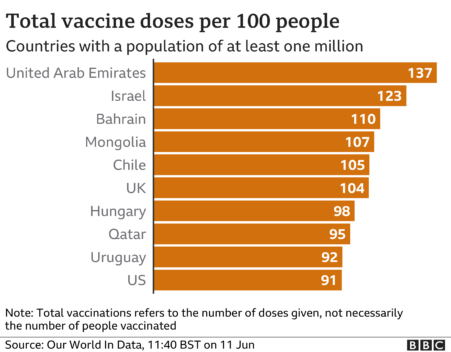
In the chart below, other nations have shown how effective they have been in getting their populations vaccinated. These are countries with populations of a million or more with vaccination dose rates per 100 people. In the lead is the United Arab Emirates with Israel second. Not included here are countries under one million, like Bhutan who successfully provided single-dose vaccines to over 63% of its population, all done in one week.
How many doses of COVID-19 vaccines have been administered to date globally? The number as of today stands at 2.2 billion, or 28.9 per 100 people. That means over 71% on this planet still need at least first-dose protection from the virus.
How to provide that coverage remains an ongoing challenge. In the world of rich nations, for example, Canada has bought more than 280 million vaccine doses from suppliers for a country of 38 million, which represents 370% more of the two doses the entire population needs. And the U.S. has placed orders for more than 1.2 billion doses, representing 180% more than the 330 million Americans will need to be fully vaccinated.
This week during a meeting of the G7, the issue of vaccine distribution to nations in need was on the front burner in discussions. The WHO, which has set up COVAX, a program whereby rich countries can redistribute vaccines where needed has been pointing out the need to take these surplus purchases and get them into as many arms around the planet as possible.
With 7.8 billion on the planet and a G7 that represents a mere 11% of the total, the pledge by its leaders to supply one billion doses (which if double doses are required means an additional 500 million immunized) in 2021 and 2022 falls well short of ending COVID-19 as a global health threat.
Who else can come to the rescue? China is not part of the G7 and has supplied 300 million homegrown vaccines and pledged $3 billion USD to countries seeking help. Russia, also not part of the G7, and with challenges of its own in getting Russians to take the vaccine (12.8% of the population have had one dose with 9.9% fully vaccinated), has offered 1.2 billion doses of its homegrown Sputnik V vaccine to countries looking for help. Even Cuba, with its own homegrown vaccines, is offering them to countries like Venezuela and Iran.
Taking all of the above pledges into consideration, the effort to vaccinate everyone within the next two years will fall well short and that means pandemic hot spots will remain with us flaring up from time to time. We have to get to more than 5 billion. That calls for more effort on the part of those who have the means to help.
In Part 2 of this topic, we’ll look at the variant threat that will only be exacerbated by our tardiness in not getting everyone vaccinated as soon as possible.
]]>
The definition of GM is the alteration of the DNA of a plant or animal using bioengineering techniques where genetic information from one species is transferred to another unrelated or related species for the purpose of enhancing specific desirable traits.
GM staple crops like corn, soybean, and wheat have been developed to combat drought, and insect and weed infestations to improve yields. Companies like Bayer and Dow have taken out patents and created rules for the use of their GM seeds. The anti-Monsanto (now owned by Bayer) movement heads up those opposed to GM largely because of these chemical companies’ practices in enforcing patent protection.
But there are other GM examples far different than the Monsanto experience. For example, a genetic modification to rice developed in 2000, at the Swiss Federal Institute of Technology, in Zurich, added a beta carotene gene to the plant. The end product is called Golden Rice. The biofortification meant growers could switch to Golden Rice away from traditional rice varieties found in Bangladesh, China, India, and other South Asian countries to address a health problem endemic to the region. There is a Vitamin A deficiency in the diet of many South Asians who rely almost exclusively on three meals of rice per day for nutrition. Traditional rice lacks beta carotene which when ingested turns into Vitamin A necessary for normal cell development and vision. Vitamin A deficiency in South Asia is linked to a million premature deaths and 500,000 cases of blindness in children annually. By creating rice containing beta carotene these two catastrophes would be averted. Better yet the developers of the rice made the seed freely available to farmers who were then encouraged to save Golden Rice seeds for replanting every year. Golden Rice was created without a profit motive. So wouldn’t you think that resistance to it would be negligible? Not so. In the two decades since its invention, Golden Rice has been attacked by environmentalists, organic food activists, government regulators, and NGOs like Greenpeace. Why? Because Golden Rice is a GM product. As a result, child mortality numbers and child blindness from Vitamin A deficiency remain endemic in South Asia.
The World Health Organization (WHO) comments extensively on GM foods. A whole section of its website is devoted to the subject. It discusses safety, environmental risk, the public debate, and regulatory issues governing planting, sale and international distribution of GM foods. It also looks at biochemical and biopharmaceutical companies that are in the business of creating GM crops and foods for profit, and the challenges faced by farmers to own the GM seeds produced by them when they plant. It notes that current GM foods available today have passed all safety assessments regarding risk to human health. But the assurances from the WHO site fall on many deaf ears.
So what happens when GM biotechnology is deployed to deal with the scourge of insect-borne diseases? The same levels of resistance, unfortunately. And we are talking about mosquitoes being the targeted species, not harmless butterflies or honey bees.
Better late than never the WHO is weighing in on GM mosquitoes at last. Mosquitoes, states the latest report, are described as “the deadliest animal on earth.” They transmit malaria, dengue, West Nile virus, chikungunya, yellow fever and Zika and cause 700 million infections annually. Areas, where mosquito-borne infectious diseases spread, are home to billions. In dengue areas, for example, 2.5 billion people reside. And dengue is the fastest-growing mosquito-borne disease with a 3,000% rise in incidents over the last 50 years.
Where malaria incidences are in decline because of the deployment of an army of mosquito control mechanisms the world is in better shape. But based on my family’s experience of a few years aog when we vacationed in Cuba, our defences remain reactive and primitive. Where we stayed in Varadero, airplanes carrying insecticides spread aerosol insecticides over the landscape several times in just one week. We were advised to stay by the pool in the morning and not go down to the beach until the aerosol vapours cleared.
For many countries tending with mosquito-borne infectious diseases, insecticides remain the primary tools of combat. The problem in continuing to use them is biological resistance. The more you spray, the mosquitoes that survive pass on that ability to their progeny. The result today, is that in more than 75% of countries fighting malaria transmission by this type of program using four different classes of insecticides, we are seeing decreasing effectiveness when deployed.
The idea behind modifying mosquitoes genetically was conceived of several decades ago. The first GM mosquitoes were unleashed only in laboratories. But only recently have GM mosquito trials been tested in limited pilot projects. After more than a decade of fighting to get regulatory approval and public acceptance, Oxitec, a British biotechnology company, has received permission to release its GM mosquito in a U.S. trial. Prior to the May 2021 release, the company has demonstrated success in Brazil, Panama, the Cayman Islands, and Malaysia with no ill effects.
The U.S. trial in the Florida Keys is aimed at the wild population of Aedes aegypti, the mosquito species known to spread Zika, dengue, chikungunya and yellow fever. ALl the Oxitec GM mosquitoes are male and when released are competing for the favours of the wild female population. The mating of the two produces larval offspring of both sexes.But the GM modification contains a gene that allows only the non-biting males to pass turn into adults while killing all females while they are still larvae. The males then carry the modified gene with them and mate with other wild females. The end result should see a decline in the Aedes aegypti mosquito population.
An analogy that may make sense to those who condemn GM anything may be of some help. Think of the current COVID-19 pandemic. We tried to combat the disease with defensive measures after people were originally infected. We put on masks, isolated, and washed our hands. But over 3 million documented deaths happened just in 2020 alone. It was as if we were applying insecticides to the disease after it was already out and circulating in the human population. At the same time, our GM equivalent strategy was the development of vaccines which in time will cause the virus population to shrink.
The WHO, in issuing its latest GM guidance states that as a novel control, GM mosquitoes may be added to the current arsenal of tools to fight insect-borne diseases. Still a maybe. But maybe may soon be replaced by absolutely once testing moves beyond current pilot programs like the one launched in Florida last month. After it and a few more, we should have enough data to validate this GM strategy and other gene drive technologies like CRISPR/Cas9 and come up with criteria and rules for their safe use.
]]>