What makes this prize different from any of the previous ones is the use of crowdsourcing to identify what three issues need to be addressed under the banner of what is being described as the grand challenges facing the oceans of the world. Scientists, business leaders, the general public, government officials and philanthropists will all have a say in what problem each prize will address. Will it be over fishing? Will it be a way to stop coral bleaching? Will it be pollution? Will it be coming up with technology to clean the plastic filled gyres at mid-ocean locations across the planet? Or will it come up with an overall strategy for addressing the 46,000 pieces of plastic per square kilometer that can be found in ocean waters everywhere today?
The ocean has already been the subject of previous prize competitions. In 2011 a $1.4 million prize was given to a team that demonstrated the ability to cleanup oil spills at 4 times the rate and capacity of any existing technology. And in September 2013 a new $2 million prize, the Wendy Schmidt Ocean Health X Prize was announced to develop affordable, robust and accurate ocean pH sensors to study the impact of carbon being sequestered by the ocean causing increasing acidification.
Why introduce crowdsourcing into the XPrize equation? Dr. Peter Diamandis, Chairman and CEO of X Prize is also a big backer of crowdfunding sites like Kickstarter and IndieGoGo. So it is no surprise that he would add crowdsourcing to engage the larger public in fostering innovation through competitions with large prizes. I suspect that once the three challenges have been identified that crowdfunding donations will be used to add money to the prize pool.

I have mentioned in a past posting on this site, the Wendy Schmidt Ocean Health X Prize. At the time it was announced as a $1.5 million competition to develop pH sensor technology to measure ocean acidification. Well now it has become a $2 million prize and a 22-month competition in which two recipients will each receive half of the money. Registration begins January 1, 2014.
Why do we need to measure ocean acidification?
Because humans are burning lots of fossil fuels and adding CO2 to the atmosphere, they are also adding it to the ocean. That’s because the ocean is a terrific carbon sink, absorbing gigatons of CO2. But there is only so much ocean and when lots of CO2 gets added the water chemistry begins to change. CO2 makes water more acidic altering its pH value.
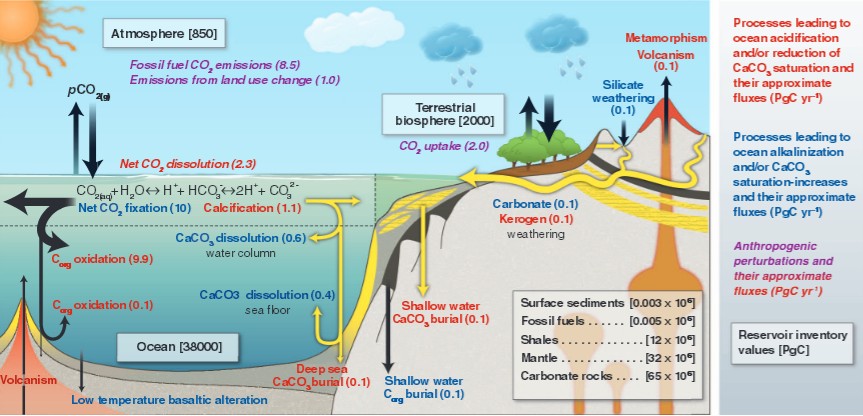
For many millions of years the chemistry of the oceans has remained stable. We know this from sampling sea floor cores and studying the evidence of the biology (chemical composition of fossil shells for example) contained within the sedimentary layers. The geological record shows us that stable chemistry in the ocean has not always been the case. So for example we know that in the late Pleistocene when North America was losing its enormous ice sheets vast amounts of freshwater discharged into the North Atlantic changing the ocean chemistry through dilution. We also can see changes in ocean chemistry occurring on other occasions in the geological record going back to the most famous extinction event, the end of the dinosaurs in the late Cretaceous. In the latter case ocean acidification appears to be associated with SO2 increases consistent with a meteor or comet impact.
So changes to ocean chemistry can be evidence of bad things happening. And right now we do have something bad happening. CO2 levels in the atmosphere have risen since the start of the Industrial Revolution in the 1800s and continue to rise at what appears to be an accelerating rate.
Why a prize?
Enter Wendy Schmidt, co-founder of the Schmidt Ocean Institute and wife to Eric Schmidt, a Google executive. Ms. Schmidt is no stranger to X prizes having created one in 2011 to encourage the development of better oil spill remediation technology after the BP Deepwater Horizon event of April 2010 showed the inadequacy of current cleanup methods.
The new prize involves two awards. Both are for $1 million. The first place winner in each category receives $750,000. The second place finisher gets $250,000.
Current pH sensor technology has failed us in giving us an accurate measure of ocean acidification. The current technology is too expensive, not durable enough, and not available in sufficient quantity to help us get the big picture. Yet we know that the transfer of carbon from the atmosphere to the ocean is creating changes to shellfish, fisheries, coral reefs and ecosystems. What we see today is a limited number of snapshots showing the impact of increased carbon in ocean water. An overall picture will tell us the effect of CO2 on our polar seas, coastal waterways and the deep ocean. And that’s the raison d’etre for the prize.
Offer a reward to engineers and scientists who can design sensors that will give us both an inexpensive technology as well as an accurate picture.
$1 million is being awarded to the team that creates the least expensive, easy-to-use, stable and accurate pH sensor that meets the criteria of a number of test scenarios.
The second $1 million is being awarded to the team that produces the most precise pH sensor technology meeting the same test scenario criteria.
If you want to put a team together to participate in the competition complete the online entry form.
