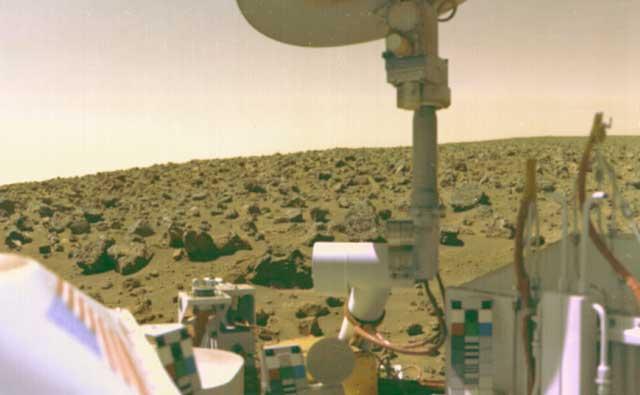
Revisiting the Viking experiments has become a repetitive process with NASA scientists. Both Vikings had on board a chemistry lab which could sample soil dug up by the landers trenching tools. In the Label Release Experiment, a diluted solution with added carbon compounds was added to each soil sample. The onboard then measured gases coming from the soil. The experiment was repeated this time with the soil sample heated to 160 Celsius (320 Fahrenheit) degrees. Again the gases emanating from the sample were measured. The experiments were duplicated on Earth using terrestrial soil samples with the results compared to what Viking produced.
Today a large number of scientists interpret the results of those Viking experiments as evidence to support that there has been in the past and is today active microbial life on Mars. They rate the certainty of this at 99%. And although no one in the NASA scientific community or at JPL Pasadena is shouting it out, there is no doubt that Curiosity’s confirmation of similar organics found at Gale Crater further validates this interpretation of the Viking experiments.
NASA remains overly cautious whenever the subject of life on Mars, both past and present comes up. That’s the public face the agency presents. But inside NASA there is an excitement about Mars that is driving interest in what will be discovered and confirmed when the Mars 2020 and European Space Agency ExoMars travel to the planet in 2020.
The latest paper published on the subject of organics found on Mars appears in the June 20, 2018 issue of the Journal of Geophysical Research. This peer-reviewed paper states that chlorobenzene, a chlorinated organic molecule that is a commonly used solvent here on Earth, was identified by both the Vikings and Curiosity, and is of Martian origin.
How does the confirmation of that discovery alter our approach to exploring and potentially colonizing Mars?
In our effort to find life elsewhere in the Universe, will we, in going to Mars, destroy the very evidence we seek? How will humans arriving on Mars not negatively impact an existing Martian microbial ecosystem? Is it in our plans to create refuges for Martian life as we begin to colonize the planet? The history of human exploration and our restless expansion to new lands has never been kind to the local flora and fauna. The mega extinctions in North America fauna that occurred when humans crossed from Asia tens of thousands of years ago is but one example. A second is the one when European explorers landed on North American shores leading to a pandemic that wiped out more than 90% of the continent’s native human population.
We need to “do no harm” when it comes to going to the Moon and Mars. It’s time to come up with a plan.
In the second decade of the 21st century Mars is more a puzzle than understood. The question our Martian adventure is getting close to answering is this: Is Earth the sole planet where living things exist? And we are getting closer to this answer without ever setting a human foot on the planet’s surface. Instead our Martian studies have involved a series of robotic missions loaded with scientific instruments. These missions have included orbiters, robotic landers and rovers. The information we have gleaned from these incredible machines has painted a picture of Mars that is altering our perspective of what constitutes a planet capable of harboring life. Let’s look at some of the technology that has gotten us to this point.
From Odyssey to Spirit and Opportunity
Odyssey
Aptly named Mars Odyssey after Arthur C. Clarke’s novel, 2001: A Space Odyssey, NASA launched this robotic mission to the planet in April 2001. Its primary mission focused on studying the Martian atmosphere, surface and subsurface using three scientific instrument packages named THEMIS, MARIE and GRS. THEMIS was designed to study active thermal occurrences on the Martian surface in order to detect surface minerals by their spectral fingerprint. MARIE was designed to study the radiation from cosmic rays not only in the vicinity and surface of the planet but throughout the interplanetary space between Earth and Mars. GRS was designed to study Martian chemistry using gamma ray and neutron detectors. Odyssey arrived at Mars in October 2001 and entered orbit on the 24th. Its original mission was designed to end in August 2004. The spacecraft continues to operate on an extended mission more than a decade after its arrival.
The Odyssey mission has given us a better picture of both the planet and what a human mission would experience in travelling there. The results of MARIE sampling indicates that humans travelling between Earth and Mars would experience twice as much exposure to cosmic rays as humans on the International Space Station.

We also have learned from THEMIS that Mars polar ice caps unleash gas jets of CO2 every spring, that the Martian surface has extensive chloride salt deposits left behind when large bodies of liquid water evaporated, that the atmosphere can churn up dust storms and dust devils similar to those found in deserts on Earth, that at least one large crater, Aram Chaos, was once a lake, and that the planet has extensive water-eroded channels on its surface. From GRS data we have detected evidence of substantial subsurface ice as well as deposits of iron, silicon and potassium.
Spirit and Opportunity
In 2004 two robotic spacecraft arrived on the surface of Mars to deploy two rovers, Spirit and Opportunity. The mission for both rovers packed with scientific instruments was to last 90 days with the objective to explore the Martian terrain, study its geology, look for evidence of water in the past and present and relay images back to Earth receiving stations. Solar power and batteries have provided the power to all the instrumentation and cameras.
Deployed at landing sites on opposite sides of the planet both rovers exceeded expectations with Spirit the first to succumb to the harsh Martian environment as it became trapped in soft Martian terrain in spring of 2009, eventually falling silent during the winter of 2010.
Opportunity, however, continues to chug along as of May 2012, a remarkable feat of technological engineering supported by a dedicated team of Earth based scientists who continue to devise new experiments and missions for the rover.

What both Spirit and Opportunity discovered shortly after landing included significant evidence that Mars was once a wet environment and that the evidence in the rocks shows that the planet has experienced wet and dry periods throughout its geological history. While on the Martian surface Opportunity has far outpaced its sister rover, Spirit (7.7 kilometers or 4.8 miles before getting stuck) accumulating a total driving distance of 34.4 kilometers (21.4 miles). To experience a portion of Opportunity’s remarkable journey access the video created by the science support team’s piecing together of end-of-day images taken by the rover as it travelled almost 21 kilometers (13 miles) between the Victoria and Endeavour Craters on the planet’s surface.
Opportunity’s current location is on the edge of Endeavour Crater assignment where it is hunkered down in its fifth Martian winter. Acting as a stationary observation platform it is conducting a study of the interior of the planet using radio-tracking to measure any wobbles as the planet rotates. A significant wobble will indicate whether Mars has a molten core or not. As Martian spring and summer unfold Opportunity will resume its trek, an amazing accomplishment.
The story of our exploration of Mars will continue in our next Space and Humanity in the 21st Century blog.
]]>
In 1976 the United States Viking-1 and Viking-2 soft landed on Mars and gave us our first experimental results on sampled Martian soil. In my last blog on robotic missions to the red planet I mentioned the Label Release Experiment and its results. Gilbert Levin and Patricia Ann Straat designed this experiment to detect microbial life. Short of having a microscope in which to view Martian bacteria, this experiment consistently matched control experiments done on earth.
The Label Release Experiment used a sample of soil dug up by the Viking trenching tool. The soil was placed in a sealed compartment on board the lander. A dilute aqueous solution with uniformly labelled carbon compounds was added to the soil. The atmospheric output of the soil was measured to monitor the appearance of radioactive gases. A repeat of the experiment was then conducted with a duplicate soil sample heated to 160 degrees Celsius (320 Fahrenheit). The atmospheric output was measured again. A comparison of the results from both terrestrial and Martian soil samples is seen below.

At the time when these test results were known they were discounted by contradictory results from another test looking for organic molecules. That test showed none in Viking derived samples. But an Earth-based control test in Antarctica also showed no organic molecules. NASA chose to err on the side of caution and concluded that there was no evidence of life on Mars.
Recently, however, scientists have revisited the data from Viking and concluded that bacterial life exists on Mars, discounting the original NASA conclusions that Viking experiments were inconclusive or could be explained by geochemistry. Using a numerical approach the scientists have published their results in the International Journal of Aeronautical and Space Sciences. In analyzing the results for complexity consistent with living systems rather than non-biological processes the scientists concluded that there was evidence to support with 99% certainty that microbial life exists on Mars.
The implications of finding life on another planet are enormous. Future robotic expeditions may finally send us confirmation of what the two Viking landers discovered over 35 years ago. The importance of the discovery of life on Mars in light of NASA’s initial reluctance to support its own experimental findings is somewhat puzzling.
]]>
Going to Mars Never Turned into a Space Race
Although the Soviet Union included Mars as a primary mission goal in its exploration of the inner planets of the Solar System, it enjoyed far greater success in getting to Venus, and very little success when trying for Mars. Why was that?
Engineers state that getting to Venus is easier than going to Mars. Venus is closer, easier to approach, requires less on board fuel for boosting the spacecraft further from the Sun as well as for mid-course corrections. Launch windows for Mars open every two years. Launch windows to Venus are far more frequent and longer in duration. Mars missions are significantly more expensive to mount because of the greater distance. With more financial resources to apply to space exploration than the Soviets the United States has reaped the benefit and become the prime explorer of Mars, not that the Soviets haven’t tried. But after four unsuccessful attempts in the 1960s they ceded Mars to the Americans.
The Technology of the 1960s that Got us to Mars
With Mariner-4 in July 1965 we witnessed the first close range images of Mars as the American spacecraft passed within 10,000 kilometers (6,200 miles) of the Martian surface. To get Mariner aloft the Americans used the Atlas Agena-D multi-stage rocket, the workhorse of the early 1960s unmanned and manned space program. Like their Soviet counterparts the Americans realized a direct path to Mars was best managed by first putting the spacecraft into Earth orbit before injecting it into a rendezvous trajectory aimed at Mars.
This first Martian explorer used four solar panels containing over 28,000 cells to keep its instrumentation operating throughout the seven month journey to the planet. The frame was magnesium to which the solar panels, antennae, TV camera, mid course propulsion system, and attitude control nitrogen gas jets, three gyros and regulators were attached. The science package included a magnetometer, dust detector, cosmic ray telescope, trapped radiation detector, solar plasma probe, and ionization chamber. Navigation positioning used sensors that located the Sun, Earth and Mars’ positions and the star Canopus. The telecommunications equipment included high and low gain antennas and a tape recording system for delayed transmission. The software command subsystem recognized 29 direct command words or 3 quantitative word commands. To keep the instrumentation from freezing or boiling the American engineers built into the spacecraft frame a series of adjustable louvers for climate control, insulating blankets to ward off the cold, and polished aluminum shields to keep the Sun-exposed side of the spacecraft cool.

The first images from Mariner-4 (see above) showed 1% of the planet’s surface, a heavily cratered area that gave us a picture of Moon-like desolation. Mars surface atmospheric pressure readings were 4.1 to 7.0 millibars (compare that to an average of 1,000 millibars at sea level on Earth) and daytime temperatures of -100 degrees Celsius (-148 Fahrenheit). No magnetic field was detected.
Even after completing its Martian flyby Mariner continued to transmit until December 1967. The cause of its demise was recorded by the on board cosmic dust detector, a micro-meteoroid shower that damaged the thermal shield, attitude control and data transmission.
Revisits to Mars by two Mariner spacecraft in 1969 enhanced our picture of Mars as they flew over the equator and south polar regions of the planet and provided further analysis of the Martian atmosphere and surface conditions. The images captured by Mariners’ on board cameras continued to reveal a cratered landscape but atmospheric telemetry revealed suspended dust, CO2, H2O, CO, and ionized hydrogen and oxygen. Equatorial surface temperatures reached a benign 17 degrees Celsius (63 Fahrenheit) in the daytime.
Mariner-9 Becomes the First Artificial Martian Satellite
Mariner-4 demonstrated successful technology design for Martian missions and became the template for subsequent flights to Mars and planets further out. One of these was Mariner-9, one of two space missions planned to orbit Mars.The first, Mariner-8, experienced a launch failure. NASA quickly redesigned the Mariner-9 mission to compensate for the loss.
Unlike other interplanetary and lunar missions Mariner-9 followed a direct ascent trajectory from Earth to Mars arriving after a 167-day flight. This method was chosen to preserve fuel.
Orbital insertion involved firing of on board rockets several times to create ideal positioning for imaging and data transmissions to Earth. This technological feat was the first of its kind. No earth-launched spacecraft had ever orbited another planet.

When Mariner-9 arrived in September 1971 a planetary-wide dust storm made it impossible to obtain images of the surface. All that could be seen were the summits of four large volcanoes never observed before. These were Olympus Mons and the three Tharsis peaks. By December the storm abated and Mariner started sending images and relaying telemetry. During its 13-month mission Mariner sent 7,329 images covering the entire planet until running out of fuel. It remains in Martian orbit today and its orbit will degrade sometime around 2022.
Mariner-9 gave us an entirely new perspective about Mars. Its images showed ancient river beds and many other flow features indicating a past that included free-flowing water on the surface. Valles Marineris as seen in the picture above proved to be a canyon larger than anything on Earth. Mariner-9 took pictures of wind-eroded sediments and witnessed weather system changes including morning fog. No longer was Mars seen as Moon-like.
The Soviets Duplicate the Feat of Mariner-9
In 1971 the Soviet Union launched an even more ambitious attempt to both orbit the planet and land upon it. They launched two orbiters, Mars-2 and Mars-3, each including a lander for studying and observing the Martian surface . Entering orbit in November Mars-2 included an on board camera and a scientific instrument payload. The Mars-2 lander, crashed in attempting a controlled descent. The Mars-3 lander achieved a soft landing and within a minute fell silent. The global dust storm enveloping Mars at the time was believed to be the cause of failure.
The Soviets continued to launch a Mars series of robotic spacecraft through 1972 and 1973 experiencing more failures than successes. Their technology for Martian landings did not work. Chip degradation during the long spaceflight was believed to have been one of the causes of failure with both the orbiters and landers. After 1973 the Soviet program stopped.
The Vikings Land on Mars
In the Bicentennial year of 1976 the United States accomplished two successful landings on the Martian surface. Viking-1 and Viking-2 were a combination of orbiters and landers. The Americans may have learned from the Soviet attempts at soft landings. The Soviets released their landers before their Mars spacecraft entered orbit. Every landing attempt either failed to touchdown properly or stopped transmitting shortly after arrival. The American answer was simple. Bring the entire spacecraft into an orbit around the planet. Have the orbiter photograph potential landing sites and then program the lander to make the descent to a site deemed safe.
Both Viking spacecraft, orbiters and landers were successfully deployed. Unlike previous Mars missions Vikings used Titan-IIIE-Centaur heavy-launchers to boost them into earth orbit before the Centaur stage placed them into an Earth to Mars trajectory. Both orbiters based their design on the Mariner-9 spacecraft but were much heavier, weighing 3,530 kilograms (7,766 pounds). The orbiters, in addition to performing reconnaissance on site selection for the landers, also acted as communications relays to transmit data from the landers back to Earth.
Both landers were timed to arrive on the planet surface in celebration of the July 1976 bicentennial and both achieved successful landing using heat shield technology, aerobraking, first practiced on Venus missions, parachute deployment followed by retrorocket fire to achieve controlled touch downs.

There remains controversy over findings from the landers’ scientific experiments. The experiments were specifically designed to study the biology and organic and inorganic chemical composition of Martian soil samples. A sampler arm with shovel scooped up a small amount of soil and placed it in an environmentally-controlled compartment where it was subject to three experiments. One of those, the Labelled Release experiment, designed by Dr. Gilbert Levin, obtained results that strongly suggested microbial metabolism. But another experiment designed to detect organic molecules found none. At the time it was assumed that a previously unknown chemical in the Martian soil was mimicking microbial metabolism. At the time of NASA’s announcement of experimental results it was not disclosed that on Earth in similar tests in Antarctica Dr. Levin’s experiment showed microbial metabolism while the organic molecule detection experiment found nothing. The controversy over Levin’s experiment continues to this day with a number of journal articles suggesting that there was and is no support for chemical agents being the cause of the observed response on Mars. More recently Martian orbiters, landers and rovers have uncovered evidence that water in liquid form exists on Mars and that Dr. Levin’s conclusions that rudimentary microbial life exists may have been right after all.
We will continue exploring Mars in our next space blog. So please stay tuned and join the conversation giving your opinion on whether life still exists on Mars today.
]]>