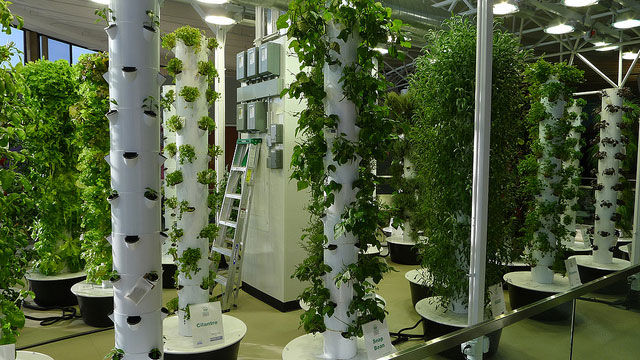
Established in 2017 by its founder James Lloyd-Jones, The Jones Food Company specializes in vertical farms using hydroponics. The company currently has built the largest vertical farm in North Lincolnshire, England, with 12 crop cycles of herbs and vegetables being grown year-round. And now it is adding a vertical farm that will be three times larger, about the size of 70 tennis courts, tended to by an army of robots.
The water being used in all its vertical farms is 100% recycled and supplemented by rainwater reserves. Hydroponics means smaller water requirements than traditional farming. And these vertical farms are low-carbon emitters. In fact, The Jones Food Company intends for its facilities to be carbon neutral in Lincolnshire by year-end, and in the Gloucestershire facility from the get-go. Solar panels on these warehouse facilities’ roofs supplemented by 100% renewable energy sources provide the power to light, heat, and operate the farms.
Why vertical farms now?
Back in 2014, I was asked to contribute a paper to an upcoming agricultural conference on urban farming. I wrote about Dickson Despommier, a professor at Columbia University, who conceived of the vertical farm. His notion was that with finite amounts of arable land and a world increasingly dominated by cities, the evolution of farming to move it closer to consumers necessitated their move into the urban fabric. The end result that Despommier envisioned was farming moving into buildings leaving more agricultural land freed up to return to a natural state as carbon sinks, and fewer emissions produced from the transporting of food from rural locales to urban consumers.
Despommier advocated for every city to produce 10% of its food needs locally and indoors. That would free up over 880,000 square kilometres (340,000 square miles) of farmland to be returned to its natural state which would be enough to reduce carbon dioxide (CO2) in Earth’s atmosphere to levels close to where they were in 1980.
The pros and cons of vertical farming were described by Kissairis Munoz in a Dr. Axe posting back in June of 2017. The pros included:
The cons included:
Food technology is turning science fiction into science fact one innovation at a time. It’s making eating ethically a head-scratcher. For vegans, the questions are no longer how sustainably agave is sourced, or whether environment-damaging pesticides are being used to grow kale. Now they have to consider ethical avoidance issues such as can they eat animal protein when it is synthetic. Imagine slaughter-free spaghetti bolognese or beef burgers where no cow is harmed.
Meat alternatives aren’t new. Tofu and seitan have been around for over 1,000 years and veggie burgers have been in supermarkets for decades. Typically, these appealed only to vegans and vegetarians, a niche market prepared to compromise on how meat-like the product is for their own ethical reasons.
With the advancement of new food technologies, however, that may no longer need to compromise. Plant-based food is becoming increasingly convincing posing as meat. Look at Impossible Foods who are using genetically modified yeast to make vegetarian burgers that bleed.
The search for sustainable, guilt-free burgers is going even further with the advent of cultured meat. A burger, made from 100% real beef, where no cows were harmed has become a reality.
Cultured meat is produced from the same or similar animal cells that make up conventional meat. As a result, it is possible to create meat products completely indistinguishable from meat on the hoof. Since the world’s first cultured burger was produced in 2013, the industry has been growing with start-ups around the globe competing to be the first company to commercialize cultured meat products.
In December 2020, Singapore became the first nation to grant regulatory approval for commercial cultured meat products. Eat Just, began selling its hybrid product made from plant protein and cultured chicken cells. And in June of this year, Future Meat Technologies, an Israeli company opened a cultured meat facility with a daily capacity to produce 500 kilograms (1,100 pounds) of cultured chicken, pork and lamb meat.
For more information on cultured meat and companies in this new business read the IDTechEx report “Cultured Meat 2021-2041: Technologies, Markets, Forecasts”.
Today we have vertical farms growing fresh produce on skyscraper walls. That includes lettuce and tomatoes as garnish for your cultured burgers.
The beauty o vertical farming is locality. Instead of produce being grown, harvested, and shipped from fields far away, a successful vertical farm means the veggies you will buy will come from markets mere metres away from where you live.
Vertical farming involves growing crops indoors in controlled environments and vertically stacked to save space. Vertical deployment means yields can be 20-30 times higher per hectare than in normal agriculture. Using advanced growing methods such as hydroponics and LED lighting tailored to the exact photosynthetic needs of the crops, vertical farming can also achieve yields hundreds of times higher than that from conventional farmland.
Almost any location can be used for vertical farming, with companies operating out of old shipping containers (Freight Farms), disused warehouses (AeroFarms uses a warehouse in New Jersey for its indoor farming) and skyscraper walls. The only limitation is getting resources in and harvested plants out.
Increasing agricultural yields in a sustainable manner is critical in meeting the demands of a growing world population. Precision farming provides one answer. It uses an approach where each individual plant (or a specific region within a field) receives targeted treatment. Planting and harvesting are tailored as well to existing ground conditions and the status of a particular fruit or plant.
This marks a technological transition from the broad-brush farming methodologies still being used today. To implement it farmers need to embrace robotics, imaging, machine vision and low-cost sensor technologies. With precision agriculture farming practices will more closely align with industrial automation seen in other business sectors.
Hyperspectral imaging monitors plant health and catches diseases early, minimizing the risk of wastage and lost crops. Rather than expressing images as red, green, and blue (RGB) values, each recorded pixel provides a complete spectral view of the plant, allowing farmers to gain far more information than what can be gleaned from standard imaging. This enables supervised artificial intelligence (AI) and machine learning to quantify the plant’s chemical composition and determine its health status. For a detailed look at the technologies emerging in this field refer to the IDTechEx report “Emerging Image Sensor Technologies 2021-2031: Applications and Markets.”
Once AI reviews the data collected by precision agriculture technologies it can provide actionable insights which call for execution. This is where the robots come in producing precision-targeted planting, fertilizing, weedkilling and harvesting. You no longer need to imagine this happening. Today robots can vary planting densities across a field in response to soil conditions and target specific areas within a field with pesticides.
To target fertilizer or application of herbicides, attributes of individual plants need to be ascertained. This can be done using algorithmic image analysis acquired from conventional cameras in the visible spectrum. But the limitations of the technology mean you cannot necessarily identify subtle differences between leaves or fruit at different stages of ripeness. That’s where short-wave infrared (SWIR, 1000 to 2000 nm) imaging comes in. Using this technology when imaging plants provide substantial differences. SWIR light can detect bruised from healthy fruit. And SWIR imaging isn’t negatively impacted by clouds, dust, or mist which can make other imaging technologies less effective.
Synthetic chemical pesticides and mineral fertilizers are less and less sustainable. Farm runoff contributes to algae blooms in our rivers, lakes and oceans. Their overuse is leading to natural soil depletion and growing weed and insect resistance. Much of the world’s food supply, however, still depends on these products being applied to farm fields.
There is a solution. It is called agricultural biologicals derived from nature. Biostimulants can be used to boost crop yields and reduce the need to apply synthetic fertilizers to boost soil health. A good example is PROVEN, developed by California start-up Pivot Bio. It uses genetically engineered nitrogen-fixing bacteria to form a symbiotic relationship with the roots of corn plants in order to boost nutrient uptake.
Biopesticides are pest management agents that use living organisms or natural products. They have proven potential to provide pest management but currently are heavily regulated by systems originally designed for the chemical pesticide industry. Examples include bait sweeteners that get carried back to an insect’s nest, pheromones that distract insect pests, sterile pollen carried by insects that land on weeds to make them infertile, and bee carrier biopesticide delivery systems.
Some aspects of agricultural biotechnology are controversial. One such is genetic engineering. But this is a technology with enormous potential for improving food security.
Crop biotechnology tools and disciplines focus on modifying the genome of organisms for a particular purpose, for example, increasing yields, or developing innate resistance to diseases in order to reduce crop losses and pesticide use. The technology identifies specific genes that confer advantages for a particular crop or livestock, and then implants and replaces the existing genetic material.
For many, there is controversy in inserting and replacing genetic material to improve farmed plants and animals. But genetic engineering is really selective breeding by another means and instead of taking generations to breed a true improvement, saves enormous time when attempting to address challenges like developing drought-resistant crops at a time of climate change.
So there you have it. Today we are at the beginning of an agricultural and food revolution where you can have a burger made from cultured meat, topped with vertically farmed lettuce, and genetically modified tomatoes. Are you game? If so, then bon appetit.
]]>———-
Food and agriculture accounts for about 5.9% of global GDP (8% of Canada’s national GDP). Global food retail sales alone account for about $4 trillion/year, and food accounts for 15% of what American households spend each year. (This weekend I read that the average Russian household spends 50% of its income on food.)
It is an industry ripe for disruption. Sensors, networks, machine learning/AI, robotics, 3D printing, synthetic genomics, stem cell science and material science are going to transform how your food is produced, delivered and consumed.
While this arena is going to change dramatically, we forget how much food has changed already over the past two centuries.

And while farming jobs have been lost to automation, the global food supply (per capita) has steadily increased.

As we move towards a world of food abundance, let’s look at a few of the fun areas of transformation and entrepreneurial opportunities.
Bioprinting of Meat: Modern Meadow is a company that uses bioprinting (tissue engineering and 3D printing) to grow meat (beef, chicken & pork) and leathers in a lab. Their vision is to do this at scale and dramatically reduce the environmental impact of meat production. In 2012, it took 60 billion land animals to feed 7 billion humans. In success, bioprinting of meat (beef, chicken, pork) has huge advantages: 99% less land, 96% less water, 96% fewer greenhouse gases, and 45% less energy.
Genetically Engineered Crops: We will increasingly rely on genetically engineered crops. In 1996 there were 1.7 million hectares of biotech crops in the world; by 2010, the number had jumped to 148 million hectares. This 87-fold increase in hectares makes genetically engineered seeds (GEs) the fastest-adopted crop technology in the history of modern agriculture. After 30 years of research, a great many of our fears about genetically engineered products have been quieted. More than a trillion GE meals have been served, and not a single case of GE-induced illness has turned up.
Vertical Farming: We will grow our food in AI-controlled vertical buildings, rather than on horizontal land. Vertical farms will be immune to weather, so crops can be grown year-round under optimal conditions. One acre of skyscraper floor produces the equivalent of 10 to 20 traditional soil-based acres. Employing clean-room technologies means no pesticides or herbicides, so there’s no agricultural runoff. The fossil fuels now used for plowing, fertilizing, seeding, weeding, harvesting, and delivery are gone as well. On top of all that, we could reforest the old farmland as parkland and slow the loss of biodiversity. Companies like FarmedHere, Green Sense, and groups like MIT’s CityFARM are making strides in the field.
Food Production Closer to Home: The average American foodstuff now travels 1,500 miles before being consumed. As 70 percent of a foodstuff’s final retail price comes from transportation, storage, and handling, these miles add up quickly. As a result of vertical farming and genetic engineering, production will become decentralized and distributed, allowing food to be produced nearer to the location of consumption, and the price of food to plummet.
Plant-Based Meat Alternatives: Beyond Meat and Hampton Creek Foods are companies turning plants into foods that look and taste just like meat and eggs. Hampton Creek’s data scientists are actively weeding out billions of proteins from hundreds of thousands of plants to learn what could form the equivalent of a chicken’s egg. The company is seeking to create the largest plant database in the world.
Food Preparation
3D Printed Food: Companies like 3D Systems, Natural Machines, Print2Taste, and others are experimenting with 3D printed food. While 3D printing in chocolates and sugars is well underway, we’ll soon see 3D printed starches, proteins (and even new proteins like algae and insects) and spices.
Personalized Nutrition: Our genome, microbiome, and even our blood type determine how we respond to certain foods/nutrients. Imagine if a 3D printed meal was custom produced depending on the amount of exercise you had that day, and your vitamin blood levels. Advanced biosensing will drive your diet and close the loop.
AI-Designed Recipes: IBM’s Watson uses machine learning to construct new recipes and cocktails that no human chef would come up with. This algorithm matches foods based on extensive taste profiles and the chemical makeup of those edibles in their database. We tried a few of Watson’s cocktails at last year’s A360: Hoof-n-Honey Ale (veal stock, grilled beef and IPA), Plum Pancetta Cider (bacon and cider), and Corn in the Coop (old fashioned with chicken).
Food for Fuel, Not Pleasure: For those that opt-in to optimize their consumption (often at the expense of “taste”), we will have mixtures that will provide us with exactly what our bodies need in terms of nutrients, carbohydrates, protein, and more. Companies like Soylent and Ambronite are already doing this. These options will be cheaper and faster than traditional consumption practices – and they will feed many who don’t have access to food at all.
Food Delivery
Food On-Demand: Press a button and food will be at your doorstep in minutes. PitchBook Data reports that companies involved in delivering groceries and meals in the region attracted $433 million in funding last year. That’s up from about $68 million in 2013 and only about $21 million in 2012. Companies like Uber Fresh, Munchery, and many others deliver high-quality, restaurant and chef-prepared food to your doorstep on demand.
———-
Much of what Peter describes expresses a strong American bias. It also ignores the impending challenges brought on by climate change. I would think this has to be part of the conversation. Is the U.S. model one that replicates globally. Canada with its much smaller population and different geography has a very different agribusiness with the majority of farm output going to export, not domestic consumption. In addition Peter doesn’t address the issue of freshwater scarcity, a growing problem not only in the United States but in much of the Developing World. Nor does Peter address food wastage, one of the greatest challenges agribusiness faces today globally.
In several past postings on this site I have written about the food that farmers grow that never gets to hungry mouths. Many countries lack an adequate supporting agribusiness infrastructure. Inadequate roads and transport means harvested crops never get to market. Lack of energy in rural areas means farms cannot refrigerate or adequately preserve what they grow. Even on-site storage facilities are insufficient or poorly designed to ensure what gets harvested can ultimately be eaten before it rots.
Today the amount of annual spoilage because of these issues is as if 28% of all arable land annually is taken out of production globally. This wastage further exacerbates global warming by contributing 3.3 gigatons of carbon dioxide and other greenhouse gases to the atmosphere annually and when calculated amounts to an annual contribution of CO2 weighing 500 kilograms (1,100 pounds) per person.
In juxtaposition to Peter’s view of agribusiness and food production I give you my own take on its future in the 21st century, a posting I wrote back in October 2012 entitled, “Will We Run Out of Food for Our Growing Population in the 21st Century?”

In my initial research on vertical “urban” farms I discovered Dickson Despommier and his concepts which you can read about at www.verticalfarm.com. Despommier has been a frequent speaker at conferences advancing the idea of agricultural intensification and localization in a world increasingly dominated by cities. Despommier is one of a number of visionaries who equates our current agricultural model as increasingly problematic because of its net contribution to global warming and its destructive impact on soil and freshwater resources.
How is this occurring? Because clearing land on a large scale to grow crops has an enormous impact on the planet’s carbon and freshwater balances. And in places like Amazonia and The Congo the demand to plant traditional farms is depleting the rainforest, the planet’s lungs and regulator of atmospheric water vapor. Meanwhile transportation of agricultural produce to urban consumers is a significant contributor to greenhouse gas (GHG) emissions. So there are so many good reasons to seek a new paradigm for farming.
I also looked at the work being done in Manchester, UK, Kyoto, Japan, Singapore and the Netherlands. The posting http://www.21stcentech.com/agriculture-part-2-why-we-are-rethinking-the-farm/ provides links to many of these projects.
Our future with climate change producing increasing risks to the current agricultural production model suggests we need a way to mitigate and overcome what could become a cascade of catastrophic occurrences throughout this century and the next few that follow. A recent report entitled “Stranded Assets in Agriculture” highlights what farmers are facing in the near and more distant future. I invite you to read a posting I wrote back in January on the economic impact to agriculture from climate change at http://www.21stcentech.com/agriculture-update-economic-impact-farmland-climate-change/.
If we are to be an urban society which clearly is in the cards, and if we are to address climate change, the urban farm in a controlled setting represents a model worth pursuing. It may prove to be the easiest way for humanity to climate proof agricultural production and ensure that we produce food with a minimal carbon footprint. Of course, adapting agriculture to this new paradigm where most of what we consume is locally produced will require governments to be proactive in developing carrot and stick policies to promote the shift from the current model.
The end result will be far less horizontal land under agricultural production and a higher concentration of farm production within 100 kilometers of urban markets. It means land currently plowed can revert to a more natural state and the potential to create a landscape that sequesters carbon and preserves the natural water balance in the air and in aquifers.