Recently, reinterpretations of Calhoun’s data conclude that humans in similar circumstances might not experience what happened to the rat and mouse populations when crowded into confined spaces. That’s because some mice and rats didn’t change their behaviour. These particular subjects carved out sufficient space around them for family members and themselves. The ones that didn’t, however, displayed declining mental health, aggression, and antisocial behaviours.
As we battle climate change, urban planners are increasing population densities in city cores, building up rather than out. They are doing this to mitigate global warming through energy conservation, and minimizing the carbon footprint from transportation. Rather than use a polluting car, people can ride electrified mass transit or walk. But can urban crowding lead to overcrowding to produce results similar to Calhoun’s experiment in people?
A paper appearing in the December issue of the journal, Environmental Research, entitled “The evaluation of the 3-30-300 green space rule and mental health” describes an observed correlation between mental well-being and the presence of green space and green views.
An urban forester, Cecil Konijnendijk, has proposed a 3-30-300 rule which states that where people live they should:
The study refers to the 3-30-300 rule in looking at a select population in the City of Barcelona, Spain. Involving 3,145 individuals between the ages of 15 and 97, the study compares mental well-being with the proximity of green views and green space. Why was Barcelona chosen? Because it has very little of either so applying the 3-30-300 rule was easy to differentiate the healthiness of the population. It turned out there was a significant correlation between citizens who lived in the few 3-30-300 areas and their use of fewer tranquillizers, sedatives or antidepressants than those living in areas with little in the way of green. These 3-30-300 people made fewer visits to psychologists and psychiatrists, lived healthier lives, experienced longer life expectancy, and had better cognitive function.
Is this a breakthrough study? It isn’t the first to look at the benefits of more green space. it isn’t the first to look at urban tree canopy coverage and overall health. But it is the first to look at both of those issues and combine that with green views from windows. It seems apt when you consider during the COVID-19 pandemic, how many people found themselves confined to their homes with only a window to look out of to see the world. Studying COVID-19 confinement and depression in the absence of green views or nearby green spaces will probably reinforce the findings of this Barcelona study.
What should this mean for municipal planners? Urban green spaces matter. Urban green spaces lead to healthier populations, reduce air pollution, lower greenhouse gas emissions, and are quieter. The problem, of course, is that urban land is expensive. As a result, green spaces get minimized when competing with other forms of land use. Central business districts in so many cities to this day are often treeless expanses of concrete, brick and glass. Trees, grass and flowers, take a back seat to buildings and other urban infrastructure.
Take the case study of my hometown, Toronto. It is Canada’s largest city with 2.7 million people and growing by 100,000 annually. The city has changed since my family moved here from Montreal in the 1950s when I was a little boy. Even back then Toronto had an extensive urban forest outside the downtown core because of the many ravines and small rivers that cut across the landscape. But the Central Business District (CBD) was far from green and remains so to this day. Back then people were moving uptown and away from the urban core. Today, the movement is reversed with tens of thousands of Torontonians living in condominium apartments in the heart of downtown.
The architects of these new homes submit plans usually with little interest in green views or nearby green space. For a time the less-than-green developers were largely left to proceed to create vertical glass and steel neighbourhoods separated by open courtyards of concrete with occasional planter boxes and small patches of lawn. But today, Toronto city planners are pushing back against the maximal land use view to shove as many people into as little space as possible without considering trees, grass and flowers. The ongoing tug-of-war between developers and urban green planners is cyclical. Right now, because of climate change, green is on the ascendant.
So what is Toronto’s current green status? A 2018 study states the forest canopy covers between 28.4 and 31% of the city. The estimated tree population is 11.5 million. That’s more than 4 per person, bettering the 3 in the 3-30-300 rule. And Toronto’s plan is to grow the canopy to cover 40% by 2050.
The plan, to date, makes no mention of mental health and well-being as the reason for planting more trees and creating more green spaces. Instead, the reasons given are:
All of these are great rationales for increasing the tree canopy. But someone in urban planning, now should look at the 3-30-300 rule and apply it to strengthen the mental well-being of Torontonians. We don’t want to be the mice and rats of Calhoun’s study. We don’t want a dystopian future. Living in harmony with trees sounds like a plan.
]]>

Here in Toronto where we have experimented in the past with pedestrian and bicycle-only rights-of-way on urban streets, the pandemic has city councillors and our mayor speculating on whether with social distancing we need to widen pedestrian access to include part of the pavement where cars, trucks and buses have predominated. The two-meter (six-feet) social distancing rule that cities have enacted has made urban planners realize that most sidewalks are unsuitable as pedestrian paths during a pandemic. To illustrate just how inappropriate, one Toronto resident has created his own social distancing machine (see image below) to demonstrate what the two-meter rule means. Current pedestrian-designed sidewalks in Toronto, for the most part, cannot accommodate the prescribed separation. So it looks like the right time to build a network of pedestrian-only and protected bicycle rights-of-way here in my home and in other cities dealing with the pandemic, the stay-at-home strategy, and social distancing requirements.

In Europe, Milan, Italy, where the COVID-19 virus struck with impunity, has seen traffic drop by as much as 75%. Air quality has dramatically improved making city streets far more appealing to walkers and cyclists. Milan’s city council has decided to transform 35 kilometers of its downtown to make it pedestrian and cycle-friendly beginning this summer and continuing once the pandemic restrictions get lifted. Marco Granelli, Deputy Mayor of Milan, in an interview with The Guardian this week, talked about how the city has been trying for years to reduce urban car use because of congestion and pollution. And now because the pandemic has shown the city officials a different Milan, Granelli believes it is time to make a transition to make the small shops in the downtown far more accessible to pedestrians and cyclists. He stated, “We think we have to reimagine Milan in the new situation. We have to get ready; that’s why it’s so important to defend even a part of the economy, to support bars, artisans and restaurants. When it is over, the cities that still have this kind of economy will have an advantage, and Milan wants to be in that category.”
Will other cities follow suit? Some see this new agenda as being a war against the car. But the pandemic is equally incompatible with mass transit because of the need for social distancing. Being locked down in homes in cities where so many live in small spaces (apartments and condominiums), means there needs to be outdoor space for people to walk, cycle, and exercise. Urban dwellers in high-rise building don’t have backyards. At most they have a terrace or small balcony which means the need for street space becomes critical. And now because of COVID-19 and the trend to work from home, road capacity requirements have been diminished because far fewer are commuting to offices and jobs.
The end results are starting to show in many places across the globe. New York City has seen a surge in cycling with people avoiding mass transit because of social distancing and a fear of getting infected. The city plans include new bike lanes on major routes in Manhattan and Brooklyn. London is condoning off some of its downtown streets to become pedestrian-only. Dublin is placing restrictions on vehicle traffic and parking in its downtown core. Besides New York City, Washington, DC is creating pedestrian-only streets as is Seattle. Mexico City is quadrupling its cycling network. Bogota, Colombia is adding 75 kilometers (47 miles) of bicycle lanes in its downtown core. And Montreal, like Toronto, is adding more pedestrian and cycle-friendly roads to reduce or eliminate vehicular traffic.
It appears that urban planners who saw more pedestrian and cycle-friendly cities as something a decade ahead have seen their plans for more livable cities kickstarted by a tiny virus a good decade ahead of what futurists had predicted.

]]>
The EV strategy is one in a number to help the city reduce carbon emissions by 40% from 1990 levels by 2030 and 80% by 2050. To do this the city estimates between 10 and 15% of non-commercial vehicle traffic on Portland roads will need to be in EVs by 2030. That translates to 50,000 EVs on the city’s roads by then.
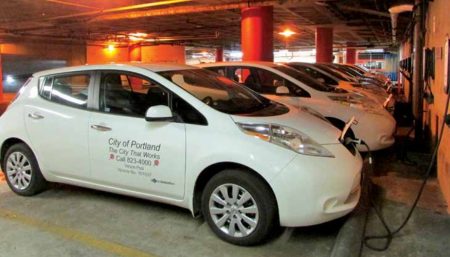
Critical to achieving these EV target goals is the building of a charging infrastructure. The city has agreed to increase EV charging in existing buildings, parking facilities and on public streets. EV charging will be incorporated into new building construction. And EV charging clusters will be strategically located throughout Portland.
Car-sharing and bike-sharing programs are part of the plan. In the case of the former the cars will be EVs. Even the bike-share system will include electric bicycles.
The city also intends to continue to research and track all new EV technology developments to allow it to make informed investments and policy decisions for further electrification of the urban transportation system. And the city wants to encourage the EV industry to become part of the industrial fabric of Portland, a place where EV manufacturers and suppliers can develop their products, providing employment opportunities for Portland residents.
]]>
And the government of China in its modernization drive intends to see that trend accelerate to more closely match population distribution in the Developed World which today stands at 80% urban to 20% rural. The first milestone is to reach 60% urban by 2020. To do this the government intends to move 100 million migrant workers into cities providing them with permanent residences. This will include urban renewal in major cities as well as a commitment to develop small and medium-sized cities and provide the necessary services, infrastructure and jobs to meet the population’s needs.
The government in announcing its urban plan is committed to “harmonious and pleasant living conditions….pursuing better ecology, more clean air and safe drinking water” as reported by the Xinhuanet News Agency.
The world has never witnessed human engineering on such a scale. The government sees the building of new cities and urban infrastructure as critical to driving growth within the domestic economy. The move from rural to urban settings is seen as a powerful agent for income growth for individual Chinese (see the graph below).

But all is not paradise in this great experiment. Cities and apartment blocks that emerge from nothing appear like “ghost cities” empty of population and traffic like the one in the picture below. With no jobs there is great reluctance on the part of China’s population to move from small farms and rural plots to economic uncertainty in these modern equivalents to ghost towns.

For many Chinese the state of China’s current cities provides little comfort. Enveloped by pollution from coal-fired power plants and traffic, China’s cities today represent the country’s greatest environmental threat. Studies show that air pollution is reducing the life expectancy for some 500 million living in Northern China by an average of 5.5 years. What will more urbanization do?
]]>
The headlines I have chosen to share with you this Friday are those that caught my fancy this week. They include a report on urban transportation infrastructure, advances in paving materials that can make cities cleaner, the current IQ quotient for artificial intelligence, the now less than secret oil spill oozing from the sands of Northern Alberta, and the recreation of a 4 billion-year old protein. Enjoy!
To Save $70 Trillion US Governments Need to Invest in Urban Transportation Now
A report from the International Energy Agency is emphatic in its conclusions. Invest now in urban transportation regardless of election cycles or watch 6.3 billion of us who will be living in urban centers by 2050 face the consequences of bad mass transit, poor neighborhood planning, and increasing pollution. The report states that 20% of the energy we use today is consumed by transportation and 40% of that is consumed in urban centers. With mass migration continuing to fill cities and empty the countryside urban consumption of energy for transportation will double by 2050 even with improvements to vehicle fuel economy.
This is a subject close to the heart of those of my readers who live here in Toronto. We are city that is filled with urban transit plans and devoid of funding and execution on those plans. But what is clear from the report is that every city needs to take a look at the mix of options available from better designed neighborhoods that are pedestrian and cycling friendly, to building a better mass transit infrastructure to minimize individual vehicle use. Unlike the picture below of Los Angeles on pretty much any day, cities in 2050 will have far fewer cars, far more places that can be reached by public transit, and much less air pollution.

New Photocatalytic Pavement May Lead to Cleaner Air in Cities
A recent study conducted in the Netherlands involved paving a section of roadway with photocatalytic concrete. This is concrete containing titanium dioxide, a catalyst that breaks down nitrous oxide. The new catch phrase – depollution, the opposite of pollution. The concrete removes contaminants from the air using photocatalysis (the process is illustrated in the image below). Motor vehicles are the primary emitters producing more than a third of this pollutant globally. And nitrous oxide is a leading contributor to asthma and other respiratory diseases, as well as a primary ingredient in acid rain and smog. Now other urban centers are looking at applying depollution technology to roadways and even concrete buildings as a way of cleaning the air. The neat thing is the titanium dioxide does not degrade over time so it continues to work for years and can be applied to almost any kind of concrete, plaster or mortar. An additional benefit, titanium dioxide coatings act as anti-bacterials. It is currently priced at between $1,850 and $2,150 per metric ton.

What’s the IQ of AI?
Would you believe no smarter than a 4-year old, not that a 4-year old is dumb. How do we know? Researchers at the University of Illinois in Chicago tested the ConceptNet 4, an artificial intelligence (AI) open source system out of the Massachusetts Institute of Technology.The AI system was put through its paces. It took the Wechsler Preschool and Primary Scale of Intelligence Test. The results, very uneven scores across portions of the test with better results related to vocabulary but worse related to comprehension. It seems that commonsense continues to confound programmers designing AI tools. By the way if you want to know how we define commonsense – it is the ability to make sound decisions based on facts. Apparently AI systems have not yet achieved a level of comprehension that would equal a child of 8. But in all fairness to MIT and its AI develpment program, the school has put out ConceptNet 5, its next generation of AI. So don’t be surprised if the next IQ test continues to show marked improvement and maybe some commonsense.

Bitumen Spill Continues to Seep into Northern Alberta Environment
Back on July 20 I wrote about a new kind of pollution coming from the extraction of oil from the sands of Northern Alberta. Well it turns out it is not an isolated case in the Cold Lake area where the first one was reported. There are three more “oozing incidents.” Alberta officials who are monitoring these spills describe the extent of them as small, contaminating a total area greater than 20 hectares (50 acres). The process responsible for this is call steam injection. Although this incident sounds like a new event apparently the Alberta government has known about similar occurrences going back to 2009. A spokesperson for the oil sands oversight body in Alberta recently stated that they don’t know“whether it has to do with technology, operating practices, mechanical issues, geology — that sort of thing.” Don’t you feel so much better now knowing that the body responsible for regulating oil sands extraction hasn’t a clue what’s going on. It’s now going on 11 weeks since the oil started leaking and this week the Alberta regulator just approved another steam extraction project.

Recreating a 4-Billion-Year-Old Protein and the Meaning of Life
Researchers at the University of Granada in Spain have reconstructed a protein that would have been in the chemical soup of Earth’s primitive oceans some 4 billion years ago. Proteins are also called enzymes. They are the messengers sent by DNA to execute its instructions. Without proteins DNA cannot function. So recreating the granddaddy of all proteins is an interesting exercise. To come up with what would have been around 4 billion years ago the researchers studied a wide range of proteins found in life forms, particularly those that have been around the longest here on the planet. That allowed them to determine the amino acid sequence within the protein. The end result was what they called a fossil protein that could bind to many different chemicals and could function in an acid environment, similar to what we believe Earth’s early oceans were like. It resembled proteins found in today’s extremophiles, bacteria that live deep within the Earth’s crust and in the mouths of thermal vents in the ocean. One of the researchers speculates that life may not have originated here at all but arrived here from our neighbour Mars, piggybacking on a meteorite. That’s because Mars 4 billion years ago was a more benign environment than the Earth (an artist’s rendering which appears here).

A Postscript
If you have a technology or science story you want to share then don’t be shy. Let me know. Thank you for dropping by.
– Len Rosen
]]>

