Just such an event is going to happen early in the 2030s when Jupiter, Uranus, and Neptune will be positioned just right for a visit. The key to achieving the voyage in a reasonable timeframe is the gravity of Jupiter. Sending two probes complete with a battery of state-of-the-art instrumentation would increase our knowledge of these two outer planet ice giants dramatically.
The infrastructure for the instrumentation on Voyager 1 and 2 is late 1960s early 1970s and includes:
Then there is the scientific payload is similar to many current exploratory mission satellites and includes:
The Voyagers are still going having been given an extended mission to explore the edge of the Solar System and interstellar space. The two spacecraft continue to be powered by plutonium and have enough fuel remaining in their thrusters to keep them stable for the onboard instrumentation that is still operating. This may be the year when they finally run their course but they will have gone further into the reaches of outer space than any spacecraft built by us.
Could there be a Voyager 3 and 4? It seems so because of an approaching planetary alignment that would make such a visit to Uranus and Neptune feasible. The brief glimpse of both planets during Voyager 2’s flyby, left a favourable impression for second visits beginning with two launch dates in the 2030s. The trajectories would take the two spacecraft around the Sun before encountering a gravity-assist from Venus, and a similar assist from Jupiter. Both arrivals would occur well before instruments and power systems had reached their performance limits.
Missions like these take years of planning, so the momentum is building to get NASA on board and funding in place. Using gravity assist and the alignment between Jupiter, Uranus, and Neptune in the 2030s would shorten the trip to both considerably. The planetary scientists this time would want more than fly-by. They would want both to go into orbit, and like the Cassini-Huygens mission to Saturn, include a detachable probe to descend into both planets’ atmospheres and maybe even land.
Today we have Voyager 2’s data and pictures as well as Earth-based telescope studies of both planets. Scientists have tracked storms in Uranus’ atmosphere. Their analysis indicates the two planets may have icy surfaces with liquid oceans beneath. Their moons add to the mystery of both. Uranus, although closer to the Sun that Neptune, is much colder and scientists don’t know why. Its axis lies perpendicular to the orbital plane, tilted by 97 degrees, and its rings and satellite moons orbit perpendicular to the orbital plane as well, unique in the Solar System. Uranus rotates in retrograde fashion, the opposite of Earth, Mars, Jupiter, Saturn, and Neptune.
Neptune features rings like Saturn although not as pronounced, and atmospheric banding and a significant dark spot similar to Jupiter. Its axial tilt is 28 degrees, not too dissimilar to that of Earth and Mars. And its largest moon, Triton, circles the planet in the opposite direction of Neptune’s rotation, the only large object in the Solar System to do this. Triton’s surface is the coldest measured place in the Solar System, yet geysers ejecting water ice have been detected rising several kilometers above its surface. Neptune also features the fastest winds in the Solar System, three times stronger than Jupiter’s, reaching speeds of 2,000 kilometers (1,200 miles) per hour. Considering how far it is away from the Sun, what is the energy source that drives these winds?
Getting back to these two worlds would answer lots of questions, and probably raise quite a few more.

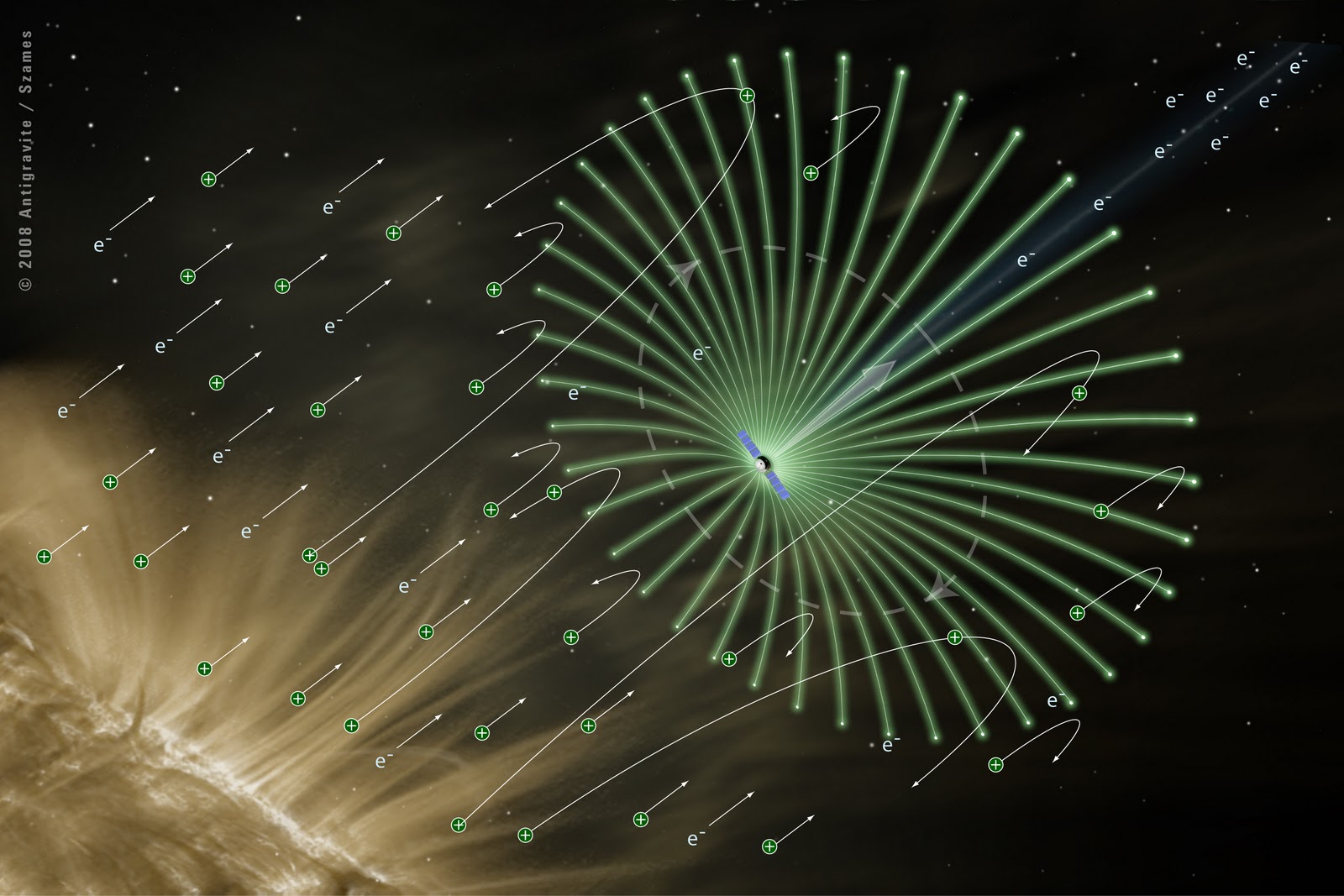
Called the ESAIL or electric sail, I wrote about this technology a year ago. It is far different from conventional solar sails which use the pressure of photons of light to push a spacecraft. The ESAIL, on the other hand, converts light into an electrical charge. It does this by extending a lattice of wires away from the spacecraft to capture and convert individual photons to an electrical charge. The amount of acceleration remains small at 1 mm/s^2. Over time, however, the accumulated thrust will achieve a velocity approaching 20 kilometers (12 miles) per second. At that speed the spacecraft will reach Uranus in 6 years.
The Uranus spacecraft consists of three parts: the ESAIL with solar panels and tether reels with extension wires, the main body of the spacecraft with on board chemical propellant for adjusting the spacecraft trajectory, and a communications component to stay in touch through the Deep Space network with Earth tracking stations.
The ESAIL concept was first proposed in 2006 and has subsequently been developed by a team of Finnish engineers. It currently is being tested on an existing European Space Agency satellite, the ESTCube-1. A second test is planned for this year with the launch of the Aalto-1 communications satellite.
The proposed technology is described in a paper entitled Fast E-sail Uranus Entry Probe Mission.
Related articles across the web
]]>In the late 20th century NASA conceived of a different Grand Tour. A wonderful confluence of planetary alignment became the motivator to develop technology and a plan to rendezvous with Jupiter, Saturn, Uranus and Neptune. This Solar System confluence occurs every 176 years and was going to happen in 1977. So NASA began planning in the 1960s to meet the objective of doing a Grand Tour of the outer planets of the Solar System. To do this NASA needed to work some things out.
Before launching its Grand Tour NASA had to test the technology it was developing. It did this through an interim mission involving two spacecraft, Pioneer-10 and Pioneer-11. Both were highly successful in reaching Jupiter and Saturn.
Getting to Jupiter and Saturn
A space mission to Jupiter bears little resemblance to one going to Mars. Mars is 227 million kilometers from the Sun. Earth is 150 million as a comparison. We use the distance of the Earth from the Sun as a measure we call an Astronomical Unit or AU. So Mars is 1.5 AU from the Sun. Jupiter on the other hand is 5.2 AU from the Sun.
To go from Earth to Jupiter you have to calculate where Jupiter is in its orbit related to Earth. That distance can be as close as 628 million kilometers or as far away as 928 million. Pioneer-10 launched on March 2, 1972. It was atop a three-stage Atlas-Centaur rocket with the third stage providing added thrust to achieve an escape speed of 52,000 kilometers (32,400 miles) per hour making it the fastest human-built object of its time. It passed the Moon in 11 hours and crossed the orbit of Mars in 12 weeks. A month later on April 6 Pioneer-11 followed.
NASA built both spacecraft using aluminum with boron-epoxy tubes. The instrument payloads included attitude controllers using radio beacons to maintain direction, television cameras for taking pictures of the planets, magnetometers, plasma analyzers, charged particle. ionizing and micro-meteoroid detectors, photometers, radiometers, photopolarimeter and transmission equipment to send telemetry and photographs to an Earth-based Deep Space Network of communication stations located in California, Spain and Australia. Both craft used hydrazine propulsion thrusters, silver-cadmium batteries and a Radioisotope Thermoelectric Generator (RTG). The RTG used thermocouples to convert heat to electricity from the radioactive decay of plutonium.
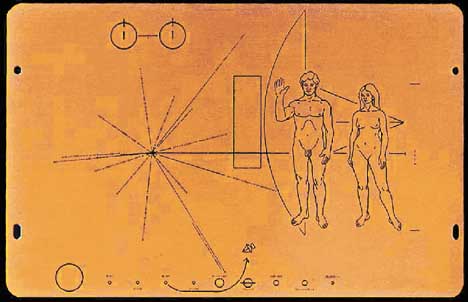
Neither spacecraft were large weighing approximately 260 kilograms (570 pounds). Both spacecraft carried a gold plaque on which information was inscribed about their origin.
Pioneer-10 was first to traverse the Asteroid Belt between Mars and Jupiter. With that success Pioneer-11 was instructed to fire its thrusters to increase velocity and change its aiming point so that Jupiter’s gravity would assist it in going on to Saturn.
Although Pioneer-10 was first to be launched it arrived at Jupiter, the first week of December 1974, a day after Pioneer-11. Both spacecraft relayed data and images about the Jovian system, its moons, magnetic field, and the presence of the solar wind. Pioneer-10 came within 130,000 kilometers (81,000 miles) of the planet’s cloud top. Pioneer-11 was even closer, just 43,000 kilometers (26,725 miles) above Jupiter’s clouds. That close approach increased the spacecraft’s speed to 173,000 kilometers (108,000 miles) per hour taking it the next 2.4 billion kilometers (1.5 billion miles) to rendezvous with Saturn.

Pioneer-11 reached Saturn on September 1, 1979 passing within 20,800 kilometers (13,000 miles) of the planet and sending back remarkable pictures that included the rings. Pioneer-11 discovered two Saturnine moons and an additional ring while studying the planet’s magnetosphere.
Both spacecraft continued to operate well beyond the completion of their primary missions with Pioneer-11 studying interplanetary space until the mid-1990s, and Pioneer-10 transmitting past the year 2000. In these two robotic spacecraft NASA had proven it could build reliable technology for the Grand Tour that soon was to follow.
The Grand Tour
For the Grand Tour NASA built two of the most complex unmanned spacecraft ever designed. Dubbed Voyager-1 and 2, the latter was launched first on August 20, 1977 aboard a Titan-Centaur rocket. Voyager-1 followed on September 5 but it was launched on a faster, shorter trajectory to have it arrive at Jupiter first.

Like their predecessors reliability over a long-duration flight meant the spacecraft would need to detect and react to internal problems without human intervention. This required the development of on-board artificial intelligence. Instrumentation included high-gain antennas, detectors of all kinds to conduct 10 different experiments, and television cameras. Both spacecraft used RTGs similar to those on Pioneer-10 and 11. They each weighed about 800 kilograms (1, 760 pounds).
Voyager-1 arrived at Jupiter on March 5, 1979. Voyager-2 followed on July 9. Voyager-1 reached Saturn on November 12, 1980 followed by Voyager-2 on August 25, 1981. The trajectory of Voyager-1 took it close to Saturn’s largest moon, Titan. The trajectory made it impossible for the spacecraft to rendezvous with Uranus and Neptune. But Voyager-2’s trajectory positioned it well for a flight to the two remaining gas giants beyond arriving at Uranus in January of 1986, and Neptune in August of 1989.
What did the two spacecraft discover? The list of firsts is amazing:

Together the two spacecraft visited more worlds than any previous spacecraft. And to this day they continue to operate, an incredible technological design achievement. As of February 2012, 35 years after launch, Voyager-1 continues to transmit data to Earth from a distance of 17.9 billion kilometers (11.1 billion miles) from the Sun, the farthest a human-made object has ever travelled. On a different trajectory Voyager-2 in February reached 14.6 billion kilometers ( 9.05 billion miles).
No voyage of human discovery has ever equalled the two Voyager missions.
]]>
