This is not the first attempt to create a robot substitute for bees. In my past research I have come across the RoboBee developed by engineers at Harvard, and about work on pollinating flying robots in Japan.
What has inspired this type of invention? One thing is the threat to honey bees from Colony Collapse Disorder, a problem that has seen bee populations plummet globally. The second is the collapse in insect populations recently revealed in a United Nations’ report. And third is the challenge of micro gravity in space and low-gravity environments such as on the Moon and Mars that would impact insect pollinators negatively.
What makes this new artificial flying insect substitute, the Bee+, more like a real insect than any previously designed? The Southern California team built it with four wings, unlike RoboBee which has only two. That extra pair makes Bee+ fly like the insects it was designed to emulate.
At present, there is a limitation to Bee+. It needs an external power source and as a result is tethered, a major limitation. But the USC team is developing actuators with the assistance of a National Science Foundation grant that is focused on achieving maneuverable, autonomous, untethered, insect-scale flight.
The team is working on catalytic artificial muscles to achieve this, using fuel-powered, shape-memory-alloys that generate heat to induce material phase transitions to create powered, stable, aerodynamically controllable flight. Critical to the research is the latter function will be control, the ability to fly where and when it wants and achieve whatever task it is asked to do.
And just what do the inventors of Bee+ have in mind?
Nestor Perez-Arancibia, USC professor in the Department of Aerospace and Mechanical Engineering, is team leader in the development of Bee+. His current work includes the Bee+ micro flyers project which also requires the development of controlling algorithms for this tiny robot, new microfabrication techniques needed to build Bee+, and soft robotic actuators that eventually will allow Bee+ to fly untethered.
Perez-Arancibia believes the other-world application for the flying robot would be one of the most exciting. He recently told Digital Trends, “I would like to see our robots flying on Mars and Titan.” He added further, “I believe that we can create ant-inspired colonies of explorers in which each member has unique capabilities and can perform specialized exploring tasks, [taking] geological samples, [measuring] the gases in atmospheres, et cetera.”

]]>

Two weeks post surgery Boesen (seen in the picture above) showed some signs that the procedure was working. And after 90 days he could feed himself, write his name, use a cellphone, hug his friends and more.
Explains Dr. Charles Liu, Director of the Neurorestoration Center, “Typically, spinal cord injury patients undergo surgery that stabilizes the spine but generally does very little to restore motor or sensory function….with this study, we are testing a procedure that may improve neurological function, which could mean the difference between being permanently paralyzed and being able to use one’s arms and hands. Restoring that level of function could significantly improve the daily lives of patients with severe spinal injuries.”
Liu reports that 90 days post surgery Boesen is demonstrating motor function that should it continue to improve will allow much greater levels of functional and physical independence than found in current standard treatment.
There are six sites in the United States currently enrolling candidates for clinical trial of this new procedure which involves escalating doses of AST-OPC1 cells (see below) developed by Asterias Biotherapeutics. The cells are made from embyronic stem cells converted to oligodendrocyte progenitor cells, cells found in the brain and spinal cord. AST-OPC1 cells in laboratory studies has been shown to stimulate myelination of damaged axons as well as development of new blood vessels.
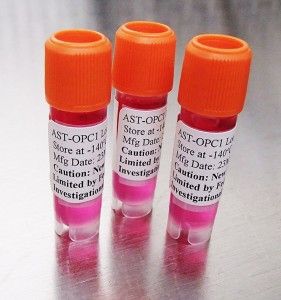
Clinical trial sites include Indiana University in Indianopolis, Medical College of Wisconsin in Milwaukee, Rush university in Chicago, Shepherd Center in Atlanta, Stanford University and Keck Medicine at University of Southern California.
]]>
There are two Achilles Heels to renewable energy form wind and solar. The first is constant availability. The wind doesn’t always blow and the Sun doesn’t always shine. The second is the variability that occurs as winds rise and fall and the Sun angle alters throughout the day impacting photovoltaic energy conversion efficiency.
Innovative solutions have been proposed to deal with these challenges. For example during maximum generation from a renewable energy power plant, electricity not needed for the grid can be used to feed a variety of storage media. The energy can pump water up a hill to create latent energy storage. The water can then be released to flow downhill and turn hydroelectric turbines attached to generators. Or energy not used for power generation can pump air into pressurized cavities or buildings. When released the compressed air can drive wind turbines attached to generators. Both solutions require considerable real estate.
A far more likely technology innovation comes in the form of batteries. We all know about lithium-ion and I have recently written about aluminum-air batteries. But for a technology robust enough to be used to supplement renewable energy power plants we need big batteries with lots of capacity. This is the technology that Sri Narayan, a professor of chemistry at Dornsife College of Letters, Arts and Sciences, USC, describes in a paper published in the Journal of the Electrochemical Society last month. He along with a team of researchers have collaborated in developing an organic-flow battery capable of being recharged through 5,000 cycles for an estimated shelf life of 15 years. That’s 500% more enduring than comparable lithium-ion technology.
The batteries work similarly to fuel cells. The diagram below displays a schematic of how these batteries work. Two tanks of water containing organic electro-active materials, one solution positive, the other negative, are pumped into a central tank divided by a membrane. The chemicals interact across the membrane release electricity. In the lab the battery is small. But the researchers are confident the battery can go from small to gigantic. And the energy released can also be adjusted to match power demand requirements.
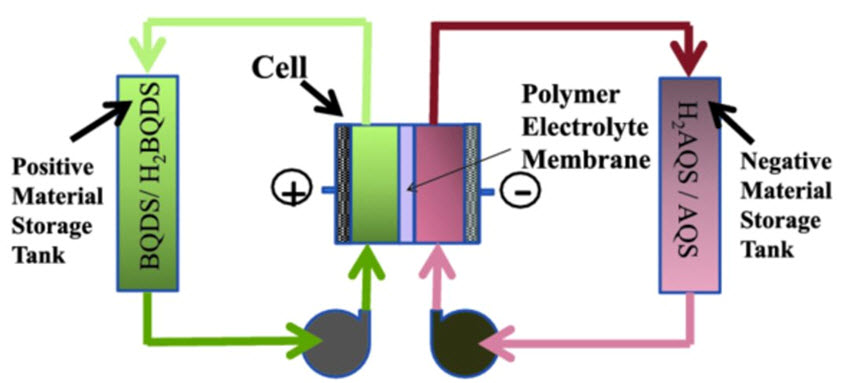
Designs like this are popping up in laboratories in universities in lots of places. The big breakthrough for USC, however, comes in the chemicals. Narayan and his team are using oxidized organic compounds commonly found in plants, fungi, bacteria and animals. These compounds are natural energy-producing chemicals used by animals in respiration and plants for photosynthesis. Called quinones, you may recognize one of the products created from them – hydrogen peroxide. The quinones in use here have been manufactured by the USC team. But in the future the team believes carbon dioxide will be the source for its quinones.
Although still in the lab, the promise of this technology has attracted the U.S. Advanced Research Projects Agency which has provided funding for scaling the battery to build larger versions. If successful this may prove to be a technology present at almost every renewable energy power facility. And we may benefit further from this technology as it helps us reduce our carbon footprint by using captured carbon dioxide for manufacturing the chemicals.


