The post If You Are Left-Handed Like Me You Will Want to Read This appeared first on Techso Mogro.
]]>What causes one hand to be dominant in a species?
What does it say about our brains when we use our left-hand over our right?
A recent study of 500,000 people’s genetic data done by researchers at the University of Oxford revealed four areas of our genome that govern left-handedness. Three of these were associated with brain development and language proficiency. Akira Wiberg, a researcher at Oxford and one of the lead authors of the study noted that people who are left-handed appear to have a different pattern of brain communication between the left and right brain hemispheres.
In Brain: A Journal of Neurology, Wiberg and her research colleagues describe our uniquely human character trait, a predominance of right-handedness. This is uncharacteristic in other animal species were dominant handedness is evenly distributed between left and right. In our nearest primate relatives, the numbers do not weigh heavily to the right.
So what could be the explanation for this unique skewed human characteristic?
Some anthropologists believe that the use of stone tools made us right-hand dominant. The left hemisphere of the human brain controls motor coordination critical to developing stone tools. Pointing to dental records of European Neanderthals, researchers see in the fossil record evidence of right-slanted striations on the front side of teeth. They hypothesize that the striations came from gripping material with the teeth while striking an object being worked with the right hand. The same evidence appears in earlier Homo habilis fossils. Hence, anthropologists believe marks like these could only come from working with tools held in the right hand. Subsequently, a combination of genomic inheritance and learned behaviour skewed human populations to become right-hand dominant.
A more disturbing aspect of the Oxford research links the four areas of the genome associated with left-handedness with several neurodevelopmental disorders including schizophrenia.
The study found that:
The most interesting aspect of this dominant-hand study is how dominant-handedness and verbal skills in language are linked giving left-handers a cognitive advantage. Being a left-hander, all I can say is “I knew it! Now, could someone help me open this can of tuna with this right-handed can opener?”

The post If You Are Left-Handed Like Me You Will Want to Read This appeared first on Techso Mogro.
]]>The post Oxbotica – Autonomous Vehicle Software That Learns As It Drives appeared first on Techso Mogro.
]]>Called Oxbotica, the idea behind it is to give the system to means to learn and grow into the job of driving autonomously. Its perception systems analyze the environment around the vehicle at all times. Its vision systems orient it to its operational space. And its ability to use a range of sensors from a few for forklift operations to hundreds for the operation of an autonomous bus, car or truck, make it scalable.
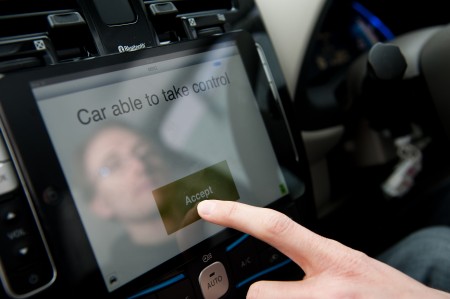
It can read stored information like onboard maps that can be fed into the vehicle’s memory. It can then match that against what it learns directly from operating on roads or on a warehouse or factory floor. States its co-founder, Paul Newman (not the actor), of University of Oxford, “if you take it out in the snow and it’s not seen it before, it keeps the ideas of snowy-ness around for the next time.” This is real differentiator from Google’s autonomous vehicle technology and even the AutoPilot found in Tesla’s vehicles. In recognizing “snowy-ness” Oxbotica, instead of relying on camera input, looks more at the data it receives from low-visibility sensors associated with laser and radar imaging.
Oxbotica learns collision or pedestrian avoidance by observing driver behavior. It learns about traffic lights and signs the same way. The more it learns the more confidently it drives.
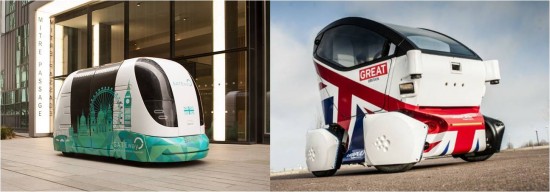
Plans to test Oxbotica in real-world settings are currently underway. The first project will incorporate the software into self-driving shuttle buses in Greenwich, UK seen below on the left. The second is in Milton Keynes, also the UK, where the software will be tested on LUTZ Pathfinder shuttle pods seen below on the right.
The post Oxbotica – Autonomous Vehicle Software That Learns As It Drives appeared first on Techso Mogro.
]]>The post Why the Number One Trillion is Too Much appeared first on Techso Mogro.
]]>In a 2009 study reported in Letters in the journal Nature physicist Myles Allen, University of Oxford, gave that one trillion number as the amount of metric tons of atmospheric CO2 to cause peak warming of 2 Celsius (3.6 Fahrenheit) degrees.
So where are we now?
The number today is 600 billion, 60% of the way, increasing by 50 billion metric tons per year. That means 8 years from now based on current CO2 emissions we will hit one trillion.
How do we then get to where we need CO2 levels to be?
Today at 400 ppm we are already seeing the creep of atmospheric warming leading to extreme weather events which scientists now describe as anthropogenic. That means 400 is not a very sustainable target. Climatologists argue we need to get back to levels below 1950, just under 316 ppm. To do that we have to change the way we create energy in a world where energy demand is increasing as world population grows.
For those who point to population as the real problem and not carbon in the atmosphere I say this:
They go together.
And even if we wrestle population growth to zero by mid-century, aspiring developing nations will still need more energy than they have capacity to produce today. So energy demand overall will rise even as the population curve peaks and begins to decline.
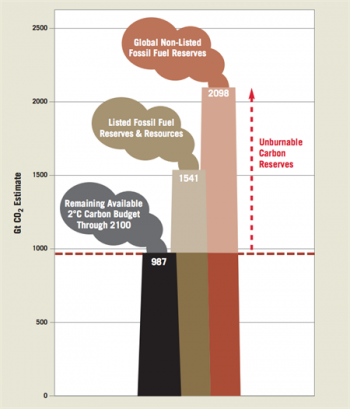
For those coming to agreement in Paris at COP2015, it means leaving 25% of known fossil fuel reserves in the ground as unrecoverable, the so-called stranded assets scenario that energy companies are facing now and in the future.
In the United States this week, President Obama announced a 32% reduction target for carbon emissions from energy providers. The reduction is being measured from 2005 levels, not 1950 or even 1990.
Will that number get us to stay below one trillion?
No.
If the President were seriously engaged in the climate file then he would be establishing a real target to be 80% to 90% below 1990 levels by 2050.
If the rest of the world were to follow suit it would mean a global 50% reduction in CO2 emissions by 2050. That’s how heavily weighted the United States is in the scheme of things, the largest CO2 and greenhouse gas emitter.
Will we be off the hook if we keep the temperature from rising beyond 2 Celsius?
If you live in a coastal city the answer is no.
If you live on an atoll island in the Pacific or Indian Oceans you will be emigrating.
Sea level rise will prove to be the most consequential result from anthropogenic warming of our atmosphere.To put perspective on this, the last time our Earth experienced atmospheric mean temperatures 2 Celsius warmer than today was 120,000 years. At that time sea levels rose between 5 and 10 meters (16.4 to 33 feet).
What would a 5-meter rise mean?
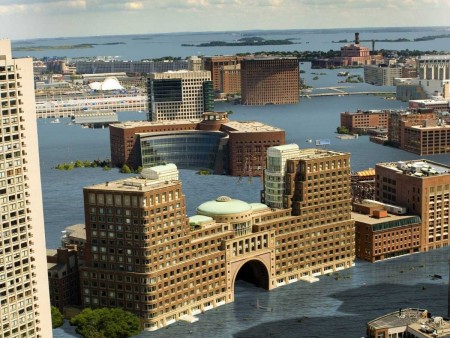
The disappearance of Lower Manhattan, downtown Boston (artist rendering depicted below), all of New Orleans, most of Miami-Fort Lauderdale and Palm Beach, Washington, DC and the Chesapeake Bay area, The Hague, almost all The Netherlands, Bangladesh, Singapore, the Maldive Islands, downtown Tokyo, Venice, Dublin, London, Cairo, Copenhagen, and Brisbane to name just a few.
The graphs below from the University of Oxford study illustrate a series of idealized (not my word because it is hardly ideal) CO2 emission profiles along with correlated temperature response benchmarks. The various lines show different scenarios. The solid red and orange lines represent cumulative emissions within 1% of one trillion. The red lines in the composition and temperature graphs (the two on the right) project the consequences of one trillion to the year 2500. The dotted red lines in both graphs plots a peak warming profile based on 490 ppm of CO2.
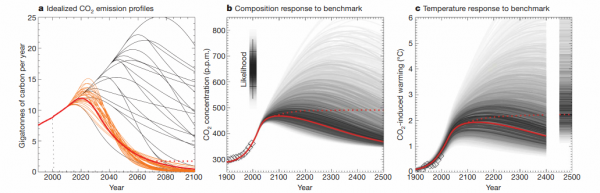
In previous postings I have described how carbon emissions created today have consequences for the generations that follow. We are the current victims of the CO2 spent into atmosphere from a century ago. And what we do today and tomorrow will impact the planet for centuries into the future. That’s why the graphs plotting scenarios to 2500 should be considered in any climate change policy action.
So you wonder why political leaders struggle to grasp the creeping crisis. They truly are the frogs in the warming pot on the stove. They are riveted in the here and now of 4-year election cycles. They’re not thinking a century ahead let alone five and as a result they have little to offer on the climate change file.
Having said that the political meetings in Paris occurring before the end of this year are focused on the subject. It is for all who read this posting, or see it on Facebook, LinkedIn and Twitter, to contact those who govern to ensure that leaders’ actions speak louder than their words.
The post Why the Number One Trillion is Too Much appeared first on Techso Mogro.
]]>The post Gizmos & Gadgets: Neuroscience Researcher Invents Smart Specs to Help Blind See appeared first on Techso Mogro.
]]>

His invention cannot make those with no vision see, but anyone with some remaining vision who has been declared legally blind can use these glasses to see nearby objects. For those with tunnel vision from macular degeneration or retinopathy, for those with cataracts blocking the field of vision, for night blindness, smart specs may help.
How do they work?
They combine a 3D camera and built-in software to enhance vision. The software enhances and highlights objects in the foreground while hiding the background (see the four panel image sample below as illustration). The wearer can even pause the visual feed and zoom in for greater detail. The depth camera works in the dark allowing for night vision.

The smart specs can be outfitted with sunglass lenses and with prescription inserts. The battery-powered control box is worn over the shoulder giving the wearer access to the zoom, pause and enhance vision features which include daytime colour, high contrast amplification and low light navigation.
This month VA-ST loaned 300 pairs of its glasses to people with macular degeneration, retinitis pigmentosa and glaucoma. The four week study will record how each of the wearers benefited from using the technology to cope with everyday living.
Plans are to go into production later this year and have VA-ST available commercially early in 2016 for less than $1,000 U.S. per pair.
Future versions of the glasses will focus on design to make them look sexier, shrink the format and reduce the weight. But for now VA-ST could be just what ophthalmologists need to help patients declared legally blind see again.
The post Gizmos & Gadgets: Neuroscience Researcher Invents Smart Specs to Help Blind See appeared first on Techso Mogro.
]]>