
The GFI1 protein, the GF stands for growth factor, seen in the image above, is described in the literature as a transcriptional repressor protein that plays a role in the development of stem cells, sensory neurons, neuroendocrine cells, and more. Mutations in the genes that express the protein have been associated with small-cell lung cancer and neuroendocrine tumors. The discovery of its role in the development of embryonic auditory hair cells represents a significant advance in our understanding of how hearing develops.
But the protein alone isn’t the only factor that can impact hearing. Environmental damage such as exposure to loud noises (those rock concerts you may have attended in your misguided youth where you experienced buzzing and ringing for days after), working in noisy industrial environments, and diseases of the nervous system can also lead to hearing loss. Today in the United States hearing loss doubles in 10-year increments with 50% of American adults at age 70 suffering from it, and 85% in those over age 85.
In my case, I developed tinnitus, a condition where I experience ringing and other high-pitched noises in my ears. The tinnitus is part of my diminished hearing capacity. It is uneven with my left ear worse than the right. The sound doesn’t come from an external source. Instead, it is malfunctioning hair cells in my middle and inner ear that are contributing factors. As a musician, the presence of this noise can be a real pain. But I have learned to live with it on most days when it is in the background. But on some days it becomes significant and bothersome. I’m not alone with this condition which affects 15 to 20% of people, mostly seniors, and have been tested for hearing loss on multiple occasions. So far, I don’t need a hearing aid.
In the Maryland study that identified the protein and its role, they used genetically modified newborn mice which lacked it. Ronna Hertzano, Associate Professor in the Department of Otorhinolaryngology-Head and Neck Surgery in Maryland, in a SciTech Daily article describes the influence of the genes responsible for the GFI1 protein. The altered mice were unable to produce GFI1. The result was the inability to develop the sensory hair cells.
The study also showed an exciting discovery, that GFI1 had regenerative capabilities and could be used for patients experiencing hearing loss from aging or environmental factors. The result is new research underway to use the protein with stem cells to create a potential cure for hearing loss from the damages caused to hair cells.
If you would like to read the original research paper, it is published in Development for advances in developmental biology and stem cells.
]]>
NASA has been considering this challenge for sometime. You can read about the consumable requirements for a crew of four on a mission to Mars on their site. The food alone over the duration would eqaul 10,886 kilograms in weight. Water usage is calculated at 11 liters (approximately 3 U.S. gallons) per person per day. Some of that could be saved through recycling technology currently onboard the International Space Station.
But unlike NASA, the European Space Agency (ESA) is looking at hibernation as a way to reduce the consumable requirement for a mission to Mars. Through the controlled use of torpor and hibernation, an astronaut’s metabolic rate would lowered to put he or she into a sleep state which would conserve oxygen, water, and food, and at the same time, reduce exposure to cosmic radiation.
The Concurrent Design Facility (CDF) at ESA has been tasked with developing hibernation technology and designing a spacecraft for the journey that would reflect the need for less consumables and physical space. What ESA is hoping to do is duplicate in the real world what we have seen in science fiction movies like “2001: A Space Odyssey.”

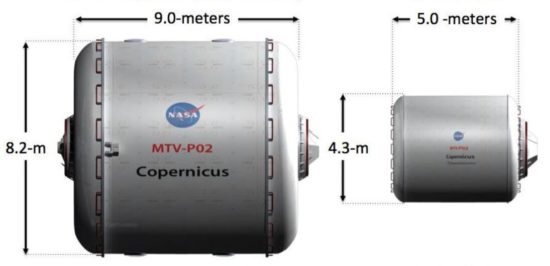
CDF in its planning considerations used a 5-year mission and 6 crew members in its planning of the design of a spacecraft. The habitation module for hibernation can be seen on the right in the image below compared to a non-hibernation alternative, a much larger spacecraft. Hibernation would not only reduce crew quarters’ size but would reduce consumables needed by at least one third for the entire mission.
The technology to induce torpor or hibernation remains a challenge, but according to a new clinical trial at the University of Maryland School of Medicine, this just might be possible sooner than later. What the medical team at Maryland are attempting is a method of dealing with acute trauma by putting a patient into suspended animation. They call the technique, Emergency Preservation, and Resuscitation (EPR). With EPR the body is rapidly cooled to a temperature of between 10 and 15 Celsius (50 to 59 Fahrenheit) by replacing blood with ice-cold saline. This induces a controlled state of hypothermia where the heart stops and brain activity slows to a minimum.
EPR isn’t meant to be used for hibernation but rather is being trialed as a method for dealing with acute trauma where there is a significant loss of blood and little time to get a patient to the operating room. Currently, the limitation in this clinical trial is not to put the patient into a torpor state for more than 2 hours before beginning the body rewarming and restarting of the heart.
States Samuel Tisherman, who is heading up the clinical trial, “I want to make clear that we’re not trying to send people off to Saturn…We’re trying to buy ourselves more time to save lives.”
The EPR process when first attempted was described by Tisherman as “a little surreal,” but if it proves successful, could become the basis for developing prolonged suspended animation and an answer to the challenge of long-duration human spaceflight. Among the remaining unknowns, however, is how an induced torpor would affect brain pathways in the initiation of hibernation and the subsequent restoration of a future astronaut to an awake state.
As ESA sees it in its planning of a Mars mission, the entire crew would be launched fully awake. The hibernation pods would double as crew cabins during this awake phase. Torpor would be achieved through drugs or a process like EPR. In advance of hibernation, the astronauts would be put on diets to increase body fat. The hibernation phase would involve cooling the astronauts to the kind of temperatures in the EPR clinical trial. The hibernation pods would keep the astronauts alive for much of the 180-day Earth to Mars voyage, maintaining a 25% of normal metabolic rate. Only the last 21 days of the transit would involve the astronauts in an awake state. To ensure minimal exposure to cosmic radiation, the hibernation pods would be shielded with water containers.
ESA plans a flight in which the spacecraft would largely operate autonomously using artificial intelligence (AI) capable of detecting faults, dealing with medical emergencies, and managing the voyage in isolation throughout the period of transit. ESA researchers note that hibernation is not such a crazy idea as is being attested by the clinical trial underway at the University of Maryland. Described as a game-changer for trauma, it is likely to become equally useful in keeping astronauts alive and well on trips to Mars and other destinations in the Solar System and beyond.

]]>
In an article published in Nature this last week, Teng Li, University of Maryland, describes a simple, effective way to transform natural wood into a “high-performance structural material with a more than tenfold increase in strength, toughness and ballistic resistance…with greater dimensional stability.”

The process involves the partial removal of lignin and hemicellulose by boiling natural woods in an aqueous mixture of sodium hydroxide and sodium sulfite followed by hot-pressing at 100 Celsius (212 Fahrenheit) degrees for a day. The end result, the total collapse of the wood’s natural cell walls and increased densification and highly aligned cellulose nanofibres. Using a scanning electron microscope they could see that the process crushed the cellulose tubes together until they crumpled and interlocked.
The key to strengthening wood involves removing the right amount of lignin (about 45%). When too much is removed it causes the wood to become brittle.
To test the modified wood strength, 9-millimeter lead pellets fired from a ballistic air gun were unable to penetrate a five-layer laminate of this new material, a mere 3 millimeters thick. The speed of the test firing although slower than a speeding bullet, was 30-meters (approximately 100 feet) per second, roughly equivalent to the speed of a car in normal traffic on a city street.
Using this treated wood, where today we currently use far more carbon-intensive materials, would help to reduce greenhouse gases. And I can imagine that cars like the old Ford Woody, (see image below) one that I remember from my childhood would still be around today.

]]>
The components of the battery include a lithium cathode, a carbon anode, and an electrolyte solution containing tiny fragments of lithium floating in organic solvents. Each is separated by very thin coatings that serve as partitions. Then the components are compacted together like a grilled ham and cheese sandwich.
Over the years of manufacturing and running billions of lithium-ion batteries in our world we have come to rely on them for powering smartphones, digital cameras, laptop computers, tablets, MP3 players, electric cars, and more. Discharge-recharge cycles happen with hardly ever a problem.
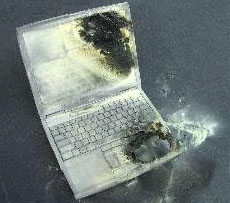
When the problems do happen we can get some pretty spectacular accidents with batteries catching on fire or exploding.
Why does this happen?
There are two common causes for lithium-ion battery accidents. The first happens if the partition coatings have flaws allowing electrolyte containing lithium fragments to leak leading to a short and a fire. The second is known as thermal runaway and is caused by imperfections in the pressurized sandwich and overall containment. Pressure can cause uncontrolled heating and when that happens the results can be either an explosion or fire.
And when a lithium-ion battery catches fire, extinguishing it can be problematic because applying water makes the fire much worse. Only dry powder Class D extinguishers kill a lithium-ion battery fire.
How do we make lithium-ion batteries safer without impacting their performance?
The United States Army has been looking at wearable electronics powered by lithium-ion batteries. and the last thing they want soldiers to experience is a battery igniting while being worn.
Scientists at the Army Research Laboratory, Adelphi, Maryland, along with The Unversity of Maryland have been experimenting with two innovations:
The combination of the two causes the electrolyte to be expelled when in proximity to the cathode. That eliminates leaks as well as the damage caused by imperfections in the sandwiching of the layers.
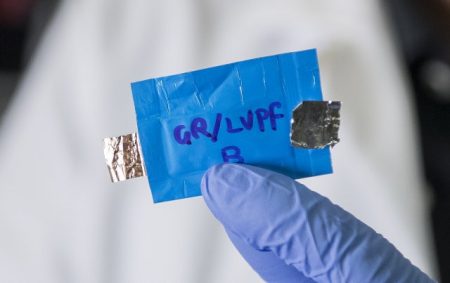
The battery they have created, seen in the picture below, is flexible and therefore wearable. Its biggest drawback at the moment is a limited discharge-recharge rate of between 50 and 100 cycles. The researchers are working on improving this to at least 500 cycles in the near future.
They believe their invention has application to other battery technologies including those using sodium-ion, lithium-sulfur, and zinc and magnesium. They also can see applications for electroplating and electrochemical synthesis.
A 50 to 100 cycle recharge-discharge rate is not an inhibitor for the U.S. Army to begin using these lithium-ion batteries. Commercial application, however, is probably still five years away.
In an article published yesterday in Nature Communications, a team of researchers at the Institute for Bioscience and Biotechnology Research, University of Maryland, describe “the utility of using biologically relevant redox molecules in translating electronic signals to changes in engineered bacterial gene expression.”
What does that mean?
That they can genetically induce bacteria to communicate using electronic controls to influence behaviour. This is biomolecular information transfer and is bringing the science fiction future close to a 21st century reality. Not only does it demonstrate the potential to create bio-neural gel packs that can be integrated with silicon or quantum computing devices, it also means we are discovering a way to communicate with the very cells within our bodies and developing tools to potentially manipulate them. The latter has significant implications for curing diseases.
Why redox molecules?
Also known as redox signaling molecules, they are manipulated by the mitochondria within our cells. When mitochondria are healthy and functioning properly redox molecules get produced. They come in two forms, one creates oxidation and the other reduction. The oxidation removes electrons. The reduction delivers electrons. Sounds like an electronic circuit in the making.
The research team at University of Maryland used E. coli to demonstrate the potential of this discovery. They submerged an electrode into a liquid containing E.coli. Applying a positive charge triggered redox molecules and oxidation. The genetic mechanism for the reaction was then isolated so that the researchers could then engineer the bacteria to automatically produce a consistent response to an electronic stimuli. When exposed to electrical input these re-engineered E. coli could be induced to swim or flouresce. The bacteria was also induced to create a signal molecule to transmit to neighbouring E. coli which then responded similarly to electronic inputs. This demonstrated the effectiveness of the process for inducing a group response.
With a little genetic rewiring this research demonstrates that bacteria can be used to both collect and deliver information. It can communicate with diseased and cancerous cells. The bacteria can deliver a message in the form of a drug or molecular kill switch. And maybe very soon E. coli and other bacteria can form those biological circuits science fiction has described.

Quantum logic and quantum algorithms have been the stuff of physics labs to date. Quantum computers have progressed from one qubit to two and three with the biggest challenge being getting them to scale to a point where they are practical for commercial use. The University Maryland’s five-qubit programmable module uses ion trap quantum architecture (see illustration below) and its inventors state it can scale by connecting a number of individual modules together. Not yet demonstrated this would be the logical next step to creating a commercial device.

On the other hand, D-Wave’s latest quantum processor, seen in the image below, makes the University of Maryland efforts seem passe. The company’s latest model claims to break the 1,000 qubit mark although many physicists including those at Maryland are skeptical. But not the folks at Google and NASA who have upgraded from 512 qubits to this new processing capability. D-Wave intends to keep making upgrades to these systems in strategic partnership with its users at University of Southern California, NASA, Google and Lockheed Martin.

It would seem, therefore, that existing computing technology will face a challenge from quantum processors and their amazing potential. As quantum computing approaches a threshold where it will serve commercial applications and become widely distributed, the National Security Agency (NSA) of the United States is voicing its concern that existing security and encryption standards will prove inadequate as a defense against quantum computing purchasers with malevolence on their minds. In other words, once quantum computers are being used not by a few, but by many, the NSA believes any secrets protected by current best encryption standards will no longer be secret.
The truth is, today, no one knows how to make quantum-computer-proof encryption. And as quantum computers scale to millions or hundreds of millions of qubits, any current computer and current software will be vulnerable.
Google, IBM, Microsoft and NSA are cognizant of the importance of developing cryptographic keys that even a 100-million qubit quantum devices cannot break. In their pursuit of developing commercial quantum computing circuits it is, therefore, clear that a window of vulnerability exists now as the technology scales up.
A team from the Robotics Center at the University of Maryland have built Robo-Raven. To emulate a bird’s lightweight skeleton the engineers at Maryland used polymers and fashioned the bird’s parts using a 3D printer and laser. In addition they developed a number of software algorithms to accurately mimic bird flight. You can watch it in flight and decide for yourself. Is this a bird or what? It can do dives, back flips, soar and dip. It can move each wing independently. It is so much like a bird that it even confused a hawk who tried to attack it thinking it was alive. And when aloft often attracts birds who fly along side it.
Robo-Raven is about 60 centimeters (over 2 feet) in length and weighs less than a can of cola. It’s wings use two programmable motors powered by batteries. The wings can act independently or synchronize. A radio transmitting hand controller instructs Robo-Raven during flight.

Robo-Raven is not the only robotic bird out there. A TED Talk in July of 2011 introduced Smart Bird, a robot over a meter (over 3 feet) in length with a 2 meter (6.5 foot) wing span, an internal carbon fiber framework and a skin covering that makes it resemble a herring gull. Not quite as adept as Robo-Raven, Smart Bird wowed the TED audience when it made its debut.

Why a wooden base for the anodes? Because wood has the ability to morph in response to electrons without becoming brittle. This suppleness means the battery can withstand up to 400 charging cycles.
The components in the battery are tiny and very thin, in fact thinner than a piece of a paper. The choice of sodium as the medium for holding the charge is about cost and environmental impact. Sodium is readily available although it doesn’t hold a charge as well as lithium. And wood is a great material for storing a liquid electrolyte. After all trees do this naturally in drawing fluid and nourishment from root systems into the trunk and leaves.
To construct the battery microscopic wood fibers from Yellow Pine like the ones seen in the image below are coated with a nano layer of tin. When charged the natural wrinkling within the fibers demonstrates a flexibility that is not possible with a stiffer medium. The result, a battery that easily handles repeated cycles of charging and discharge.
Where would such a battery be considered useful? For large scale energy storage state the researchers who see their wood coated with tin invention as an ideal solution to support variable renewable energy such as solar and wind power plants.
The research results are described in a YouTube video and published in the May 29, 2013 edition of NANOLetters.

]]>


