But this is not one of them. So no April Fools.
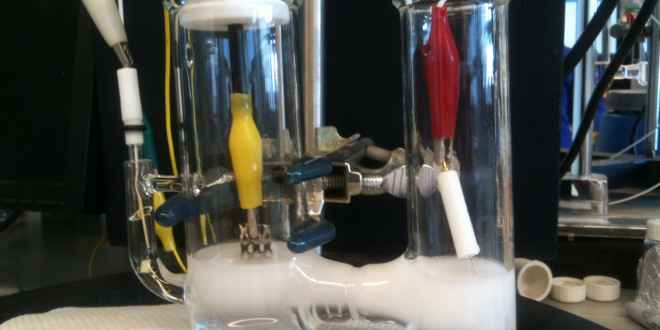
Two chemistry professors, Curtis Berlinguette and Simon Trudel, at the University of Calgary have published a paper in the journal Science in the last week in which they describe their discovery, a low-cost catalyst that can split water into hydrogen and oxygen. The catalyst contains a combination of iron, cobalt and nickel which when exposed to a light source decomposes the water into its base components.
The professors have formed a new start up company, FireWater Fuel, to commercialize their invention. On their website they tell the story of the value of hydrogen as an energy source, that is, a single kilogram of hydrogen contains three times the energy of an equivalent amount of gasoline. So it makes sense to be looking at hydrogen even though up until now the cost of releasing that energy has always been prohibitive.
That’s why FireWater’s invention is so significant. The catalyst is cheap to produce and has significant potential for use in many different applications.
Initially the company intends to produce an electrolyzer that generates hydrogen for energy storage that when combined with wind farms or solar power arrays will provide storage to support continuous energy production when the wind doesn’t blow or the Sun doesn’t shine.
FireWater also sees its technology as useful for inexpensive hydrogen fuel cells in electric vehicles.
It can also be used to convert sequestered CO2 into liquid fuels.
A freezer-sized electrolyzer trademarked under the name FFCat is planned for release on the market in 2015. The electrolyzer will convert a few liters of water per day into electricity for domestic consumers. Is this the beginning of the hydrogen revolution? Maybe. We’ll keep watching and reporting.
What is an Autoimmune Disease?
Autoimmune diseases are inflammatory response diseases caused by our immune system attacking us. They are non-discriminating and can be found in almost every organ and system in the human body. They tend to be chronic conditions continuing throughout the lifetime of the individual. There can be periods of remission followed by reappearance of symptoms. They tend to strike women more than men. Hormones may play a role. But there are some autoimmune disorders that are more prevalent in men such as Type 1 Diabetes.
How significant is the problem? It is estimated that 24 million Americans and 5 percent of the population in Western countries suffer from autoimmune diseases. Compare that to cancer at 12 million Americans and you begin to see the enormity of the problem.
There appears to be a correlation between our genetic inheritance and autoimmune diseases with children tending to develop diseases that appear in parents, and close relatives exhibiting common autoimmune diseases within extended family groups. Multiple sclerosis represents one of the most common autoimmune diseases that tends to run in families.
What confounds the medical field today about autoimmune diseases is finding the smoking gun or guns, the direct causal link that triggers the immune system response. Lots of circumstantial evidence points to viruses, chemical exposure, foods and environmental toxins but doctors and researchers continue to investigate what triggers these diseases. Having a family member who continues to experience an autoimmune disease has made studying this subject very personal to me.
Autoimmune diseases attack every part of the body. The American National Institute of Health identifies at least 80 different autoimmune diseases that include many familiar conditions you probably never thought were caused by our immune system. See how many you know from this partial list.
Today’s Autoimmune Controls Create Their Own Problems
Currently autoimmune disease treatment is all about reducing or reversing symptoms. In the case of diabetes we treat sufferers with insulin rather than restore pancreatic cell function. In the case of many of the inflammatory responses from autoimmune diseases we treat patients with a cocktail of drugs that include prednisone and other corticosteroids, anti-inflammatories like aspirin, acid blockers, antihistamines and immune suppression drugs (the kind used to stop rejection in organ transplants). In many cases the side affects of these drug cocktails proves to be worse than the diseases.
HLA, T and B, Autoimmune Diseases and a Potential Cure
When scientists and researchers talk about the immune system the letters in the above title become part of the conversation.
What is HLA?
What does T refer to?
What is the B all about?
HLA stands for Human Leukocyte Antigen, the genes that reside on the 6th chromosome in our cells and that govern immune response. The proteins associated with these genes are called antigens.
The T and B refer to different types of leukocytes, the white blood cells that reside in our circulatory systems and marshal our response to infections. The T and the B refer to T-cells, and B-cells. In addition there are sub-categories to leukocyte groups. One is the T-regulatory cell or T-reg and researchers study it because these cells play a role in regulating the level of immune response by other leukocytes.
If we could develop a technology to stop specific unhelpful autoimmune reactions while allowing our normal immune response to deal with unwanted bacterium and viruses then we would be making a big leap forward in our ability to deal with autoimmune diseases. That’s exactly what researchers at the University of Calgary in Alberta, Canada, have been working on using nanotechnology as the delivery mechanism for a vaccine that cures Type 1 Diabetes and has implications for other autoimmune disorders.
Dr. Pere Santamaria works at the Julia McFarlane Diabetes ResearcherCentre in the University’s Faculty of Medicine.

Working with mice with Type 1 Diabetes, Dr. Santamaria and his team looked at stopping the autoimmune response that damages the pancreas leading to the condition. They studied the behaviour of specific T-cells responsible for the disease and the T-reg cells whose role is to inhibit the former from attacking healthy host tissue. Their goal was to strengthen the T-reg cells to stop the destructive autoimmune response. Using synthetic iron oxide nanoparticles and a cocktail of antigens from insulin producing cells, the team created a vaccine that could be directed at the autoimmune attack, strengthening the T-reg cells. The treatment not only restored normal blood sugar and insulin levels in the mice, it also prevented the onset of the disease. At the same time the vaccine treatment did not compromise the rest of the immune system.
The implication of using nanovaccines such as the one Dr. Santamaria’s team developed to treat other chronic autoimmune diseases is enormous. For those who suffer from one or more of that long list of autoimmune diseases described above, this is technology with great promise.
]]>