These conclusions contradicted commonly held views by climatologists, that equatorial forest carbon sinks are generally negative emitters. But it turns out the oldest tropical forests on our planet can only absorb so much carbon before starting to give some of it back through vegetation decay and other natural processes.
On the other hand, new research out of the Birmingham Institute of Forest Research at the University of Birmingham in the United Kingdom concludes that young forests are far more significant as terrestrial carbon sinks. And by young forest, the Birmingham researchers define these as having tree ages of less than 140 years on average. That means forest areas that have been harvested in the past or cleared by fire are better at sequestering carbon than any other natural processes other than the ocean, the world’s largest carbon sink.
The research on carbon uptake of forests between 2001 and 2010 shows that regrowing forests absorb carbon because of two reasons: the fertilization effect, and the young effect.
What is the fertilization effect?
The increasing amounts of carbon dioxide (CO2) in the atmosphere is having a greening effect on the planet, increasing the amount of photosynthesis occurring in plants. That contributes to carbon uptake.
What is the young effect?
New forests take up carbon much faster than older ones because young trees need the carbon to grow. The age effect accounts for 25% of all CO2 absorbed by the Earth’s forests.
Where are the young forests?
Not in the tropics, but in temperate to high-latitude climates. We are talking for the most part about the forests of Scandinavia, Russia, Canada, China, and the United States where a combination of farm abandonment, forestry, and wildfires have led to reforestation programs to renew the biomass through new tree growth. The added bonus beyond CO2 uptake derived from young forests is their ability to store water and as a result, alter the climate within their proximity contributing to cooler daytime high temperatures. If you don’t believe this to be true, just sit under a shady tree on a hot summer day.
So why don’t we do more forestry and reforestation in older tropical forests?
These equatorial forests play a significant role in our Earth’s atmospheric dynamics. For example, the atmospheric water vapour generated by the Amazon basin is described as a river in the sky which brings the monsoons to the Indian subcontinent every year. Wholesale cutting of these forests could have unintended consequences. As it is tropical rainforest deforestation, largely through burning, is contributing significant carbon to the atmosphere. When the forests are gone, they are replaced by single-crop plantations for growing sugar cane or harvesting oil from palm trees, or by ranches where beef cattle are raised. And where reforestation projects occur in equatorial forests, the species of trees don’t grow as fast as their counterparts in temperate climates.
One of those who worked on the Birmingham study, Tom Pugh, a professor in the School of Geography, Earth and Environmental Sciences, in a press release is quoted saying “It’s important to get a clear sense of where and why this carbon uptake is happening, because this helps us to make targeted and informed decisions about forest management.”
One of the challenges faced by reforestation programs in young forest areas is the tendency to plant a single species of tree. When my wife and I visited Portugal last fall we saw the folly of such a strategy. Portugal’s forestry industry has reforested and replanted much of the country with Eucalyptus trees. Why? Because they are fast growing and within three to five years can be harvested. The unintended consequences of this strategy became apparent as we toured areas where entire forests had gone up in flame because Eucalyptus turns out to be inflammable in a big way.

]]>
I’ve written about a variety of these types of options from pumped storage that pushes water uphill to a reservoir and then releases it flow down to power turbines and generators, to compressed air stored in sealed buildings or underground impermeable reservoirs. But this new facility near Manchester is something new.
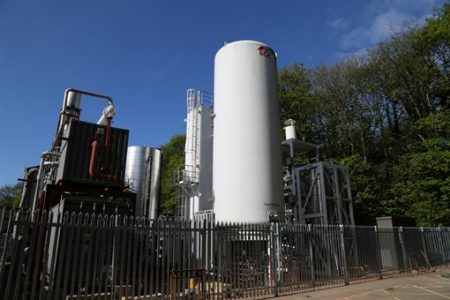
The Pilsworth Liquid Air Energy Storage (LAES) plant opens today. Developed in conjunction with The Birmingham Centre for Cryogenic Energy Storage, University of Birmingham, LAES is owned and operated by Highview Power and has a capacity of 15 Megawatts or enough electricity to serve 5,000 homes continuously for three hours. The Pilsworth facility is a pilot project. A larger plant is planned with a capacity of 50 Megawatts.
So how does LAES work?
The plant uses coolants to decrease air it takes into the system to -196 Celsius (-321 Fahrenheit) degrees. At that temperature, the air liquefies making it easy to store as a cryogenic fluid. In fluid form the air volume is dramatically decreased which makes the change of state from liquid back to air a means to exert sufficient force to drive turbines which then generate electricity.
The plant which has been built on a landfill site outside Manchester is a finalist in the United Kingdom for being the BusinessGreen Renewable Energy Project of the Year. The award is to be presented June 27, 2018.
The process is similar to that used for liquefying natural gas which involves super cooling and compressing the fossil fuel into liquid form. But instead of natural gas the fuel is ambient air. The energy sources to operate LAES can be waste heat from landfill or industrial plants, or can be off-peak period electricity generated from any power source. Regardless the energy derived is used to power conventional air conditioning absorption chillers which cool the ambient air drawn into an industrial air separation unit. For every 700 liters of ambient air, LAES creates 1 liter of liquid air which gets stored in an insulated, unpressurized tank. When heated the liquid air boils and gets converted back to 700 liters of air. The pressure exerted by this phase change from liquid to gas is used to drive a turbine connected to a generator.
The University of Birmingham is also experimenting with liquid nitrogen rather than ambient air largely because there is are existing commercial industrial sources for that gas with a transportation infrastructure to make it readily available. And because nitrogen is the most significant gas in our atmosphere (four times greater than oxygen), using it for LAES as opposed to ambient air, seems doable on a commercial operating scale.
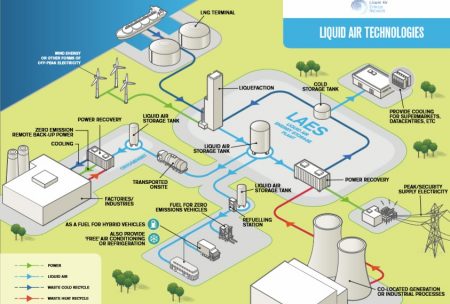
The University of Birmingham has prepared a report which can be downloaded from its site entitled “Doing Cold Smarter.” In the report, it proposes an emerging “Cold Economy.” An illustration of the various ways it believes liquid air technologies could be deployed can be seen below. It is noteworthy that the technology would produce net-zero emissions which makes it attractive in the effort to combat global climate change. To learn more watch this YouTube posted video.