March 14, 2020 – Today is Pi day because when the date is written as 3.14.2020, the first three numerals represent the value Pi the ratio of a circle’s circumference to its diameter. Take the Earth for example. The circumference at the equator is 40,075 kilometers (24,901 miles). The diameter is 12,742 kilometers (7,917.5 miles). Divide the circumference by the diameter and you get 3.14 followed by a string of numbers. My son-in-law proposed to my daughter on Pi Day because he and many other nerds celebrate this mathematical ratio reflected in the calendar. Guess what is his favourite dessert? No doubt you have figured out it is pie.
It is strange how our brains latch on to ideas that become lifetime fixations like Pi Day. And the more we study the brain, the more we realize just how marvelous an organ it is. Today when we want to study the brain using imagery we are largely limited to MRI, CT and PET scans. These technologies are complex and capital intensive.
But that may soon end if the work being done at Imperial College of London, and University College London moves beyond a current proof-of-concept to become a standard new imaging technique. The researchers at these two institutions have invented a small device that can be placed on an ambulance to provide brain scans in situ, giving neurosurgeons and emergency health teams literally “a heads up” on a traumatic injury before arriving at the hospital.
This technology uses seismic waves to create a detailed image of the brain. The device resembles a helmet and Bryan Williams, a professor and Director of the National Institute of Health Research at University College London describes the invention as “an extraordinary and novel development in brain imaging which has huge potential to provide accessible brain imaging in routine clinical practice to evaluate….head trauma, stroke and a variety of brain diseases…If this lives up to its promise it will be a major advance,” and is “a fabulous illustration of how the collaboration between engineers and clinicians, using methods from another sphere of science, can bring ground-breaking innovation into medical care.”
To what disciplines is Williams referring? Geologists and petroleum engineers use seismic data and a computational technique called Full Waveform Inversion (FWI) to map the inside of our planet. Seismic data picked up from strategically placed seismic sensors measure Earth movement. When plugged into FWI algorithms they can create three-dimensional images of the Earth’s crust, useful for oil and gas exploration, and for studying earthquakes. Now FWI is being applied to studying the brain producing high-resolution images.
The helmet is lined with an array of acoustic transducers that send sound waves through the skull and into the brain. The recording produced is analyzed using FWI to create a detailed image. With test subjects using the prototype, the researchers have been able to create detailed images of the brain that can be studied for signs of a stroke, the second most common cause of death and the most common condition associated with adult neurological disability.
The advantage of the FWI device over MRI, the latter the current gold standard for detailed imaging of the brain, is the former’s portability. The FWI helmet can work anywhere, whereas MRI requires a dedicated hospital space and a controlled environment. An MRI cannot be used on patients with metal implants whereas the FWI can.
States Parashkev Nachev, a professor at University College London, and co-author of the study describing the invention states, “This is a vivid illustration of the remarkable power of advanced computation in medicine. Combining algorithmic innovation with supercomputing could enable us to retrieve high-resolution images of the brain from safe, relatively simple, well-established physics: the transmission of soundwaves through human tissue…Neurology has been waiting for a new, universally applicable imaging modality for decades: full-waveform inversion could well be the answer.”
A paper published on March 6, 2020, in Nature’s npj Digital Medicine journal describes the device in greater detail.

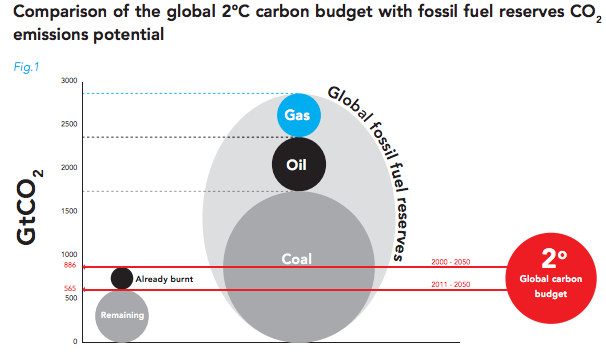
The Brits aren’t picking on the oil sands per se. Their study entitled “The geographical distribution of fossil fuels unused when limiting global warming to 2 degrees Celsius,” which was published yesterday in the journal Nature, makes the assumption that greenhouse gas emissions must be controlled so that temperatures do not exceed 2 Celsius degrees throughout the 21st century. That means the cumulative carbon emissions from the year 2011 to 2050 cannot exceed 1,10o gigatons of CO2. Where does that number come from? It is the one that The Intergovernmental Panel on Climate Change has set as the budget for further CO2 emissions to keep global warming from exceeding 2 Celsius degrees.
The authors of the study have taken an integrated assessment of oil, gas and coal reserves. They have regionally distributed production of fossil fuels to stay within the 1,100 gigaton limit. The results suggest the following distribution that should remain permanently in the ground:
Over and above these restrictions, if we were to burn all current proven fossil fuel reserves, the gigaton limit would be exceeded by more than 300 per cent. And if we added estimated reserves that number would be surpassed by 1100 per cent.
In evenly distributing the bad news the authors try to be fair. They have suggest the following regional impacts on proven reserves.
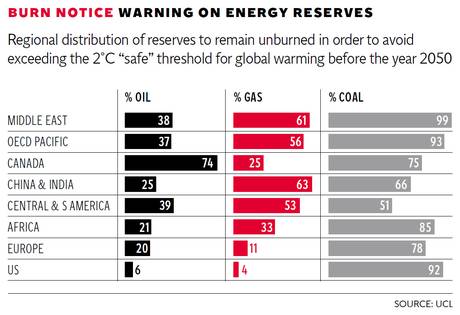
For Canada it means leaving 85% of the oil sands, 80% of the coal and 25% of natural gas proven reserves in the ground. For the oil sands that means no more than 7.5 billion barrels can be produced between 2011 and 2050. At close to 2 million barrels a day in current production that amounts to 730 million barrels per year or ten more years before the oil sands have to be shut down. And the ten year number is based on current levels of production which are far below estimates from the Canadian Association of Petroleum Producers who expect oil production to reach 3.91 million barrels per day this year and have forecast growth to 6.44 million by 2030.
The current Canadian government response to this study is one for the ages. Natural Resources Canada stated, “The majority [of the world’s energy] will come from fossil fuels, even under its most stringent greenhouse gas reduction forecast. The choice is whether to use energy from a secure, environmentally responsible, transparent country like Canada, or to seek energy from less stable countries without responsible environmental policies.”
In the study new fields are not in consideration and according to the authors shouldn’t be undertaken without offsetting fossil fuels already in proven reserves. That means forget exploring the Arctic Ocean Basin for offshore oil, and ending further exploration for sources of oil and natural gas in deep water.
Professor Christophe McGlade, one of the authors of the study comments, “Nearly all politicians across the world would like to develop all domestic sources of oil and gas and coal that they have and also search for new resources.” This suggests inconsistency in policy positioning because as McGlade further states, “Every country can’t exploit all of their domestic reserves and keep to two degrees.”
So what should governments be doing with all the current exploration, all the new fields being discovered through methods like hydraulic fracturing (fracking)? The authors suggest that governments have to determine where to take away the proven reserves from existing fossil fuel sources to meet global climate change limits. So, for example, if a new gas field is brought into production then maybe a coal mine is closed.
For the coal producer beholding to shareholders this has powerful implications. Proven reserves become unburnable assets. Should government then provide some form of compensation or should market forces prevail?
On the other hand there is a technological solution for fossil fuel companies. It is carbon capture and sequestration (CCS). But to-date only one commercial CCS project is operating in North America, the Saskatchewan Boundary Dam, an old coal-fired power plant that captures CO2 from smokestack gases and pumps the gas as liquid to old oil fields in neighboring Alberta. Of the 34 other CCS projects on the go, most are small scale or pilot studies. Fossil fuel companies have often pulled the plug on CCS projects leaving government funding partners holding the bag. So at best they appear lukewarm to the prospect of investing in large scale CCS as a way out. Yet that may be their best strategy.
As physicist Peter Eisenberger of the Lamont-Doherty Earth Observatory at Columbia University, New York, recently stated, “Any solution that doesn’t take carbon from the air is, in principle, not sustainable.” There certainly is incentive for energy producers to invest in CCS. Captured CO2 when pumped underground can up the extraction levels of old oil fields while permanently trapping the carbon. Power plants running on fossil fuels can be the producer of the captured CO2 making it a salable commodity rather than a pollutant. The fossil fuel companies gain in additional reserves can then be further offset by additional CCS projects that capture even more carbon when the fuel gets burned. For the energy companies it means those proven reserves can stay on their balance sheets and are no longer unburnable.