In the latest Navigant Research study entitled “Country Forecasts for Distributed Energy Storage,” it cites solar and wind power as the primary growth drivers for DESS indicating a twentyfold increase in usage in 26 countries by 2028. Ricardo F. Rodriguez, one of Navigant’s research analysts argues that DESS represents flexibility in energy generation infrastructure deployment and “limits the need for peak capacity resources.”
Generating continuous electricity to match demand requirements has always been the most significant detractor for the use of intermittent renewable energy resources. Particularly, in countries where the bulk of electricity is distributed over a ubiquitous grid, utility companies to ensure predictable, continuous power build to exceed peak demand requirements. Whether the power comes from thermal power plants burning coal, or natural gas, or from solar and wind farms, exceeding peak demand is an industry sacred cow. That surplus power generation, produced in off-peak periods can find a home in DESS.
You are probably thinking that DESS comes in the form of large batteries that can discharge stored energy when needed. But energy storage comes in many different forms, not just chemical batteries. For example, surplus power can pump water uphill into reservoirs where it can be released as needed or can create compressed air storage which when released can drive turbines connected to generators.
The real strength of DESS is in its ability to help energy companies transition from traditional thermal-power generation to renewables. DESS smooths out the supply of electricity from intermittent energy sources of which the sun and wind are two. And DESS can discharge power quickly unlike reserve fossil-fuel burning thermal power stations which require a considerably longer ramp-up. DESS also works best in remote areas away from a ubiquitous transmission grid where power disruptions are more frequent. In these more isolated regions, a microgrid distribution system with DESS backup can prove to be an ideal solution.
The Union of Concerned Scientists, in a 2015 publication, noted that the United States had 23 Gigawatts of storage capacity equal to 38 typical coal-fired power plants. At that time pumped hydroelectric storage represented 96% of total capacity. But growth in DESS is likely not to come from hydroelectric pumped storage but rather from alternative solutions such as large-scale chemical battery vaults like the ones seen to the right in the illustration below.

Examples of DESS in practice are growing. There is the Tesla-installed 100 Megawatt lithium-ion battery system recently installed in Hornsdale, South Australia. Billed as the world’s largest lithium-ion storage system, it is one of a number of projects slated for completion in Australia by 2021 and includes a 900-Megawatt battery from Neoen SA, a 270-Megawatt installation built by Total Eren SA, and a 140-Megawatt battery from EPS Energy.
Flow batteries are among the mix in energy storage solutions. These giant storage tanks of liquid electrolytes can provide a lower-cost solution than lithium-ion stacked battery technologies such as the system Tesla installed at Hornsdale.
More recently I have written about modular cryogenic energy storage systems such as the CRYOBattery providing power to 200,000 homes in the United Kingdom. And even funkier is kinetic storage devices like flywheels which, deployed in a farm of these devices, is currently providing 20-Megawatts of power at the Stephentown Flywheel Energy Storage Plant in New York State.
The biggest impediment to wholesale DESS deployment will be the reluctance of energy providers to adopt the technology with a pre-existing infrastructure of sunken costs into fossil-fuel-based electricity production. Mitigating climate change, however, will be the driving force for DESS growth with governments around the world seeing the value of storage associated with intermittent renewable energy as the new paradigm for power generation.
Energy storage will not come cheap. The necessity, however, to address carbon emissions, and the limitations on hydroelectric renewable power capacity with fewer sites available, are among the factors behind Navigant’s forecast of a 2,000% growth.
A reader of this blog posting, Bob Meinetz, suggested that Navigant’s forecast is, in his words, “far too conservative.” He refers to Lazard, and Deutsche Bank forecasts of anywhere from 12,000 to 20,000%, and GreenTech Media reporting an increase of more than 70,000%.
]]>Trump is backed by fossil fuel interests who see any effort to reduce carbon emissions as a threat to their existence. Hundreds of millions of dollars have been spent by the industry to influence politicians. The President is just another with his hand ready to take money from the industry and spread doubt about any scientific evidence that indicates his approach is bankrupt of reason and fact.
Enter Jair Bolsonaro, the new President of Brazil, a Trump acolyte, who has the backing of the agricultural and mining dons of his country with an eye on exploiting the Amazon rainforest. Bolsonaro, like Trump, has talked about pulling Brazil out of the Paris Climate Agreement signed in 2015. Brazil is the 11th largest carbon pollution emitter based on 2015 data. And since that date Climate Action Tracker indicates the country has seen accelerated deforestation growth of 30% which means the amount of carbon pollution is going up, not down. Now with Bolsonaro in charge and blatantly talking about exploiting the rainforest for the moneyed interests that back him, it would appear that emissions will only get worse.
With Trump and Bolsonaro at their country’s helms, the efforts to stop anthropogenic climate change are nearer to their death bed. And what is amazing is the willful behaviour of these political leaders to ignore facts that are critical to the safety and future of their citizens.
These two national leaders are not alone. In Canada, the federal government has enacted a price on carbon pollution. It is a levy that starts in 2019 at $20 CDN per ton. But provincial leaders in at least five of Canada’s ten provinces are opposed to carbon pricing. In Ontario with a newly elected populist Conservative, Doug Ford, the carbon cap-and-trade program implemented by the previous government has been quashed leaving industry holding nearly $3 billion CDN in what are now worthless carbon credits.
The Union of Concerned Scientists (UCS), a not-for-profit science advocacy group located in the United States and founded in 1997, have expressed alarm at this rising tide of anti-science political leadership, largely right-wing and populist in flavour. UCS keeps a scorecard on political and industry leaders analyzing 28 metrics that include misinformation, and lack of disclosure on physical and environmental risks based on current policies. They also keep an accountability scorecard on the fossil fuel industry and it is interesting that the misinformation given out by the industry matches well with that presented to the public by Trump. No doubt if the UCS were to turn its attention to Bolsonaro and his agribusiness and mining backers, the scorecards would be similar.
The widening gap between scientists and politicians is a major concern for the people of this planet. We are being led down a garden path by incompetent leaders who refuse to take the science seriously because they don’t like what they are hearing. They don’t like that they have to tell the public that we have to make some hard choices to a sustainable environment for our children and our children’s children. Their political instincts have them mired in winning the next vote which is all about the here and now and not the future.
In a recent article appearing in The Guardian, Jonathan Watts writes, “The global instinct for radical change is right, but unless that is geared towards ecological rebuilding the world’s democracies may go extinct before the corals do.”

Some would argue that the media and some scientists in the field have got it wrong. They propose that human factors not related to carbon release are a strong causal agent. And what are these factors?
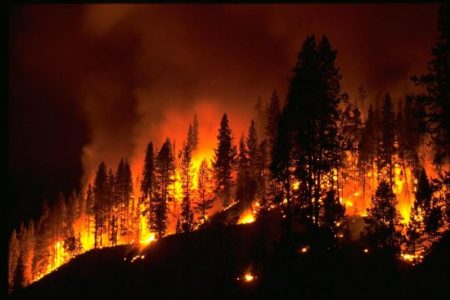
In California and British Columbia, human settlements have crept into forested areas for decades. And where humans go fire follows. Our forestry and land management practices further exacerbate the conditions out of a conservationist concern not to deal with dead and fallen trees, leaving them in situ to become fire fodder. And then there is the human use of fire which often is to blame for starting wildfires.
The Union of Concerned Scientists, however, disagree with these explanations. Based on a study published in the journal Science in August of 2006 they reference data from the United States Department of Agriculture and the Forest Service which shows increased budgets and percentage of budgets being consumed to contain and put out wildfires.
The Forest Service, in a 2015 report, blamed climate change for the lengthening of the wildfire season in the Western United States stating that since 1970 the fire season has grown by 78 days. That same report noted that the size of wildfires have increased and projected that by mid-century the amount of forestland affected by fire will more than double.
One line in the Forest Service report stood out to me after all the talk about climate change. It pointed to “increasing development in fire-prone areas” as a significant change related to wildfire frequency and costs associated with fighting them.
There is no doubt that climate change is altering precipitation and temperatures across the planet. This summer is no exception. Over the last four years we have seen the four warmest on record since we began tracking temperatures globally. The latest projections place 2018 as the fourth hottest year only surpassed by the three previous ones.
At the same time climatologists have taken note of a shifting climate boundary that roughly ran along the 100th parallel of longitude since recordkeeping began. This line which roughly bisects the country from north to south has shifted by 2 degrees amounting to a drier America moving east by 225 kilometers (140 miles). To the east is wet America. To the west is a growing, drying area of the country. I wrote about this observation back on April 16, 2018 and highly recommend you read it to appreciate how anthropogenic-influenced climate change is having a real impact.
But there are climatologists who disagree with the Union of Concerned Scientists, not absolutely, but in terms of the degree climate change plays in wildfire activity. One of the dissenting voices is climate scientist, Cliff Mass, who teaches at the University of Washington. Mass has read the California data very differently seeing no appreciable increase in the number of wildfires over the last century in that state. He argues in a recently published blog that the wildfires are for the most not climate-change related but linked directly to other human behaviours: population encroaching on wild areas within the state, and our fascination with fire.
He accuses the press and members of the government in California of providing misinformation to the public and writes “there are so many factors that must be considered.”
Here is his list:
A final comment about Mass’ conclusions. His remarks and observations are confined to California wildfire data and not incidents and frequency of wildfires elsewhere. It would be interesting to see if his conclusions hold water when data comparisons are made with British Columbia, Northern Ontario, Scandinavia, Siberia, Spain, Portugal, Greece, and other locales where this summer’s wildfires are burning fiercely.
]]>
In the last two weeks, Toronto has experienced two violent but short-lived rain and windstorms. These punctuated events are unlike anything seen in the past except when we have been on the receiving end of large cyclonic storms coming up from the Gulf of Mexico or from the northeast Atlantic Ocean. At both weather events, the rain bursts caused extensive flooding on Toronto streets while the wind felled hundreds of trees across the city. I was driving to a dinner event in the aftermath of one of the storms, and a 30-minute commute took over 2 hours because of felled trees, downed power lines, and hundreds of non-functioning traffic lights. I never did get to the dinner because the event was long past by the time I arrived at my destination. I suspect we will see more of these weather events in the years to come as the atmosphere warms and becomes more turbulent in the mid-latitudes of our planet.
Speaking of the latest environmental insult, Donald Trump this week signed an executive order revoking an Obama-era directive aimed at protecting the oceans off America’s coasts, the coastlines, and the waters of the Great Lakes. Being National Ocean Month the President asked the nation to “reflect on the value and importance of oceans” and then immediately focused on extracting its resources whether oil and natural gas, fish, and anything else he could think of that could be removed from this invaluable resource.
For Trump, National Ocean Month is a time to strengthen federal waters for national security, to lay claim to an exclusive economic zone larger than the land mass of the United States, and to reduce America’s dependence on imported energy. No mention of conservation. No mention of environmental stewardship. No mention of biodiversity. No mention of plastic pollution. And of course no mention of climate change and rising sea levels. It seems appropriate that he chose this tone and renunciation of Obama-era conservation initiatives since it was only a year ago during a previous National Ocean Month that the President announced America was pulling out of the Paris Climate Agreement. This ongoing disregard for reality fits with the President’s own litany of denial and lies about almost everything.
As Trump ignores the reality of what is happening to the oceans off his shores, a new federal government report issued by the National Oceanic and Atmospheric Administration (NOAA), a subset of his Department of Commerce, states that coastal areas of the United States are under siege from an increase in flooding events by as much as 60% over the last 20 years. Cities on the Atlantic and Gulf of Mexico coasts are the ones most affected including these top five: Boston, Atlantic City, Sandy Hook, Sabine Pass, and Galveston.
The same report notes that flooding events associated with high tides set new records in 2017. And rising sea levels along America’s coasts with or without strong storm or hurricane activity are leading to compromised coastal infrastructure including shoreline erosion, washed away roads, extensive property damage, and saltwater intrusion into freshwater aquifers.
The report further states that in 2017 more than 25% of the U.S. coastal areas recorded record-breaking high tide flood days. In fact, because the level of flooding has become so frequent, NOAA has set a new higher elevation threshold for future flood reporting. This change in reporting will probably suit the anti-climate President who, if he should read one in the future, can then claim that there are fewer flooding event days than in the past which means climate change is hogwash.
Of course, changing how flood days get measured and reported doesn’t speak to a growing economic reality. In the latest study from the Union of Concerned Scientists, it reports that 2.4 million American homes and businesses worth more than $1 trillion are at risk from flooding as the century progresses, amounting to 15% of all coastal real estate in the country. A link to the report entitled “Underwater,” is provided.
You would think that a President, who in his business life has been a property developer, should be concerned about his own personal real estate holdings along America’s coastlines as well as properties overseas. But in his acknowledgment of National Ocean Month, Trump appears to be in denial of the reality of changes his own administration is reporting as the climate changes.

]]>
How dry? Swain notes that coastal humidity is down to 1 to 2%. That’s drier than California’s interior deserts in the summertime. Imagine, drier than Death Valley? Just when Southern California had finally seen the end of a more than 10-year megadrought, it experienced heavy winter rains in late 2016 and early 2017. That encouraged new growth. But then summer and fall came along with record heat and dryness.
At the World Series played in the Dodger’s home park of Chavez Ravine, temperatures were in the mid-to-high 30s Celsius (in the mid to high 90s Fahrenheit), and that was at game time in the late afternoon and early evening. The heat baked the life out of all that new growth which when combined with the Santa Ana winds created ideal tinder conditions for wildfires. They are burning with ferocious intensity fed by Santa Ana wind gusts that at times approach hurricane strength. Fires are raging from the northern suburbs of Los Angeles to the city of San Diego. Containment without nature assisting with rain is next to impossible. So they may only run out of combustible material when they finally reach the Pacific coastline.
The Union of Concerned Scientists has chimed in on what is happening in California and in many other parts of the U.S. West where wildfires are increasing in frequency and duration since the mid-1980s. How much is the increase in wildfire outbreaks? They are happening four times more, are lasting five times longer, and burning six times more land area.
The scientists note that although human land use and behaviour can influence wildfire outbreaks, many affected areas are places where there isn’t much human activity going on. For example Yosemite National Park. As a result, the scientists are correlating the increase in frequency, duration, and extent is being linked to global warming. A warmer world will see fluctuations in precipitation to create the kind of extremes Southern California has experienced. Already drier than most areas of the United States, the conditions for severe wildfire outbreaks are ripe.
But of more concern are the forested areas of much of the western United States where the scientists’ climate models indicate wildfire seasons will grow from the current seven months of the year to become year round. Why are forests seen as more at risk? Because they have the fuel to burn, whereas, dried out grasslands, a common sight in much of the U.S. Southwest, provide little in the way of wildfire fodder and are generally good fire breaks.
In Southern California, the tragedy lies in the urban-forest interface with millions of homes built adjacent to dry forest and scrubland found in the canyons and valleys of the state. Whether from San Francisco Bay and Napa Valley in Northern California to San Diego, forests abutt homes and communities with barely a fire break between them.
To make matters worse, as the fires destroy forested areas, the barren hills become a potential threat of a different kind when it rains. With the soils so dry from low humidity conditions, and with the loss of vegetation including root systems to hold the soil in place, absorbing any rainfall is next to impossible. The result, flash floods, and mudslides.
The scientists believe that warming for the moment is unstoppable because of increasing carbon dioxide and other greenhouse gases we humans are pumping into the atmosphere. But they do believe, however, that through mitigation efforts, Californians can be spared in the future the unspeakable tragedies that are happening today.
What is needed is buffer zones between forests and homes. That means zoning laws in California cities have to consider wildfire risk and plan accordingly. And when these current wildfires finally stop their destructive drive to the ocean, people have to consider the risk of rebuilding where susceptibility is greatest.

