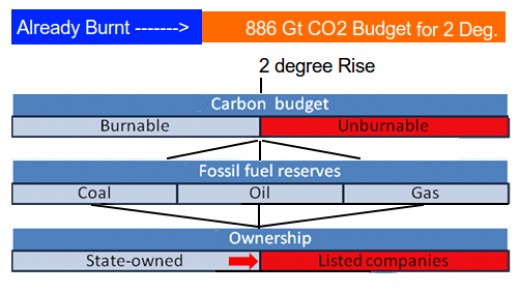
The Brits aren’t picking on the oil sands per se. Their study entitled “The geographical distribution of fossil fuels unused when limiting global warming to 2 degrees Celsius,” which was published yesterday in the journal Nature, makes the assumption that greenhouse gas emissions must be controlled so that temperatures do not exceed 2 Celsius degrees throughout the 21st century. That means the cumulative carbon emissions from the year 2011 to 2050 cannot exceed 1,10o gigatons of CO2. Where does that number come from? It is the one that The Intergovernmental Panel on Climate Change has set as the budget for further CO2 emissions to keep global warming from exceeding 2 Celsius degrees.
The authors of the study have taken an integrated assessment of oil, gas and coal reserves. They have regionally distributed production of fossil fuels to stay within the 1,100 gigaton limit. The results suggest the following distribution that should remain permanently in the ground:
Over and above these restrictions, if we were to burn all current proven fossil fuel reserves, the gigaton limit would be exceeded by more than 300 per cent. And if we added estimated reserves that number would be surpassed by 1100 per cent.

In evenly distributing the bad news the authors try to be fair. They have suggest the following regional impacts on proven reserves.

For Canada it means leaving 85% of the oil sands, 80% of the coal and 25% of natural gas proven reserves in the ground. For the oil sands that means no more than 7.5 billion barrels can be produced between 2011 and 2050. At close to 2 million barrels a day in current production that amounts to 730 million barrels per year or ten more years before the oil sands have to be shut down. And the ten year number is based on current levels of production which are far below estimates from the Canadian Association of Petroleum Producers who expect oil production to reach 3.91 million barrels per day this year and have forecast growth to 6.44 million by 2030.
The current Canadian government response to this study is one for the ages. Natural Resources Canada stated, “The majority [of the world’s energy] will come from fossil fuels, even under its most stringent greenhouse gas reduction forecast. The choice is whether to use energy from a secure, environmentally responsible, transparent country like Canada, or to seek energy from less stable countries without responsible environmental policies.”
In the study new fields are not in consideration and according to the authors shouldn’t be undertaken without offsetting fossil fuels already in proven reserves. That means forget exploring the Arctic Ocean Basin for offshore oil, and ending further exploration for sources of oil and natural gas in deep water.
Professor Christophe McGlade, one of the authors of the study comments, “Nearly all politicians across the world would like to develop all domestic sources of oil and gas and coal that they have and also search for new resources.” This suggests inconsistency in policy positioning because as McGlade further states, “Every country can’t exploit all of their domestic reserves and keep to two degrees.”
So what should governments be doing with all the current exploration, all the new fields being discovered through methods like hydraulic fracturing (fracking)? The authors suggest that governments have to determine where to take away the proven reserves from existing fossil fuel sources to meet global climate change limits. So, for example, if a new gas field is brought into production then maybe a coal mine is closed.
For the coal producer beholding to shareholders this has powerful implications. Proven reserves become unburnable assets. Should government then provide some form of compensation or should market forces prevail?
On the other hand there is a technological solution for fossil fuel companies. It is carbon capture and sequestration (CCS). But to-date only one commercial CCS project is operating in North America, the Saskatchewan Boundary Dam, an old coal-fired power plant that captures CO2 from smokestack gases and pumps the gas as liquid to old oil fields in neighboring Alberta. Of the 34 other CCS projects on the go, most are small scale or pilot studies. Fossil fuel companies have often pulled the plug on CCS projects leaving government funding partners holding the bag. So at best they appear lukewarm to the prospect of investing in large scale CCS as a way out. Yet that may be their best strategy.
As physicist Peter Eisenberger of the Lamont-Doherty Earth Observatory at Columbia University, New York, recently stated, “Any solution that doesn’t take carbon from the air is, in principle, not sustainable.” There certainly is incentive for energy producers to invest in CCS. Captured CO2 when pumped underground can up the extraction levels of old oil fields while permanently trapping the carbon. Power plants running on fossil fuels can be the producer of the captured CO2 making it a salable commodity rather than a pollutant. The fossil fuel companies gain in additional reserves can then be further offset by additional CCS projects that capture even more carbon when the fuel gets burned. For the energy companies it means those proven reserves can stay on their balance sheets and are no longer unburnable.

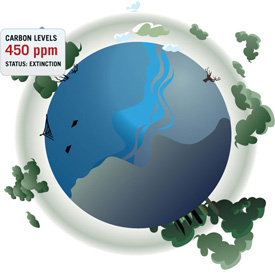
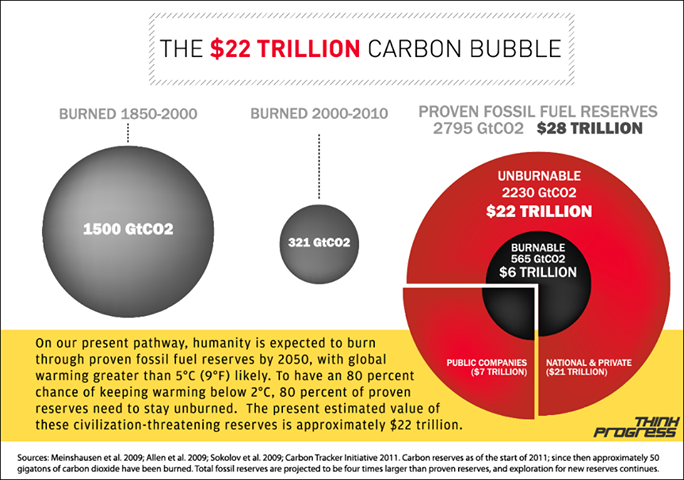
The magic number scientists believe we cannot cross is 450 parts per million (ppm) of CO2. That’s about a 50% increase in the amount of that greenhouse gas since 1950. Currently we are 400 ppm and inching upwards. The questioning by major shareholders and investors followed a 2011 report by Carbon Tracker, a not-for-profit based in the United Kingdom. Entitled “Unburnable Carbon – Are the world’s financial markets carrying a carbon bubble?” this document spelled out the amount of carbon we could continue to put into the atmosphere to remain under the 450 ppm CO2 level. At the time of the report, based on the amount that fossil fuel companies could still pump or mine it was determined that only 20% of existing reserves could be burned. Hence the term stranded assets was born.

In 2013 a second report, “Unburnable Carbon 2013: Wasted capital and stranded assets,” published by the same not-for-profit indicated that a carbon bubble was in the offing with $6 trillion US the number. This was the amount on the books of coal, gas and oil companies that could never be extracted and burned.
Since then stranded assets has moved to the forefront with a number of universities doing research papers and workshops on the subject. In May Carbon Tracker issued its third report, “Carbon Supply Cost Curves: Evaluating Financial Risk to Oil Capital Expenditures.” It looked a new capital expenditures on exploration, in particular, deep water oil, Arctic Ocean oil, and oil sands. These are areas of exploration where companies are expected to invest up to $13 trillion U.S. through 2050. The companies with greatest exposure include Petrobras, ExxonMobil, Rosneft and Royal Dutch Shell.
According to Carbon Tracker, in a world committed to action to not let CO2 atmospheric levels exceed 450 ppm, the industry would be facing a carbon bubble exceeding $28 trillion ($19.3 trillion for oil, $4 trillion for gas, $4.9 trillion for coal). The calculation is based on a floor price of $95 per barrel for oil and rising over the next several decades.
China, which has been gungho on coal-fired power plants, is not immune to the same issue. The latest report from Carbon Tracker, “The Great Coal Cap – China’s energy policies and the financial implications for thermal coal,” looks at stranded assets in coal-fired capacity. The U.S. Environmental Protection Agency (EPA) has also focused on coal in its latest regulatory policy focused on reducing emissions by 30% from 2005 levels by 2030. For China, so heavily invested in coal, it means stranded assets worth trillions. Energy utilities with an inventory of coal-fired power plants, and coal mining companies in the U.S. are equally at risk with stranded assets of greater value than those in China.
Carbon reduction policies are on a collision course with the financial reporting of fossil fuel and energy companies. That $28 trillion bubble, should it burst, will wipe out a large percentage of investors’ savings. And yet there has always been a way out for the fossil fuel and energy industry – diversification through investment in renewable energy including solar, storage, wind, tidal, wave and geothermal. Many of the fossil fuel giants have dabbled in the world of renewables but not to a point where they reduce their exploration budgets for carbon-based energy. Others in the fossil fuel community pay lip service to diversifying their mix of energy resources. BP is a great example having sold off its renewable energy investments.
Meanwhile, world leaders are being pressed by the overwhelming scientific evidence, and a growing majority of the public, to get serious about CO2, and when they do by bringing in hard targets, carbon trading and carbon taxes, what will ExxonMobil and Royal Dutch Shell do? According to their letters and disclosures to shareholders, it will be business as usual.

The CRVT blueprint contains 5 built-in scenarios that can be adjusted to reflect specific energy company data. These 5 cover potential futures that include:
The CRVT defines unburnable carbon assets as “stranded.” These are assets that need to be devalued or converted to liabilities. The tool allows the investor to build an income and cash flow for a company and then apply discounted cash flows from the write down of stranded assets.
The above scenarios are based on governments heeding scientists about climate change and applying decarbonization policies. The assumption under such terms is that oil prices will fall as demand decreases. This would impact top-line revenue and bottom-line earnings. At the same time the costs of extraction will remain the same. At some point the cost of extraction would exceed the selling price leading to the end of production.
CRVT also looks at how energy companies expend their capital and determines when it becomes a waste of money because exploring for new finds no longer makes economic sense.
The CRVT also looks at how climate change regulation would impact the price of carbon emissions and how that would negatively impact corporate earnings.
And finally it looks at harder to reach carbon assets like the oil sands and how such carbon-intensive extraction technologies could further impact costs and net earnings after applying regulatory penalties.
The CRVT published study looks at the biggest market cap energy companies and then applies its various scenarios to them. These include:
Not surprisingly last-ditch decarbonization has the least impact on the energy companies while the $50 oil price per barrel beginning in 2020 yields to the worst results with shares declining by 58%.
The authors of the CRVT admit to some limitations in their model. For example they use average pricing for determining the cost of extraction which penalizes companies that may have multiple extractive processes in operation, some less expensive and some more. In such cases the company could stop producing at fields that were no longer cost viable. The model also doesn’t consider other avenues that an energy company might explore because of changing regulation around extracting and emitting carbon.

In the letter it states, “we would like to understand BP’s reserve exposure to the risks associated with current and probable future policies for reducing GHG emissions by 80% by 2050 to achieve the 2 degrees Celsius goal, and the risks to its operations as well as the economy as a whole of increasing extreme weather associated with the world’s current path to a warming of 3.6 degrees Celsius or more. We would also like to understand what options there are for BP to manage these risks by, for example, reducing the carbon intensity of its assets, divesting its most carbon-intensive assets, diversifying its business by investing in lower-carbon energy sources, or returning capital to shareholders.”
In addition the letter states, “Under a carbon-constrained scenario….40 to 60% of their market value could be lost because a portion of their proven reserves would become stranded assets.” It further questions the “creditworthiness of oil and gas companies, particularly those that have large exposure to high cost unconventional oil and production such as oil sands.”
The letter goes on to ask BP to review and disclose its risk assessment plans pointing out that BP’s “business-as-usual scenario such as that used in….current reporting” appears to be seriously flawed. The signators asked that this re-assessment evaluate “potential GHG emissions associated with the production of all unproduced reserves.”
This is an unprecedented request by investors who are asking not just BP but 44 other fossil fuel energy companies to come clean about their futures in light of the latest IPCC report on climate change. It’s no wonder that companies like Exxon fund disinformation campaigns like the one recently launched by the Heartland Institute in anticipation of the release of the IPCC interim report.
What these 70 investors are stating for the first time is that fossil fuel companies need to come clean about climate change and how they intend to address it. These investors are questioning the value of “unburnable” carbon reserves currently considered assets on fossil fuel company books. If these fossil fuel assets are unburnable then all the fossil fuel companies need to adjust their books to reflect real value, or they must diversify into non-carbon energy technologies or other businesses to retain the confidence of the shareholders these investors represent. But BP has been demonstrating the exact opposite strategy in some of their most recent moves.
For example, in 2011 BP divested itself of its solar business stating “the continuing global economic challenges have significantly impacted the solar industry, making it difficult to sustain long-term returns for the company.” In 2012 the company got out of the wind power business stating the move as “a continuing effort to become a more focused oil and gas company and re-position the company for sustainable growth into the future.” I wonder if the writers of the letter of September 9 saw these BP executive statements before composing their missive to the company and other fossil fuel giants?
]]>
In an article published in Forbes last December, entitled Fossil Fuel Divestment Is A Timely Issue For Investors, the author talks about a climate cliff, a point in time when our continuous harvesting and burning of carbon-based fuels tips us into a new age of economic and social disruption caused by wonky weather, rising sea levels and biological extinction for many species on the planet.
From purely an investment point of view, therefore, it would seem that oil companies represent a bad long-term investment. Yet today they provide some of the best return on investment for stockholders. I’m one of those stockholders and I find myself in a quandary. My investment advisors who have created my balanced portfolio have populated it with a mix of energy producers. But for how much longer? And should I be insisting that my wife and I revise our portfolio to divest ourselves of fossil fuel energy producers?
Every time an oil company drills a new fracking well or discovers a new gas or oil deposit in the deep sea they revise their proven and estimated reserves. And those numbers affect share prices. But here is the conundrum. Finding more oil and gas may prove meaningless in light of rising CO2 levels in the atmosphere. The oil and gas discoveries may prove, in light of global warming, to have no value whatsoever because we will never be able to use them. Leaving them in the ground may be our sole strategy for minimizing the disruption that will come from rising atmospheric temperatures.
If you want to get a better understanding of the problem read Unburnable Carbon 2013: Wasted capital and stranded assets, a report from the Grantham Research Institute at the London School of Economics and Political Science. It concludes:
This year I reported that CO2 levels had reached a milestone 400 ppm in readings from Mauna Loa, the volcano on the main island of Hawaii. That represents a 25% rise in CO2 since 1955. More frightening is the fact that CO2 level increases are accelerating with much of the increase happening in the last two decades, correlating to an overall rise in atmospheric and ocean surface temperatures that seem to be keeping pace. And CO2 isn’t the only greenhouse gas on the rise. Methane, an even more potent gas, is being released at fracking wellheads, and through polar permafrost melts in the high Arctic.
The Grantham report paints a very good picture for investors in fossil fuels. If we limit what we burn so that we keep global temperatures from rising beyond the 1.5 to 2 Celsius (2.7 to 3.8 Fahrenheit) degrees then we cannot burn a good portion of what exists in reserves today.
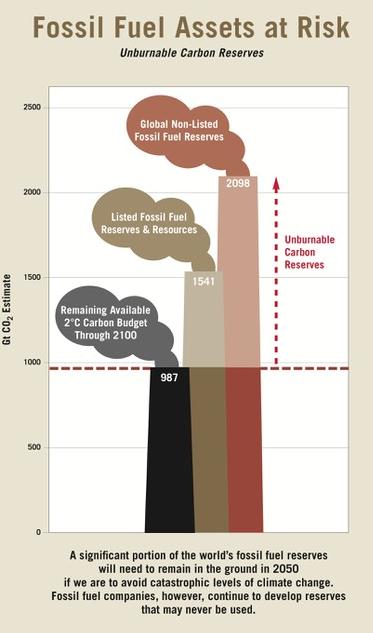
Total proven reserves today if burnt equal 2,860 Gigatons of CO2. Burn all of this and scientists tell us that we will raise the average temperature of the atmosphere by over 3 Celsius (5.4 Fahrenheit) degrees. At the poles where we are seeing temperatures rising by 5 or more Celsius (9 Fahrenheit) today when average atmospheric temperatures have only increased by less than 1 degree Celsius (1.8 Fahrenheit), we could see increases in the double digits. That means the end of permanent polar sea ice and increasing sea levels.
So let’s say we only burn half the current reserves and leave the rest in the ground. Maybe then we can keep global temperatures within the 2 Celsius (3.8 Fahrenheit) target limit. So what then is the real value of all this drilling and finding of new oil and gas when so much of what has been discovered can never be burned? And I do mean never. We cannot afford to put any of this CO2 into the atmosphere after 2050 because the gas already in the atmosphere will linger for as much as several millennia unless we discover new CCS technologies that really make a difference in sucking the stuff out of the atmosphere at a faster rate than natural processes.
One thing is very clear.
Oil, gas and coal companies are clearly overvalued, that is, if we are serious about tackling CO2 and climate change. Otherwise the continued positive performance in share price of these energy providers speaks to a total lack of understanding by the companies, our governments, and us, about what we face.
In an article appearing in the July-August issue of Report on Business Magazine, Eric Reguly states “the more serious threat to oil or coal investors is an environmental Pearl Harbor — a global warming catastrophe so damaging that carbon output would have to be slashed in a hurry.” Call it Pearl Harbor or Armageddon, it appears that without global action we are headed in that direction.
But many of the energy providers are very cognizant of the shifting sands of their perceived value if not the moral and survival issue of tackling CO2 emissions. These companies are investing in clean energy enterprises. For example, in today’s Globe and Mail newspaper, an article appears about TransCanada, the developer of Keystone XL, (that as yet built oil sands pipeline venture), taking possession of the first of nine Ontario-based solar power facilities. These nine will generate 86 Megawatts once online, enough energy to power 17,000 homes. This is part of TransCanada’s carbon-free portfolio, a hedge maybe against its existing carbon assets. Maybe TransCanada knows something about the latter’s real net worth. I wonder how many other oil companies are hedging their bets as well, or will they, along with the investment community suddenly have a rude awakening?
When my wife and I next meet with our investment advisers later in the summer I have a question for them. What will be their and our divestment strategy related to energy companies? What is yours after you have read this posting?
]]>


