The Mainz researchers in studying paleoclimates came across two climate change events. The first was the Paleocene-Eocene Thermal Maximum (PETM) which occurred 55.9 million years ago when global average temperatures rose 5 to 8 Celsius (9 to 14 Fahrenheit).
They describe what occurred in findings recently published in the journal Nature Geoscience. The paper describes the significant environmental changes that occurred during the PETM including rapid atmospheric warming, ocean acidification, and changes in the water cycle leading to a mass extinction event in the deep ocean, and major changes to ocean surface biology.
PETM had a rapid onset phase coinciding with significant increases in volcanic activity and persisting for 200,000 years. The volume of greenhouse gasses (GHGs) entering the atmosphere included massive amounts of carbon dioxide (CO2). PETM was followed by failry rapid climate cooling.
The mechanism for this restoration to cooler times is linked to evidence the Mainz researchers found in silicate rocks which at the time showed high levels of chemical weathering occurring during and after volcanic activity. The weathering appears to have been facilitated by acid rain.
Why was the rain acidic? Because it contained high levels of CO2. Meanwhile, the warmer conditions establsihed by the high levels of CO2 in the atmosphere caused precipitation amounts to exceed the norm which then accelerated the weathering. Leached minerals containing lithium, calcium, magnesium and more combining with carbonic acid rain entered the oceans to form insoluble limestone. The CO2 was permanently sequestered in the rock. The cooling followed. Philip Pogge von Strandman, a professor at Johannes Gutenberg University Mainz calls the PETM event a lesson to learn about natural climate control mechanisms.
The Mainz researchers compared the PETM event to a similar period of heightened volcanic activity that occurred 15 million years later. It also led to another spike in atmospheric CO2 and a period of global warming. Called the Middle Eocene Climatic Optimum (MECO), it lasted twice as long as the PETM event. The cooling also took much longer.
The Mainz University researchers wanted to know why these two climate events differed. They were able to pin the differences on changing natural conditions in the 15 million years between the two events. At the time of MECO, the fossil record shows extensive rainforests covering most land surfaces. More vegetation meant increased soil. That meant less weathering of rock surfaces, and where chemical weathering occurred, the soils absorbed the leached minerals. The evidence during MECO is heavy clays throughout the fossil record. With fewer minerals ending up in the ocean, less limestone was created. The CO2 contained in the acid rain instead contributed to ocean acidification with some of the gas returning to the atmosphere through evaporation. That’s why after MECO global atmospheric temperatures stayed warmer longer.
The differences between the two climate events led Pogge von Strandman and his fellow researchers to suggest a potential way to deal with our present elevated levels of atmospheric CO2. They could recreate the weathering observed during the PETM event by plowing finely crushed rock into fields. If the crushed rock dissolved over time then it would mimick what happened during the PETM event. But if the minerals in the rocks got trapped in the soils, then the results would be similar to the MECO event.
Mainz University isn’t the only place where crushed rock being added to soil was being studied to remove CO2 from the atmosphere. As I researched background to this posting I came acrosss a University of California Davis and Cornell University study that appeared recently in the journal Environmental Research Communications. The researchers there were field testing adding crushed silicate rocks to soil to see if it would remove CO2 from the air. In their experiments carried out over three months during a period of extreme drought in California, they showed a 2.6 to 2.9-fold increase in bicarbonate creation within the soil, suggesting enhanced weathering even in low-moisture environments removed CO2 from the air. No deluge of acid rain was needed to create these results.
So maybe, we can learn from paleoclimate events how to deal with our present climate change crisis. Just how much rock will be needed to drawdown a megaton or gigaton of CO2? It would be interesting to do the math.
]]>Climate change, when added to the population equation, puts us on pretty shaky ground related to food security. As we approach mid-century the food demands of the planet will become even more problematic.
At UC Davis, plant geneticist Pamela Ronald is researching new varieties of rice. It is hoped through genetic modification, rice, and other crops can handle all that our changing climate will deliver: droughts, monsoonal rains, more extremes of heat and cold, sea level rise, invasive species threats, and more.
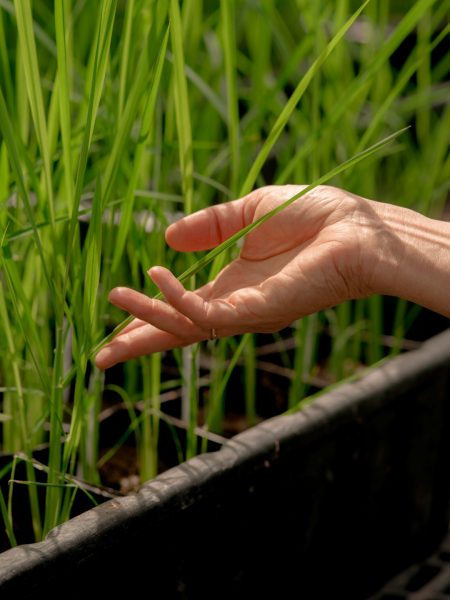
Ronald has been working on genetically modified rice for several decades. She chose rice because it is the food staple most commonly consumed by more than half of the planet.
Today, one of her discoveries, rice containing a Sub1 gene, is grown by 5 million farmers on more than 2 million hectares (over 4.9 million acres). Sub1 GM rice is resistant to prolonged flooding. Its planting has restored the viability of farms that were experiencing rice losses amounting to 4 million tons annually prior to its invention. Today, with the help of the Bill andMelinda Gates Foundation, the Sub1 gene has been added to 10 Asian rice varieties which are being distributed to farmers in India, Bangladesh, Indonesia, Nepal and other South-Asian countries.
But flooding’s opposite, extreme drought, is seen as a much greater problem with climate scientists predicting a doubling of such events in South Asia and Sub-Saharan Africa by the end of the century. Based on climate models scientists forecast that higher carbon levels in the atmosphere by mid-century will reduce rice yields by 15% globally. That will put upward pressure on the price of this important food staple.
Studies of the socioeconomic consequences of food security are not the normal area of study for climate scientists. But for those studying food security, the impacts of climate change are very much apropos. A 2015 paper entitled, “Climate change impacts on agriculture in 2050 under a range of plausible socioeconomic and emissions scenarios,” appearing in IOP Science, analyzes the global and regional impacts of climate change on agricultural yields, looking at consumption and pricing. The authors conclude that climate change and high-carbon emission sensitivity will yield price shocks exacerbated by average yield drops globally of 6.9% by 2050. This will happen despite increased total hectares under cultivation and global trade in staple crops. Distribution of this phenomenon will be uneven globally impacting those regions currently most vulnerable to food shortages.
Ronald recognizes that manipulating genes has become a political football and a counter-narrative to the food challenges humanity is facing as the century unfolds. She states, “this focus on genes in our food is a distraction from the really, really important issues.” Drought-tolerant GM rice could be the difference between starvation or a sustainable diet for hundreds of millions of people in Sub-Saharan Africa and South Asia. Trying to develop drought-resistant rice by more traditional means would likely take far too long using conventional selective breeding, and may fail to produce the desired outcome even after multiple generations of experimentation.
We have the tools to meet the challenge. The distractions that keep on getting in the way have to disappear so that humanity by 2050 and beyond will be able to continue to feed itself in a sustainable way.