
Called LaWS, short for Laser Weapon System, it fires a directed energy beam at a target. The operator sits behind a video-game console and can choose a degree of intensity from disable the target to destroy it.
The U.S. Navy has been testing LaWS for three years. It has been used to disable everything from small boats to destroyer-sized ships. It has even downed unmanned test aircraft. If the summer sea trial works then the U.S. will deploy LaWS on a variety of ships in its fleet including guided-missile destroyers and the Littoral Combat Ship, the navy’s newest stealth technology.
LaWS looks like a telescope. It uses fiber solid state lasers and is directed by an operator who coordinates targets using radar tracking systems.

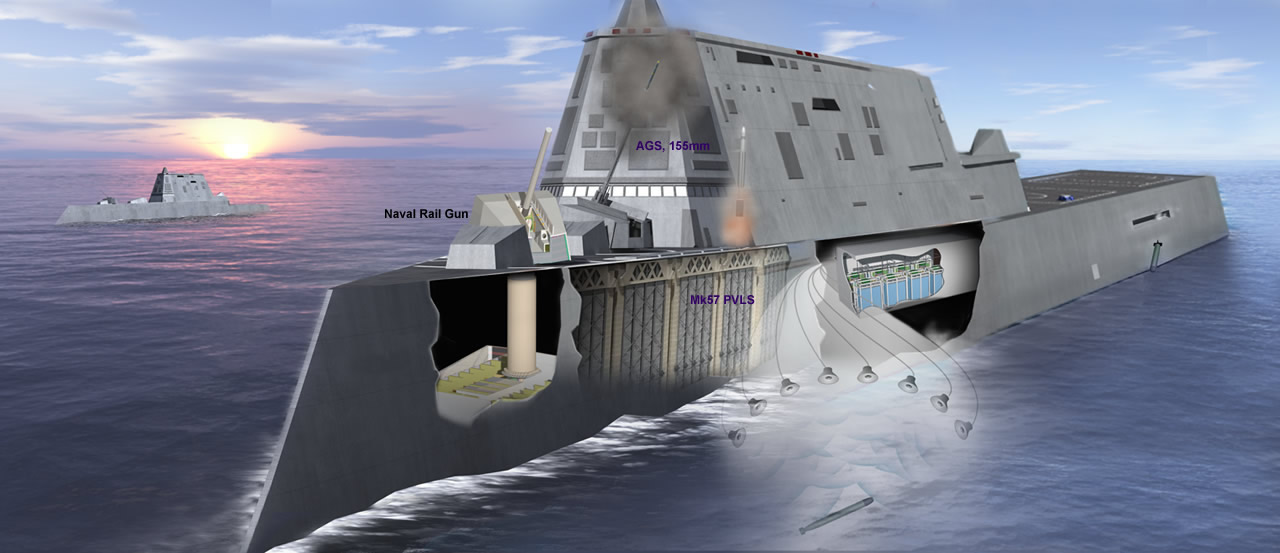
A railgun consists of a three-part structure, a power source, a pair of parallel rails and a projectile platform on which is housed anything from an artillery shell to a rocket. A high-powered million-amp electric current runs from the positive rail across the projectile platform to the negative rail and then back to the power source. In the case of the navy, that power comes from the ships engines. The two rails act like wires and the current running through them creates two magnetic fields one running counterclockwise around the positive rail and the other clockwise around the negative rail. The combination of the two magnetic fields creates the energy to drive the platform along the rails. Depending on the rail length and the amount of power a projectile can be launched at speeds of Mach 5 or more. That’s over 6,000 kilometers (3,730 miles) per hour. Extend the length of the rail gun and increase the amperage and you have a gun that can put a satellite in orbit.

When air power ended the age of battleships no one envisioned their revival, but railgun technology represents a new level of lethality for naval ships to use against threats from the air, land or ocean, a new era for a new kind of battleship. And compared to other projectile weapon systems such as missiles, it turns out that railguns are far less expensive to operate. So I expect that the United States will in building ships with EM guns begin a process we have seen before in history.
At the beginning of the 20th century the British brought out a revolutionary, heavily armored battleship, HMS Dreadnought. It made all previous warships obsolete and led to a global arms race that inevitably contributed to the eruption of the First World War.
Could we consider using railguns for another purpose or is it inevitable that we always begin by exploiting the science to build a weapon? Can Lorentz Force power transportation? Imagine trains and suborbital commercial transportation using this type of technology. It seems almost certain that this is a path worth exploring.
Can what Lorentz discovered help us to develop other types of magnetic force technologies such as shields to protect humans from cosmic rays in space habitats? If so then maybe this military invention will spawn a range of peaceful applications.
The American Navy Plans to Stop Using Dolphins and Sea Lions in War
I’m sure that the U.S. isn’t the only country that exploits dolphins and other marine mammals in its military operations. But in December of 2012 the U.S. Navy announced it would phase out dolphins by 2017 in its search for undersea mines, very dangerous work, and would instead replace them with robots like the Nekton Research Transphibian prototype pictured in the image below.
 The navy started employing dolphins in 1960 as part of its marine mammal program. The fact that dolphins are self-aware, sentient creatures that have powerful echolocation sensory skills and can be trained by human handlers to expose themselves to the danger of mine explosions has had no bearing on the decision making. According to the navy it’s a cost thing. The robots that will replace them can do the job from a longer distance and can work 24×7 unattended. The dolphins aren’t the only ones losing their jobs to robots. So are sea lions who will join the unemployment line. I am sure both marine mammals will be happy to be relieved of duty.
Pee May be the Latest Power Source for Battlefield Fuel Cell Technology
SiGNa Chemistry makes mini fuel cells for charging smartphones. The U.S. military likes the technology so much that it has launched a pilot project to test the fuel cell in battlefield conditions. Called the PowerTrekk, the device, seen below with a smartphone attached, is a mobile hydrogen fuel cell containing dry-powdered sodium silicide. Combined with any water source including pee it turns into a fuel-cell power source that can be used to recharge a smartphone, MP3 player, GPS, LED lighting, camera, battery of sensors, you name it.
The PowerTrekk provides consistent power output and, unlike batteries, zero power degradation. The sodium silicide is non-inflammable, stable in ambient temperatures, and works with any water source including salt water and, of course, urine in the absence of other sources of moisture. For soldiers in the field it means a weight saving of 12 kilograms (25 pounds) in field gear.

Can a Cure for Type 1 Diabetes in Dogs Eventually Lead to a Human Cure?
A single session of gene therapy has cured type 1 diabetes in dogs. The research, done at the Univesitat Autonoma de Barcelona, reported this month in the journal, Diabetes, a publication of the American Diabetes Association, describes the protocol used to introduce gene therapy vectors, one focused on the insulin gene and the other on the glucokinase genes. We all know the role insulin plays. Glucokinase is less well known and serves to regulate enzymes responsible for removing glucose from the bloodstream.In combination the two genes act as a glucose sensor and reduce excess blood sugar.
The dogs were treated with a single administration of gene therapy and exhibited no episodes of hypoglycemia, even after exercise, showing improved body weight with no secondary complications four years after treatment. The research team and some of their very happy subjects appear in the picture below.

Scientists Create Solar Sponge to Capture CO2
To sequester carbon from the atmosphere you need an efficient way to capture it. A new smart material called metal organic framework or MOF is the invention of scientists at CSIRO, an Australian scientific research institute. MOF acts like a sponge soaking up and storing gases. The process is called dynamic photo-switching.
MOF has the ability to capture a liter of nitrogen gas per gram of material. That’s because every gram contains a surface area equivalent in size to a football field. When exposed to UV light the azobenzine molecules in the MOF release as much as 64% of the captured gas.
MOF is a flexible material so you can put it almost anywhere where you need to soak up polluting gases. It should prove to be an effective way to capture CO2 and with the right carbon storage technology fit into a sequestration strategy quite well.

Geoengineering Idea Promoted as Cheap and Easy Way to Solve Global Warming
The plan is simple. Get a bunch of business jets outfitted with equipment to disperse fine powdered sulfur into the atmosphere at an elevation of 20 kilometers. The sulfur would combine with water vapour to form a fine dilute sulfuric acid aerosol. The aerosol would spread through the stratosphere acting as a sunlight blocker to reduce the total amount of solar radiation falling on the surface by 1%. Scientists believe a decrease of 1% in solar radiation would be enough to offset the warming caused by greenhouse gases.
David Keith, who teaches at Harvard University, is the scientist who has proposed this geoengineering experiment. He notes that even if we halt spewing CO2 into the atmosphere entirely, the current levels of the gas approaching 400 parts per million would continue to warm our atmosphere for 1,000 years. But if we were to pump fine sulfuric acid particles into the atmosphere for an indefinite period of time we could reduce the impact somewhat. Just a few grams of sulfur could offset warming from a ton of CO2.
He is not the first nor the last to propose seeding the atmosphere to reduce sunlight striking the Earth’s surface. And it seems more and more scientists are considering experiments such as this.

Postscript
Today I placed a deposit on a new place for us to live. This means in the next three months my family and I will move to a smaller abode and a smaller carbon footprint. We will leave our house on the city edge to move downtown where we will continue our lives in an apartment. Soon one of our two cars will no longer be needed because we will be close to rapid transit lines and will be able to walk almost everywhere to do shopping. I hope we can make many more environmentally conscientious choices for daily living to help mitigate climate change. Everyone on the planet, and particularly those of us fortunate to live in North America and Western Europe have to be looking at ways to reduce our carbon footprints. It’s just another living challenge of the 21st century.
Once again I thank you for your continued readership and welcome your questions and comments.
– Len Rosen
]]>


