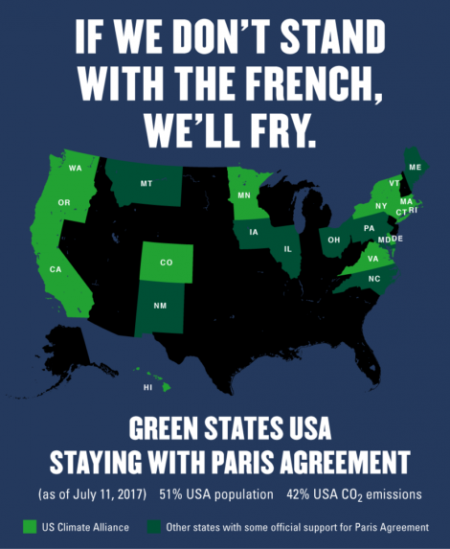
Formed in June of 2017 when President Donald Trump first announced that the United States was going to withdraw from the Paris Climate Agreement, the Climate Alliance is led by California, New York, and Washington, its founding members.
In announcing Wisconsin’s inclusion in the alliance the governor has issued a statement in which he says, “it’s time to lead our state in a new direction where we embrace science, where we discuss the very real implications of climate change, where we work to find solutions, and where we invest in renewable energy.”
The states that have joined so far are not exclusively blue, and describe their alliance as a bipartisan coalition attempting coordinated state actions to contribute to the overall global effort to fight climate change.
The Climate Alliance’s three core principles include:
Each state has committed to:
The Climate Alliance has an established liaison with the United Nations to ensure a line of communication with its efforts to coordinate the global response to climate change. It has raised money from philanthropic partners to fund some of its activities including staffing for analytical research, and intergovernmental sharing of best practices, expertise, and challenges.
Among the publications produced by the Climate Alliance so far are the following:
The introduction into the newly elected House of Representatives of a Green New Deal has given further impetus to the goals of the Alliance. The Deal sets the goal of achieving zero carbon emissions within the United States by the end of the next decade. The likelihood of that seems unfeasible. But the fact that the Deal is being aired, and debated by members of Congress is a sea change for the United States after two years of Donald Trump’s policy of climate change denial and rollbacks of climate mitigation and adaptation initiatives put in place by the previous federal administration.

Its principles include:
The Alliance’s current membership includes 14 U.S. states, and Puerto Rico, and contains 36% of all Americans, produces $7 trillion in GDP, and has generated 1.3 million in clean energy jobs. Collectively, Alliance members have reduced GHG emissions by 15% between 2005 and 2015. They have achieved this without negatively impacting their economies and have actually outperformed non-members over the ten-year period. And by 2025, based on current policies, they project a combined 24-29% reduction in GHGs which meets the U.S. target commitments made in Paris.
Current membership includes California, Colorado, Connecticut, Delaware, Hawaii, Massachusetts, Minnesota, New York, North Carolina, Oregon, Puerto Rico, Rhode Island, Vermont, Virginia, and Washington.
The Alliance is launching cross-state collaboration to accelerate clean energy deployment and transform the U.S. economy within their jurisdictions to tackle climate change through developing mitigation and adaptation strategies. The group may soon be joined by other states that have expressed support for the Paris Climate Agreement. These include Illinois, Iowa, Maine, Maryland, Montana, New Mexico, and Ohio.
Best summed up as to why all of these jurisdictions have committed to Paris, I quote from one of the governors, Jay Inslee of Washington:
“Those of us who understand the science and feel the urgency of protecting our children’s air and water are as united as ever in confronting one of the greatest challenges of our lifetime.”
]]>