He had told a TED2022 Conference audience that he was motivated to acquire Twitter, now renamed X, to turn it into a platform for free speech across the planet. He talked about it as being a public commons, an open town hall where ideas could be shared and discussed.
Unless you have attended public town halls which I have from my past work with government representatives, you don’t know how quickly they can descend into chaos. An individual with a beef can take over a town hall discussion and destroy the meeting of minds and public harmony in short order.
It shouldn’t be a surprise to learn that Musk has beefs and has now become not just the town crier, but also the dissenter who shows up to comment and post on the site. To make things worse Musk has invited back a bunch of dissenters who spout extremist conspiracy theories, or content that was previously banned on the site.
It is hard to fathom why Musk has chosen this path for X which is not paying for itself and losing subscribers and advertisers. Maybe the simplest explanation is the right one. Maybe it is just about a man with a giant ego and too much money to burn.
I have admired Musk for his vision regarding electric vehicles (EVs) and how their adoption can help the planet end its addiction to fossil fuels. I equally endorse the work at SpaceX to make rockets reusable to drive down the cost of getting to space. The Starlink satellite network is today making the Internet accessible to more people on Earth than at any time previously. It is truly raising all boats and has attracted copycats like Jeff Bezos who has begun to belatedly launch Kuiper, a competitor.
NASA has become reliant on SpaceX in ways no one a decade ago would have predicted. SpaceX ferries crews to the International Space Station (ISS). SpaceX resupply and return Dragon capsules bring work being done on the ISS back to Earth, something no other suppliers can do.
Tesla EVs have been the key disrupters of the automobile industry with the traditional dominant companies in this sector rapidly altering plans to move from internal combustion engine vehicles to ones running on electric batteries.
In a headline article that appeared on the Huffington Post online news site yesterday, it reads “Elon Musk Calls Antisemitic Conspiracy Theory ‘The Actual Truth.'” There is little to admire about Twitter’s evolution to X under Musk’s ownership. Before it was X, Twitter content was moderated to remove hate speech. But today, X disseminates hatred, racism, and anti-Muslim and anti-Jewish propaganda. In the defence of free speech on the platform, Musk appears to be siding with these new truths about race and religion and endorsing antisemitic conspiracy theories. So much for creating a public town hall where ideas get discussed in an environment where civil discourse is respected.
]]>

What is a bot? It is software in the form of an automated social media account that poses as a real person. Not all bots are malicious. Some are marketing-campaign specific helping to promote a brand. The ones of concern are those that spread “fake news,” lies meant to influence human behaviour to meet an ideological or political objective.
How Twitter knows that it has been infested with 70 million maybe bots is a lesson to share with all of us about bot detection. Knight in his article lists a number of ways to determine whether you are dealing with a bot or not. Although the list is Twitter-focused, it is equally applicable to Facebook and other social media platforms.
If you have experienced interactions with bots and have something to add to this list, please feel free to comment.

]]>
Australia and shark attacks seem to go hand-in-hand although these events are extremely rare. But that hasn’t stopped the State of Western Australia from tagging more than 300 sharks with gadgets that alert floating sensors anchored near popular swimming beaches. When a tagged shark draws near a tweet gets sent advising the Surf Life Saving team about its proximity. Of course, untagged sharks don’t tweet.

Australia had 14 recorded shark attacks in 2012. Compare that to 121 drownings and 1,193 road deaths in the same year. It would seem sharks stir the public imagination ever since the movie “Jaws” came out. So now when a shark comes near a Western Australian beach be assured your lifeguard will get a tweet.
For Western Australians you may have a 1 in 3,362 chance of drowning while your lifeguard picks up the field glasses to look for the shark. But you will be safe from the 1 in 292,565 chance of being attacked and killed by a shark. It seems in the 21st century we still haven’t overcome our fear of monsters under the bed.

The graph that appears below is known as the Keeling Curve, names after Charles Keeling, the scientist who began documenting fluctuations in atmospheric CO2 back in 1958. Mauna Loa is a good site to do atmospheric data collection because it is far from any major continental land mass. When Keeling started measuring back in 1958 CO2 levels were 317 parts per million. If you subscribe to the Twitter feed you can witness when CO2 passes 400.
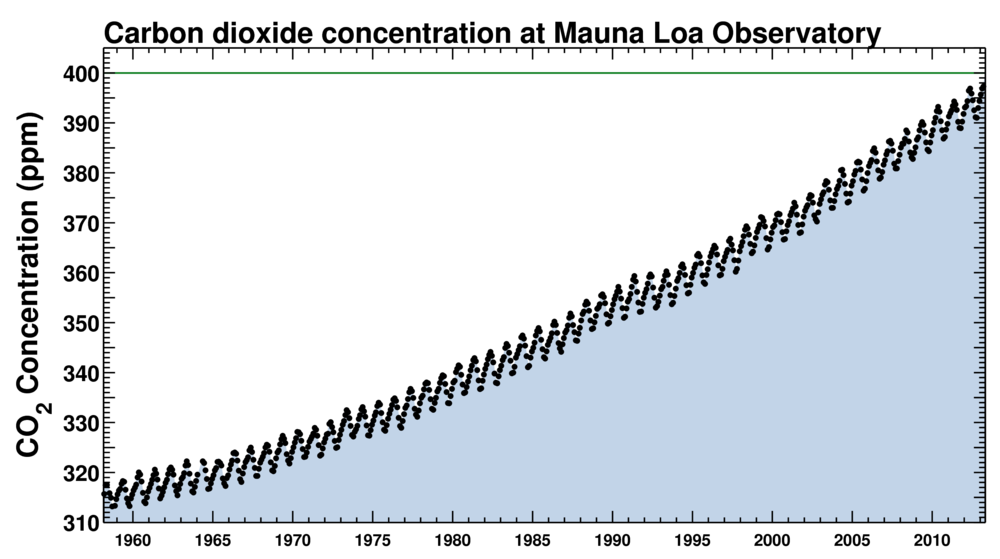
We have only measured CO2 at Mauna Loa since 1958 but we can sample old air trapped as bubbles in ice cores from the Antarctic and Greenland. These bubbles date back to the Ice Age when CO2 concentrations varied from 200 to 300 parts per million. We also can measure historic CO2 levels using geochemistry allowing us to go back even further, millions of years in fact, to a time before humans existed. At that time between 3 and 5 million years ago, the Mid-Pliocene, mean global temperatures were 2 to 3 Celsius (3.6 5.4 Fahrenheit) degrees higher than today. The polar areas of the Mid-Pliocene were much warmer with temperatures 10 Celsius (18 Fahrenheit) degrees higher on average. With warmer poles, polar ice cap melting caused sea levels to rise between 5 and 40 meters (16 to 131 feet). As evidenced from the fossil record, tropical flora and fauna both on land and sea migrated toward the poles. Even Ellesmere Island, high in the Canadian Arctic, had forests where today there is just ice, moss, lichens, scrub grass and bare rock.
So in the next few months with the average annual rise of atmospheric CO2 at 1.9 parts per million we should see 400 breached and you can be alerted on Twitter the moment it happens. Something to tell your children and grandchildren about.
Al Gore writes in The Future, a book I recently reviewed, “Roughly a quarter of the 90 million tons of global warming pollution we put into the atmosphere each day will still linger there — still trapping heat — more than 10,000 years from now.”
It is a sad statement about our human nature that we choose not to solve this CO2 challenge by an all out effort to move away from fossil fuel-based energy generation. The problem and evidence is staring us in the face and yet only 2% of our present energy consumption comes from renewables today. The rest involves burning carbon. This carbon legacy will continue to be measured by the Keeling Curve in coming decades as we surpass 400 this year and watch the number climb to 450 by 2040 even if we mitigate our carbon burning ways starting now. And we must.
]]>