What’s this technology all about?
A New Type of Sail
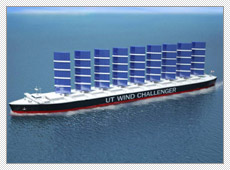
Ships will be outfitted with multiple 20-meter wide (65.6 feet), 50-meter high (164 feet) telescoping sails made from aluminum or fibre-reinforced curved plastic. The material of each sail is hollow in the centre to expand and contract as weather and wind conditions change.
A computer control system will position each sail to take advantage of maximum wind force. In simulation and wind tunnel experiments on models, the sails work effectively even in heavy cross winds. When in port the sails will collapse. At sea the sails can be partially to fully deployed based on prevailing wind and weather conditions.
Weather and Wind Tracking Technology
The control system will use weather forecasting live feeds, networked maritime navigation information from other ships at sea, on-board wind measurement including both direction and speed to optimize sail usage. Individual sail wind analysis will be combined with wind-flow analysis for the multiple sail array to ensure that all sails gain optimum value from prevailing winds.
Navigation Routes Redefined by Wind and Weather
Currently ships at sea seek the shortest distance routes to get from one port to another. Wind is not a factor in defining these routes. But that would change if merchant and cruise vessels were outfitted with these high-tech sails. Each sail equipped ship would be equipped with ocean wind forecasting technology for plotting an optimal course.
Measurable Benefits
Current model tests are built to scale to a size suitable for large merchant ships. The next step is to build a half-scale model for testing at sea before full-scale manufacturing and first sea trials on a 180,000-ton bulk carrier outfitted with 9 sails as early as 2016. Wind Challenger is a project headed up by researchers at University of Tokyo along with a number of ship builders and vessel and fleet operators.
]]>Developed World cities have the same problems with air pollution as cities in the Developing World. The difference is in length of time in which these problems have appeared. Developed World cities grew at a slower pace than the Developing World cities of today. So although emissions from automobiles, trucks, home heating, industrial plants, and power stations contributed to ground-level ozone, CO2, and urban-created smog, these problems became apparent over a half century or more, not over a decade or even less time than that.
Air pollution in cities spreads far and wide regardless of the location of the city in the Developed or Developing World. In addition the demands cities put on their hinterlands exacerbate the problem. Cities need energy. Coal-fired power plants produce that energy and may be hundreds of kilometers away but their emissions pollute from point of origin and downwind often contributing to greater problems for the cities they heat and light.
Beijing, China, experiences many days each year when air pollution reaches such dangerous levels (see picture below) that it is unsafe to be outdoors. Cities of the Great Lakes in Canada and the United States get the drift of air pollutants from local origin as well as the emissions from coal-fired power plants up wind. Tailpipe emissions from cars, trucks and buses create ground-level ozone making walking on local sidewalks in urban settings hazardous to the health of those who have asthma or other respiratory diseases.

Air Pollution in Urban China
Before Beijing hosted the Olympics,it began a program to greatly decrease air pollution. This involved restricting traffic, reducing the operations of coal-fired power plants, and limiting the hours that heavy industry could operate. Even with regulation the quality of the air during the 2008 Olympics was only marginally better. When measured throughout the Games Beijing air contained higher than acceptable levels of ozone, sulfur dioxide (SO2), carbon monoxide (CO), carbon dioxide (CO2), reactive aromatics (toluene, xylene), nitrogen dioxide (NO2), reactive nitrogen (NOy), alkanes and benzene. For the athletes the exposure presented minimal risk but for Beijing citizens living in the city before and after the Games, air pollution is a major contributor to chronic respiratory disease.
Air pollution in China is not limited to Beijing. Shanghai, China’s largest city, experiences air pollution so thick that residents report it is often impossible to see buildings a few blocks away, or the road from as little five stories above. Beijing and Shanghai have had to close their international airports on days when the air pollution has made it impossible to safely take off and land. Space shuttle and International Space Station astronauts have reported that many of China’s cities are invisible from space because of the blanket of pollutants that shroud them from view.
For China’s it is a tradeoff between air quality and production and its urban population as its economy rapidly expands. In a 2010 study of air pollution in urban China it stated that one-third of 113 Chinese cities failed to meet air quality standards. A World Bank report indicated that 16 of the 20 worst air polluted cities were in China with 20% of the urban population exposed to heavily polluted air. The primary cause is the burning of high-sulphur coal, the principal mined fossil fuel in China. Six million tons is burned daily not just for power and industrial plants, but also as a domestic heating and cooking source. The total health cost of airborne particulate matter in a 1995 study was estimated to equal $54 billion annually or 8% of Gross Domestic Product (GDP). Considering the expansion of the Chinese economy since 1995, that number is today much greater. Today China is adding a new source of air pollutants to the mix. The number of motor vehicles is rapidly on the increase. The result, airborne lead in major Chinese cities such as Shenyang and Shanghai is contributing to blood-lead levels 80% percent higher than those normally considered dangerous to mental development. With a rising middle class and a lot more automobiles and trucks on the road lead pollution will only get worse.
Air Pollution in Developing World Cities
The same factors that contribute to the problems in Chinese cities exist in cities throughout other parts of the Developing World. More than a billion urban dwellers in these cities experience dangerous levels of air pollution, contributing to 2 million premature and prenatal deaths annually. It is estimated that urban air pollution costs Developing World countries 5% of GDP annually compared to 2% for the Developed World. More than 90% of the pollution is attributable to transportation and domestic use, not power and industrial plants as in China. Older vehicles, poor vehicle maintenance and poor-quality highly leaded gas are major culprits. Burning kerosene and other fuels for domestic cooking contribute to the bad air in these urban environments. Local industries rely on diesel generators because of a lack of power from central utilities.
In Lagos, a city we have documented in previous blogs, traffic, flaring of waste gas from petroleum refineries, kerosene burning for cooking, and incineration of solid wastes, have contributed to air pollution that is 500% higher than safe levels established by the World Health Organization (WHO). In 2007 the WHO estimated that air pollution contributed to 14,700 deaths in Nigerian cities.

Solutions for Cleaner Air in Developing World Cities in the 21st Century
What can be done to clean up the air over the cities of the Developing World? What is affordable? What technologies exist today or will exist in the near future to mitigate and end this growing problem that not only contributes to premature death but also to climate change?
In China, South Asia and Africa the goal to decrease air pollution involves a cooperative effort among government, industry and citizens. Technology solutions exist at the macro and microeconomic level. What are these?
Substituting cleaner fuels for generating power, heat and electricity. In China, washing coal before burning it would greatly decrease (SO2) and acid rain. Better yet getting off coal by finding alternatives will dramatically reduce many of the other pollutants that shroud Chinese cities. Diversifying means using renewable power sources such as wind, photovoltaics and other solar technology, hydroelectric power, nuclear power, natural gas and oil.
Today, China is the world’s largest manufacturer of wind turbines not just for export but also for domestic use. China is building variable-sized wind turbines with sizes deployable off the grid for rural power generation. Small wind turbines represent a supplementary power source for clusters of homes or single family dwellings.
One of the many challenges in cities in places like Africa is the lack of capital to invest in manufacturing at a level of sophistication and in quantity as in China. Instead, small-scale manufacturing projects involve the use of local materials. A good example is a project in Cameroon. The town of M’muock, population 7,000, is working with Green Step, a German company, to build and operate small wind turbines and other renewable energy power generators from locally sourced wood, and old car and radio parts.

Refining gasoline to get the lead out. Lead as an additive in gasoline was first introduced in the 1920s despite its known toxicity and it has taken 90 years to eradicate it from the production of this fuel. The United Nations has set a goal of 2013 to end production of leaded gasoline globally. Once this is achieved new lead sources will no longer contribute to the problem. But the residual environmental threat remains.
Even though leaded gasoline was banned in 1986 in the United States, lead remains in the soil and air because it is almost indestructible. For children this represents a greater risk because they ingest lead 5 to 8 times more rapidly than adults. Children absorb up to 50% of inhaled lead. Those living near highways, playing on roads or in playgrounds near parking lots are at greatest risk as dust with lead gets ingested into lungs.
Inexpensive lead remediation programs involve combining compost with contaminated soils to inactivate the lead. Lead when exposed to phosphates forms an insoluble compound. Similarly lead is remediated when exposed to soluble iron oxides.
Replacing polluting motor vehicles with low-emission and zero-emission alternatives. Older automobiles and trucks are major contributors to air pollution in urban environments. Emissions include (NO2) nitrogen dioxide, (CO) carbon monoxide, (CO2) carbon dioxide, benzene and other partially combusted hydrocarbons. Internal combustion engines (ICE) are the principal polluters even those with catalytic converters although a converter halves the amount of NO2 that gets into the atmosphere.The combination of partially combusted hydrocarbons, NO2 and sunlight cause ground-level ozone and smog. Recycling the older vehicles that clog the roads of Developing World cities can at least begin to reduce NO2. Proper maintenance of older vehicles to improve the air-to-fuel ratio can dramatically reduce CO emissions.
Ideally the arrival of electric vehicles with infrastructure for managing both the charging of batteries and their disposal will dramatically reduce air pollution.
Implementing emission control technologies in industrial and power generating plant smokestacks. Reducing emissions whether in cars or trucks, or from industrial and domestic sources will lower air pollution levels in Developing World urban centres. Proven technologies include:
Cyclones to create cyclonic motion in the smokestack air stream to cause pollutant matter to drop out. Cyclones are inexpensive and useful for removing large airborne particles only.
Settling Chambers like cyclones alter the air stream, not by spinning the gases but by passing them through a larger space in the smokestack causing the air speed of the effluent to drop and precipitating out large particles. Settling chambers are inexpensive to implement.
Wet scrubbers filter out pollutants from the air stream by passing through water. Pollutants combine with water droplets and precipitate into settling tanks. Pollutant-laced water is discharged into settling ponds which can become quite large over time and highly toxic.
Fabric filters use porous temperature and corrosion-resistant fabrics to remove pollutants from the air stream as it passes up the smokestack. The filters need frequent replacement.
Replacing kerosene and coal as domestic cooking and heating fuels with cleaner alternatives. Urban dwellings in Developing World cities may not have access to reliable utility-delivered electricity or natural gas. Being off the grid is more common than not. Using generators that run on gasoline or other highly polluting fuels just contributes to air pollution. Building homes that can generate their own electricity through wind, solar and battery storage is one way to reduce airborne pollution. Where the infrastructure can deliver reliable electricity and natural gas, reductions in pollution will result. Houses like those being built using Eco-Tec designs represent a model for construction in these urban environments.
In our next edition of urban landscapes we will address water pollution in the 21st century.
When we started talking about transportation we briefly introduced how humans made the initial breakthrough to conquer the air in the 20th century using heavier-than-air technology. The 21st century will feature a wide range of technologies for air passenger travel and transport. These technologies will include alternatives to the airplane to address energy conservation and the need to reduce carbon emissions. One of these technologies, the airship, is the subject of this blog.
Airships: What Are They and Where Are They Today?
In North America at every major sporting event we see a descendant of airships hovering over the venue giving us a bird’s eye view of the playing field. These lighter-than-air blimps, as they are called, are powered balloons. They are not airships in the true sense because they contain none of the rigid framework that characterizes that technology. To understand the difference between blimps and airships, let’s look at the history.
For a period in the 20th century Germany and Great Britain turned to airships to cross the Atlantic Ocean. This was before passenger airplane technology had the capability to make a non-stop flight across several thousand kilometers of open ocean. What were these airships?
They were aluminum alloy frameworks covered by a weatherproof cloth with vertical and horizontal fins attached at the tail. Vertical fins acted as rudders. Horizontal fins allowed the airship to climb or descend. Internally airships contained impermeable bladders called gas cells. These were filled with lighter than air gases, either hydrogen or helium. Crew and passengers were accommodated either within the structure or in a suspended cabin attached to the bottom of the frame. Internal combustion engines turned rear-facing propellers that pushed airships at speeds of 130 kilometers (80 miles) per hour.
The name most associated with airships, Zeppelin, appeared in 1900 with the launch of a series of airships in Germany. Count Ferdinand von Zeppelin perfected the airship and during World War I manufactured a fleet of them for the German military to use in bombing raids over Great Britain. Zeppelins, as they were called, proved to be impractical weapons of war because they provided British flyers and antiaircraft batteries with enormous, slow-moving targets.
After the war the Zeppelin and other commercial manufacturers found a peaceful purpose for their airships, offering passenger service between major European and North American cities. The Graf Zeppelin, an airship built in 1928, flew around the world in 1929. In 1936, the Hindenburg, the largest airship of its time, began a regular transatlantic passenger service between Germany and New York City.
The cause of the Hindenburg disasterremains unknown but the use of hydrogen gas made fire inevitable as a consequence of whatever accident occurred at Lakehurst, New Jersey on May 6, 1937. Germany lacked helium. The United States was the world’s largest producer at the time and restricted export to what was then Nazi Germany. The combustible nature of hydrogen gas made the airship particularly vulnerable to almost any accident that could cause a spark. Whether it was a snapped cable, or static electricity, the hydrogen gas in the Hindenburg ignited and the craft crashed to the ground killing and injuring dozens of passengers and onlookers. The Hindenburg’s demise sounded the end of passenger airships although the Graf Zeppelin continued to fly until 1940 just after the outbreak of World War II.

Blimps survived the demise of airships, largely serving as flying billboards, or sky-mounted camera platforms. Unlike airships blimps lack the structured aluminium framework. Instead the engine, fins and crew cabin are attached to the blimp’s outer skin which remains rigid because of the helium gas contained within it. Goodyear is the brand most associated with blimps. But the technology that Goodyear is using today may soon be replaced by new designs that incorporate new materials and engine capability.
One of the pioneers in delivering this new type of airship is Aeros, operating out of Montebello, California. The Aeroscraft is a rigid variable buoyancy airship with vertical takeoff and landing capabilities. Unlike blimps and airships of old, Aeros technology uses dynamic buoyancy management and not water ballast to keep afloat and on an even keel. More aerodynamic in shape than traditional blimps and airships, the Aeroscraft contains helium cells that hold up to 400,000 cubic meters (14 million cubic feet) of the gas, negating 65% of the aircraft’s weight. The forward and aft fins, called canards and empennages respectively, create additional lift.
Almost 2oo meters in length and as tall as a 14-storey building, Aeroscraft has a cruising range of close to 10,000 kilometers (6,000 miles) and a top speed of 280 kilometers (174 miles) per hour. Aeroscraft can be used as a flying hotel, or as a payload carrier capable of delivering materials to remote areas inaccessible because of terrain or lack of roads. Aeroscraft requires no ballast and can handle payloads of up to 400 tons or 250 passengers in a hotel-like cruise ship setting.

Pelican is a Pentagon funded smaller airship being built by Aeros to deliver payloads of 60 tons to remote locations. Like its larger cousin, Aeroscraft, Pelican uses a rigid-aeroshell,variable-buoyancy from pressure-stored helium, an impermeable helium cell, and a load-bearing internal frame made of carbon-fiber. The Pentagon sees it as a quick deployment, strategic aircraft for delivering soldiers or equipment to staging areas with greater load capacity than helicopters and vertical-take-off and landing capability.
Future Uses of Airship Technology
Aeroscraft and its successors may find themselves being used for a variety of applications as this technology matures. Here are just a few that take us past the flying billboards of present day:
The world became a lot smaller place as transportation technology evolved faster ways to get from one place to another. Human settlement patterns altered from being predominantly rural in the 19th century to urban in the 20th. By the mid-20th century cities spread out spawning underground and above-ground railway networks and road infrastructure that created the urban daily commute from home to work and back.
The automobile became a personal freedom machine for those who could afford it. And increasingly in North America and Europe, automobiles were economically feasible for much of the population. This expansion was supported by a network of energy suppliers providing a fuel infrastructure for gasoline and diesel.
By the end of the 20th century in North America the era of relatively cheap gasoline and diesel was coming to an end. In Europe gasoline and diesel was already prohibitively expensive in the last 20 years of the century but that didn’t stop Europeans from buying and driving cars.
In the last decade of the century developing world automobiles and the infrastructure to support them started to take off with China and India representing the fastest growing car markets. This increased demand for gasoline and diesel to fuel these new automobile consumers.
Western governments, in trying to reduce fossil fuel consumption, began legislating fuel efficiency standards for automobiles. In 1997 Toyota, Japan’s largest automobile producer launched the first hybrid vehicle using a combination of electric-battery-driven motors along with a gasoline internal combustion engine. Honda soon followed in 1999 with its own hybrid, the Insight. This combination of electric motor and gasoline internal combustion engine provided manufacturers with a way to improve fuel efficiency. For a short period, one manufacturer, General Motors, designed and delivered to a limited market an all-electric car. But this experiment was soon squashed.
But automobiles represented only one type of transport. At the beginning of the 20th century land transportation for industry relied on rail and marine shipping to acquire raw materials and deliver finished products to market. But by the end of the century rail played a smaller part for these same industries as trucks became predominant. Ships went through dramatic redesign as well growing ever larger, whether moving bulk raw materials or container systems largely spawned by the rise of the trucking industry.
Even more significant was the development of heavier-than-air flight capability. The airplane and the infrastructure to support it became one of the great achievements of the 20th century. Air travel contributed to a rising global view of the planet, reducing the amount of time required for travel dramatically.
For a short time in the 20th century balloons vied with airplanes but became novelties by the end while jet-engines became predominant with propeller-driven aircraft relegated to specialized markets from the mid-century to its end. As airframes increased in size, global distribution of goods through the air grew rapidly in volume supplanting rail and marine shipping. Air passenger transportation briefly went supersonic with the launch of the Concorde and TU-144. By 1978 the latter was no longer in service and the Concorde’s last flight occurred in the first decade of the 21st century.
In the 20th century humans travelled in to Earth orbit and to the moon using rocket technology first pioneered in the United States, perfected as a weapon of war in Germany, and then enhanced further after World War II as the Americans and Soviet Union developed the technology further for military and scientific pursuits. Rocketry remained the purview of national governments with the cost of the technology far exceeding the ability of most private enterprise.
What will make the 21st century different? The planet has grown very small in the 20th century and will be even smaller still in the 21st. Our concepts of transportation will take on three perspectives. At the urban level we will need to enhance and invent new means of mass transit. At the planet-wide level, globalization will drive innovation on land, sea and air. And in space, extra-planetary transportation will alter our frame of reference as a species and representative of all the life on Earth.
In subsequent blogs on transportation we will explore the following:
1. Urbanization and Population Growth and its Impact
Urban concentration of human population will change our transportation models. Toronto, Canada, where I live, provides a great example. Between 2001 and 2006, growing traffic congestion increased the average commute time by 16%. While Toronto increased road lanes by 56% between 1986 and 2006, public transit grew by only 18%. Almost one-third of Toronto workers commuted more than 15 kilometers each way to do their jobs in 2006. In the Greater Toronto area and suburbs average daily commutes were longer. Toronto is one of the worst examples of unplanned urban transportation impacting on quality of life. But Toronto is not unique as a North American city. So we will look at this subject in greater depth.
2. Energy Conservation as a Transportation Challenge
In other sections of this blog we have talked about energy and the significant challenge that energy consumption has for our technical society. Governments are legislating industry to innovate to reduce the amount of energy needed for transporting people and goods. Reliance on fossil fuels is increasingly impacting health and the environment. Reconciling our need for energy and modes of transportation is something that 21st century technology needs to address.
3. Environmental Pollution, Climate Change and Transportation
Humanity by necessity is being forced to reduce its carbon footprint. We have talked about geo-engineering the planet in another section of this blog. But in this coverage we will specifically look at the technologies we currently use to move materials, goods and people and their impact on the environment and climate. How will we continue to do business globally using transportation technology to move raw materials, agricultural produce, and manufactured goods half way across the planet while dealing with CO2 and other pollutants?
4. Employment Patterns
We are changing the way we work today. The Internet, software-as-a-service (what techies call the cloud), virtual business presence, the disassembling of our bricks and mortar ideas about what is a business, have undergone dramatic change in the first decade of the 21st century. How will that accelerate through the rest of the century. What will the impact of the electronic commute be on the automobile industry and other forms of personal transportation? What will it mean for logistics and supply management when companies go virtual?
5. Alternative Fuels
Electric cars, biofuels, hydrogen, solar power, ion propulsion, micro-nuclear, what will be the fuels that drive our transportation technology in the 21st century? Will we wean ourselves completely from fossil fuels?
6. Technical Innovation
Electronic roadways, chained automobiles, smart vehicle technology, robotics, high-speed maglev and pneumatic rail systems, radical new ship designs, hypersonic aircraft, ion propulsion, solar sails, space elevators….these are concepts on the drawing boards and in the labs and R&D centres of innovators and entrepreneurs today. What is promising and realizable in the 21st century? What will remain a dream?
Enjoy the journey with me and please remember to ask questions and comment. I always respond.
]]>