In pursuit of a net-zero emissions future, ammonia is seen as an important compound. Ammonia produced from green energy sources serves as an energy storage medium. It is easily transported in liquid form and can be cracked to produce green hydrogen which is a zero-emission fuel. It also can be burned to produce energy without emitting greenhouse gasses (GHGs).
Toyota is the world’s largest maker of automobiles. It developed the first hybrids. (Full disclosure, my current car is a Toyota Venza running on gasoline and lithium-ion batteries.)
Toyota has been a skeptic when putting all its eggs into the electric vehicle (EV) basket. It has had limited success with the Mirai, the first commercial hydrogen fuel cell car. Its vehicle lineup is dominated by internal combustion engine (ICE) cars and trucks that use gasoline and diesel fuels. It also has well-established expertise with hybrid-powered vehicles that combine batteries and small ICE powerplants.
It, therefore, shouldn’t be too surprising for the company to explore new fuel sources for ICE vehicles. With no carbon atoms in ammonia (NH3), using it to fuel vehicles means no carbon emissions. So heavily invested in ICE technology, the company may see green ammonia fuel as a stay of execution. Ammonia-powered vehicles when compared to EVs could be easier to support within the transportation industry and supply chain and, as a result, cheaper to build and maintain. And green ammonia would make these cars as eco-friendly as EVs.
Toyota owns 50% of a Chinese vehicle manufacturer, the GAC Group. This year it launched its first ammonia-powered model, a four-cylinder car that produces 161 horsepower and a very small carbon footprint.
Vehicle challenges using ammonia as fuel include that it is harder to ignite than gasoline or diesel and it burns slower. Pure ammonia requires high boost pressure and compression to compensate for the ignition issue. Blending hydrogen with ammonia corrects the problem.
Today, ammonia is produced for industrial uses using the Haber-Bosch process, a method invented early in the 20th century to synthesize the chemical compound using hydrogen and nitrogen. The process uses high pressure (200 to 400 atmospheres) and 400 to 650 Celsius (750 to 1,200 Fahrenheit) temperatures with natural gas, coal or oil providing the heat and the resulting high carbon footprint.
Just how high? According to the International Energy Agency (IEA), direct emissions from ammonia production produce 450 Megatons of CO2 annually with indirect emissions amounting to 170 Megatons. The main sources of these emissions come from the production for use in fertilizers. Compared to steel and cement, that is twice the amount or 2.4 tons of CO2 per ton produced.
To convert ammonia production to make it green means using renewable energy sources to provide sufficient heat and pressure. Siemens is working with the University of Oxford to take electricity produced from wind to do hydrogen electrolysis to synthesize ammonia. The Siemens Green Ammonia Demonstrator at the Rutherford Appleton Laboratory in the United Kingdom uses water electrolysis powered by a wind turbine to extract hydrogen which is then combined with nitrogen from the air to produce ammonia for energy storage.
The same distribution challenges faced by EVs is one that Toyota’s ammonia-powered cars will face. Where do you fuel up? For EVs, it has involved creating a fast-charging network as pervasive as the current distribution infrastructure that serves gasoline and diesel vehicles.
How large is the fossil fuel distribution network? In the United States today, there are 168,000 stations. In Europe, 140,000. In Canada, 12,000. In China, more than 22,000, Russia, 25,000, Australia, 6,500, the United Kingdom, more than 8,300, and Japan with 29,000.
For ammonia-powered cars, Toyota will have to find room in the fossil-fuel inn to make a go of its venture or face the same challenges that its Mirai model has faced and hydrogen-powered vehicles in general that have attempted to break into the mainstream of the green-vehicle revolution.
The comparison between hydrogen and fossil-fuel infrastructure is stark. At the beginning of this year, the Green Car Congress noted that hydrogen fuel stations had finally surpassed the 1,000 mark globally. In the United States, the number of places to fuel up with hydrogen amounted to less than 100. How can you compete with a hydrogen-fuel-cell-powered vehicle like the Mirai with so few places to fuel up?
]]>
In April I wrote about BYD, a Chinese electric vehicle (EV) manufacturer, that is using sodium-ion (Na-ion) battery packs instead of lithium-ion (Li-ion) in some of its models. In its latest report, IDTechEx, out of Cambridge in the United Kingdom, states that although Na-ion batteries are not the answer to all battery-power applications, they do provide a complimentary addition to battery packs used not just in EVs but also for backup power within utilities and factories.
IDTechEx points to several small factory pilot projects already being planned or built with a capacity of over 100 Gigawatt hours (GWh) within the next three years. These can be found in the UK, the US, France and China (see chart below). India is the site of what will be a 2 to 3 GWh factory that is planned to open in 2024.

The advantages of developing Na-ion battery storage cannot be underestimated. The capacity to grow because of material availability makes these batteries attractive when compared to Li-lon.
IDTechEx forecasts that the average cost per Na-ion battery cell will drop from the current US $87/kilowatt-hour (kWh) to $40/kWh by 2030. Na-ion energy density is not equal to Li-ion with the weight-to-energy density ratio higher than the latter impeding widespread adoption. But for use in commercial energy and grid storage, where size and weight are far less of an issue, Na-ion batteries should take off. Other advantages include they are faster to charge, more resilient in cold temperatures and more tolerant to heat. This makes them a good option for backup storage in utilities and as a power source for factories and buildings.
The first time I wrote about solid-state battery technology was back in 2014. Solid-state batteries when first released were seen as a good low-power, long life cycle solution for medical and remote sensing applications.
In 2017, Toyota, the world’s largest automobile manufacturer, announced it was planning to put a solid-state battery-powered EV on the road by 2022. That deadline passed without explanation. Toyota has been late to the EV game having put much of its low-carbon emission investments into hybrid systems that combined battery and small internal combustion engine (ICE) models. (Full disclosure: I drive a Toyota Venza hybrid which combines a Li-ion battery pack with an ICE. My previous car was a hybrid RAV4 which used a Nickel-cadmium battery pack combined with an ICE.)
What makes solid-state batteries so attractive to the automobile industry? They are lightweight, have no liquid electrolyte, have higher energy density, and don’t overheat which is a common concern for Li-ion storage technology. They also charge faster (10 to 20 minutes) than Li-ion, provide a greater operational range, and last longer.
In Toyota’s latest announcement in partnership with Panasonic, the companies have announced a technological breakthrough which reduces the size, weight and cost while providing an extended range of up to 1,200 kilometres (745 miles).
The only disappointment in the latest Toyota “breakthrough” announcement is that its solid-state powered models will be introduced in 2027 and 2028. In the interim, the company is continuing to make improvements to its Li-ion battery packs and plans to launch a line of EVs with an operational range of approximately 1,000 kilometres (621 miles) using this technology in 2026. An interim strategy is the launch of hybrid models containing small solid-state battery packs by 2025.
Toyota is not alone in pursuing solid-state battery-powered EVs. BMW plans to have a working prototype model by 2025. Nissan plans to introduce solid-state-powered EVs in 2028. And Ford, Volkswagen, Mercedes, BYD and others are all in hot pursuit as well. Meanwhile, Tesla, the company that made EVs a thing, is slow-walking solid-state technology, pursuing instead an enhanced Li-ion battery of their design.
]]>
This is the second solar vehicle the Eindhoven group has invented. The first was a family car called Stella Lux. This one has been given the name Stella Vita. As you can see from the picture above, the vehicle has aerodynamic lines. On a sunny day, its range is 730 kilometres (450 miles) if you don’t use any of its many amenities inside.
When parked the roof slides up and two solar panel additions extend out on either side increasing the solar capacity to 17.5 square metres (188 square feet), not only providing power, but also a bit of shade. You can also plug the vehicle into a charging station in the event of a cloudy day. To fill the battery storage to capacity takes the solar panels about two to three days.
The interior comes with a bed, fridge, toilet, couch, and cooktop. There are charge ports for smartphones. tablets, and laptop computers. The onboard information system keeps the driver apprised of his or her energy use.
To demonstrate the technology the team is sending a driver south on a 3,000-kilometre trek that will last for four weeks with stops at universities and events along the way to show off.
The pursuit of solar-powered vehicles is ongoing and not just confined to university and polytechnical institute campuses. The limitations have always been recharging rates and range. But integrating photovoltaics is becoming more attractive to mainstream vehicle manufacturers and new startups. A number of companies are developing prototypes. These include startups like Squad Mobility, Stella Ersa, Aptera Motors, Atlis Motor Vehicles, Fisker, Light Year, and Sono. And then there are the better-known mainstream contenders like Hyundai, Toyota, and Tesla.
Hyundai’s solar car uses a roof system of solar cells to generate electricity. But it is a hybrid so the solar aspect plays only a supporting role.
Toyota’s entry is a Prius with 34% of its surfaces covered by 0.03 millimetre-thick cells. Compared to the average of 20% for other solar vehicle contenders, Toyota claims that its car will be able to continuously run without ever requiring a plug-in recharge.
Tesla is building its all-electric battery-powered Cybertruck with a solar panel option that can extend operational range each day by up to 24 kilometres (15 miles).
So Stella Vita is far from being alone in carving out a place in the solar car race. According to members of the Solar Team Eindhoven, they expect vehicles powered by the sun to be a reality before the end of the decade. But, for now, if you are in Southern Spain in the next few weeks you may be able to see what the future will bring, a self-sustaining tiny solar house on wheels.
]]>Today’s lithium-ion (LiON) technology has limits: range, recharge rates, and recharge cycles. For example, a Tesla Model S has a range limit of 400 kilometers (250 miles) before recharge. With a fast charger, it can take 30 minutes for a full recharge. That’s pretty much state of the art for EVs today.
On the other hand, there are solid-state batteries which can extend range dramatically while recharging much faster. A solid-state battery of similar output to Tesla’s LiON could extend the car’s range two to three times. That battery would be smaller and lighter as well.
Other solid-state advantages:

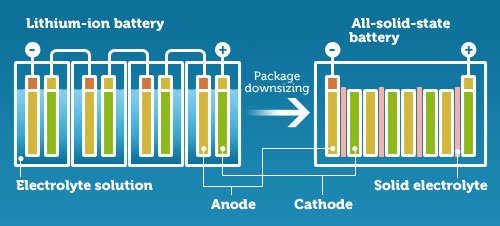
Solid-state batteries can be made using the following materials:
And they come in two varieties:
Lithium-phosphorus-oxynitride, also known by the acronym, LiPON is a material suitable for thin film solid state. These batteries are ideal for watches, other wearables, and cell phones. After 40,000 charge cycles, a typical LiPON battery will lose a mere 5% of capacity. That means LiPON technology can last from 40 to 130 times longer than comparable LiON.
Garnet-oxide is a material suitable for bulk solid state. It can produce the same energy output as current LiON technology using a much smaller footprint while at the same time retaining capacity over many more charge cycles.
In all cases, solid-state recharges much faster than LiON. The batteries Toyota expects to use in its 2022 EV models will recharge in 5 minutes (about the same amount of time it takes today to fill a gasoline-powered vehicle fuel tank.) The batteries will retain 100% charge capacity over a minimum 1,200 recharge cycles outperforming LiON by 400%.
When you consider Toyota has not been a big adopter of LiON technology it is not surprising that the company is choosing a different route in the evolution of its EVs. The leap to solid-state will be dramatic. But in the interim, the company intends to continue producing its existing Prius and other brand-hybrid cars, a hydrogen-fuel-cell car, and in 2019 will begin manufacturing LiON-powered EVs in China.
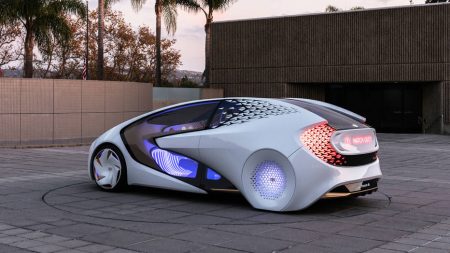

That seems to be a strong motivator for Mercedes-Benz according to its chief executive, Dieter Zetsche. He fears that “third parties would step between yourself and the customer” with the auto industry becoming no more than a hardware supplier. By third parties Zetsche is referring to Apple and Google (Alphabet). His company and others are seeking software technology company acquisitions with this goal in mind. Joining Mercedes-Benz are General Motors, Ford, Toyota, Nissan, Hyundai, Audi, BMW and Volkswagen and more, all shopping for the apps and services that can be integrated into their vehicles and that will keep them connected to customers and not just the makers of hardware.
General Motors (GM) recent $500 million US investment in Lyft (an Uber competitor) back in January is a good example of a common industry trend. This is GMs bet on autonomous cars reshaping the market sooner than later. States GM President Dan Ammann, “we think our business and personal mobility will change more in the next five years than the last 50.” With Lyft software GM driverless cars will become available on demand to consumers providing network coverage in urban centres. Lyft will also be used by Toyota and Ford and be integrated into dashboard screens. Ford is testing ride hailing by putting a fleet of autonomous driven transit vans into its Dearborn campus in Michigan.

GM has also entered into partnership with Mobileye, an Israel-based company offering sophisticated vision algorithms that interpret scenes in real time to provide drivers with crowd-sourced imaging downloaded to any vehicle with GM’s OnStar on board service. This is fact checking driving conditions and a perfect segue into driverless cars in the near future. GM Executive Vice President, Mark Reuss, describes as “a critical enabler” in getting the company to its ultimate goal of autonomous vehicles. GM isn’t alone with Volkswagen joining them in partnership with Mobileye.
Toyota, the world’s largest car manufacturer these days, owns more patents for self-driving cars than any other company. In fact Japanese companies lead all others in developing autonomous driving technology with German companies second, South Korean third, followed by GM. In January the Wall Street Journal published an article describing Toyota’s “late shift into self-driving cars.” The company recently invested $1 billion of its annual $9 billion research and development budget to set up shop in Silicon Valley, California, where it hopes to hire away some of the talent that can help it turn patents into apps and products. Setting up in Google and Apple’s backyard represents a direct challenge to those companies for supremacy in the development of autonomous and semi-autonomous technologies.
Meanwhile Google’s StreetView is feeling the heat from competition from Here Maps, a former Nokia division. Here Maps (see a sample map in the image below) is a multi-platform mobile application recently acquired by a consortium of car manufacturers that includes Mercedes-Benz, BMW and Audi. According to a Nokia spokesperson, “its focus is on developing precise and accurate mapping as well as services that will enable an entirely new class of driver experiences, including highly automated driving.”

All of this investment doesn’t preclude the use of Apple and Google apps in automakers’ products. But what it does do is give the manufacturers leverage with the app communities created by these two hardware and software industry giants. Expect many more acquisition and partnership announcements from automakers in 2016 and beyond as we see an accelerated push to implement autonomous technologies sooner than later.

Having said all this, in the last week a Google autonomous vehicle crashed into a bus with the Google vehicle being blamed. According to the report the vehicle was traveling at a speed of 3.2 kilometers (2 miles) per hour. According to Google the autonomous vehicle presumed that the bus would yield to the car. It didn’t. Google announced it redesigned its algorithms in light of the accident.
]]>The challenges fuel cell technology faces include:
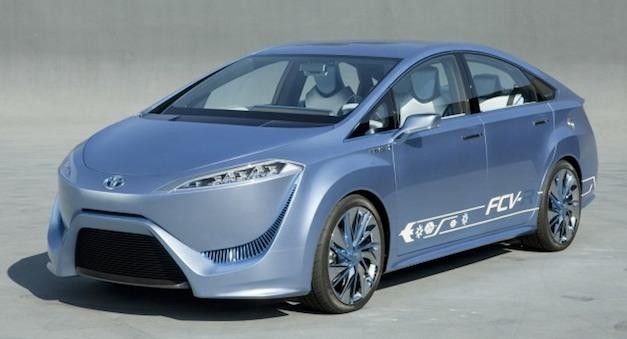
General Motors and Honda are collaborating to drive down the cost of fuel cell technology. They like Toyota hope to be putting sedans on the road by 2015 that sell for $50,000 making them cheaper than the Tesla-S electric vehicle (EV) from Tesla Motors. For GM, Honda and Toyota they argue that fuel-cell cars have distinct advantages over EVs with better range, up to 650 kilometers (400 miles), and faster refueling, less than 4 minutes, although Tesla is experimenting with new processes that can swap out an electric battery in under two minutes as it builds its station infrastructure.
Fuel cell backers also argue that their technology is cleaner than EVs and any ICE car because when EVs are recharged from dirty power sources such as coal-fired power plants, it negates their operational zero emission performance. In addition even if the hydrogen is derived from natural gas they point to U.S. Department of Energy studies on carbon emissions that claim fuel-cell vehicles when all is considered will emit less than half the CO2 of ICE-powered cars.
As for the safety of hydrogen technology (think Hindenburg and you’ll undersatnd the issue), I recently wrote about advances in hydrogen production that make it a much safer source of energy, and about Firewater Fuel, a new start up company that is commercializing a low-cost catalyst for hydrogen production. Also research at the Brookhaven National Laboratory in New York has found a way to store hydrogen in a liquid state at ambient room temperatures making it much easier to transport safely. All of these advances point to a potential rosy future for fuel-cell cars. But it won’t happen without a massive investment in hydrogen infrastructure to make filling your fuel-cell car as easy as your current gasoline-powered vehicle.
]]>

Advantages of using natural light conveyed by mirrored surfaces are obvious. Besides the more pleasant aspect of being in natural light, with no energy required to light windowless interior spaces, buildings can greatly decrease power requirements during daylight hours.
The technology has received major awards in Japan from the Association of Building Engineering and Equipment, the Japan Aluminium Association, the Illuminating Engineering Society of North America and the Illuminating Engineering Institute of Japan.
]]>