CAESAR to Revisit Comet 67P/Churyumov-Gerasimenko
The European Space Agency’s (ESA) Rosetta spacecraft rendezvoused with Comet 67P in 2014 and deployed a lander to its surface. Now NASA intends to follow up with CAESAR, the Comet Astrobiology Exploration Sample Return mission. The plan is to rendezvous with the comet and collect samples from it to return to Earth for analysis.
JAXA, the Japanese Space Agency, demonstrated a technique for sampling materials from a Solar System object and returning them to Earth in 2010 with its Hayabusa mission. Lasting seven years, Hayabusa was launched in 2003; rendezvoused with Near-Earth Asteroid Itokawa in 2005; deployed a small robot named Minerva to the surface; collected samples from several sites; and then returned the samples to Earth in 2010. NASA intends to use the demonstrated success of the Hayabusa mission in its design of CAESAR while using the incredible amount of data collected from the Rosetta mission to determine the best landing sites for sampling the comet’s nucleus.

Dragonfly to Follow Up Cassini-Huygens Mission by Delivering a Drone to Fly Through Titan’s Atmosphere
Our exposure to the fascinating world Titan is an important legacy of the Cassini-Huygens joint NASA and ESA mission that ended in September of this year. The Cassini orbiter with the companion Huygens lander was launched in 1997, arrived in the environs of Saturn in 2004, deployed the lander in early 2005, and mapped the moon’s surface over the next 13 years. We both know and don’t know Titan. It appears at first glance to be a colder version of Earth with rivers, lakes, and seas. Instead of the water cycle that drives the chemistry and biology of Earth, Titan has a hydrocarbon cycle with liquid methane a substitute for water. It is methane that flows on the surface, that forms the clouds in Titan’s sky, and that occasionally turns into rain. Cassini observed two rainstorms in its many years circling Saturn.
The Dragonfly mission, first proposed by a team from the Johns Hopkins Applied Physics Laboratory in Laurel, Maryland, proposed the advantages of creating a combination lander-flying robot capable of studying many Titan sites. The spacecraft that arrived at Saturn would release the dual-quadcopter robot which would visit many locations. Each flight could last up to one Earth hour moving tens of kilometers between sites. The plan would be to make one flight per Titan day (equivalent to 16 Earth days). The initial mission duration is set at approximately 2 years but if it is anything like the Mars rovers, Opportunity, and Curiosity, Dragonfly could zip around Titan for many years.
One of the big challenges is how Dragonfly will be powered. Solar is out with Titan’s so far from the Sun and a thick atmosphere that filters the light. Cassini was powered by a small nuclear reactor. Similar technology powers New Horizons, the Pluto probe. And Curiosity uses a radioisotope thermoelectric power pack to keep its instrumentation and motors that drive its wheels operating. This is the solution for Dragonfly as well. After daytime flights to new sites, the dual-quadcopter will then recharge during each Titan night (an 8 Earth day stretch).

Why Revisit Two Places in the Solar System We Have Already Visited?
Visiting a comet and acquiring a sample that can be returned to Earth will give scientists a chance to study a body that formed at the very beginning of our Solar System over 5 billion years ago. Comets originate in the Oort Cloud, beyond the Kuiper Belt of which the Pluto-Charon dwarf planet is a member. They are described as dirty snowballs and probably delivered the water that today is the predominant feature of our planet, the oceans of Earth. Bringing samples back from Churyumov-Gerasimenko, where Rosetta detected organic compounds could help answer the question, how did life begin on Earth?
Dragonfly isn’t a repeat of the Huygens lander. The proposed instrumentation will include mass spectrometers, gamma-ray spectrometers, meteorological and geophysics sensors, and cameras. With these tools, we will develop a detailed picture of Titan’s surface composition at many sites. We will measure the atmosphere and detect what is beneath the moon’s surface.
Astronomers believe under the surface of Titan lies an ocean of water greater than all the water on Earth. Dragonfly will turn belief into fact. And Dragonfly will also look at the complex hydrocarbons and chemistry of the moon, studying its organic chemistry to understand the prebiotic conditions that at one point may have been here on Earth before the emergence of life. It is even thought that beneath Titan’s surface, where water is present when combined with the hydrocarbons there as well, life might exist, described as “exotic methanogenic lifeforms.”
What Other Robotic Missions are Possible in the Next Decade?
Two other concepts will receive funding to develop the needed technology.
One is a mission to study Enceladus called ELSAH which stands for Enceladus Life Signatures and Habitability. ELSAH will fly through the plumes of water seen rising from Enceladus to measure the composition of the ocean that lies beneath the moon’s icy surface. Enceladus plumes contain organic compounds that could mean prebiotic or biotic conditions are in evidence.
The second is called VICI which is an acronym for Venus in situ Composition Investigations. VICI would be a lander capable of withstanding the hellish surface conditions of our planetary neighbour and would contain instrumentation capable of measuring surface composition.
All of the approved and pending missions are under the NASA New Frontiers Program focused on advancing planetary science, and first described in NASA’s 2014 Strategic Plan.
]]>Only the Viking landers were equipped with experiments designed to sniff out potential evidence of life signatures in samples dug from the Martian regolith. The results of the tests, when aired in the press in 1976 stated that life had not been discovered. But in April of 2012, a revisit of the data collected from Viking’s two landers and their Label Release Experiment measuring the gases emitted by soil samples heated to 160 Celsius (320 Fahrenheit) degrees, overturned that assessment.
The results, published in the International Journal of Aeronautical and Space Sciences (IASS) stated there was 99% certainty that microbial life exists on Mars. Unequivocally the results the investigators reported were not caused by any Earth-borne contaminants arriving on the landers but were unique to Mars. The results were also consistent with similar tests run on Earth in Antarctica with conditions resembling the extremes of cold and dryness found on the Red Planet. Since Viking, NASA has sent many landers and probes to Mars including Opportunity and Curiosity (the latest), but strangely the agency has never tried a Viking retest or included more advanced life detection experiments, a surprising oversight by the agency. Instead, we have looked for organic molecules, the presence of water today, and evidence of significant surface water in the Marian past. And we have found all three.
The Mars 2020 lander, which will be the successor to Curiosity, doesn’t include any onboard life detection experiments in its current configuration. One wonders why not? Is NASA deliberately avoiding the question of life on Mars? And if so, why?
There could be several reasons.
One is religious. If life is not unique to Earth then the creation myths of the world’s major faiths are called into question.
The second is the ethical dilemma that Mars presents. An inhabited Mars, even if only microorganisms, is not something to be trampled upon and suborned by alien life brought to the planet by humanity. That would be a criminal act.
The third reason is the profound implications of finding Martian life in a world seemingly inhospitable to it, and what that could mean for other places in the Solar System and beyond where conditions seem equally if not more inhospitable.
Here are just a few relatively nearby examples:
Planetary scientists today note that Titan bears similarities to Earth with liquid both on the surface and in its thick atmosphere, that falls as rain and flows through river valleys into lakes and seas. But there are differences as well. It’s not water but liquid methane in those rivers and seas. And the temperatures on Titan are so cold that water exists as ice and forms much of the land mass through which those methane rivers flow.
On Titan there is also an abundance of organic molecules bearing a resemblance to the building blocks of life we find here on Earth. And needless to say life on Titan may be organic-based but one cannot imagine it turning into anything resembling that which exists on Earth. Would a future robotic rover or human visitor even recognize life on Titan if stumbled upon?
Considering the Viking experiments and the controversy associated with detecting or not detecting life on Mars, it is pretty clear that recognizing life we find elsewhere in the near-space of the Solar System will be difficult. And when we can’t devise an experiment to recognize it or visually identify it, yet it’s there, that will certainly be problematic.
That to me makes Elon Musk’s Martian venture and the Mars One project very dangerous steps for our species to take. Establishing colonies there means permanent contamination of an alien ecosystem with the potential extermination of its native life. Or maybe that life kills us before we kill it.
In H.G. Wells, War of the Worlds, the Martians, with their superior technology, arrive on Earth and overwhelm our human defenses. Ultimately, however, it is our native microbial allies that kill them off.
Wells parable should not be taken lightly. We may not come as invaders to conquer Mars, but when we arrive there we may face the risk of being exposed to an incompatible form of life that kills us.
Yet it is clear that we, as a species, are outward bound to go beyond Earth this century. Why does that mean we need to find alien ground to colonize?
We have the potential to engineer communities in space, to make them self-sustaining habitats capable of duplicating conditions on Earth. A Deep Space habitat would use resources mined from lifeless asteroids and comets to provide the material, fuel, water and breathable air needed to be self-sustaining. Such habitats could draw upon the continuous energy of the Sun and move around on the solar wind. Habitats could even simulate Earth gravity, and if and when we want to feel like we are on the Moon, Mars, or elsewhere, we could create habitats that simulate those bodies’ conditions.
To me, this is a far better way for us to establish our off-world presence than what Musk and others are proposing, and certainly, one that is less fraught with risk to both our species and to life that may already exist on nearby alien worlds.

When Juno arrived at Jupiter in the last week we were told that the mission to the Solar System’s largest planet was designed to avoid crashing into Europa because scientists didn’t want to contaminate that moon potentially introducing Earth microorganisms into an alien ecology. NASA hopes in a future mission to Europa to uncover the mysteries of its subsurface ocean and hopefully identify alien life there.
Evidence for life on Mars remains a question mark. Tangential evidence from the early Viking biochemistry experiments, the discovery of water ice by the Phoenix lander, evidence of water both in the past and present detected by orbiters and the two working rovers, Opportunity and Curiosity, and occasional whiffs of methane point to a likely biological source. But we won’t know for certain until we send further robotic landers and eventually human crews to the planet’s surface.
Most intriguing are two recent reports gleaned from the Cassini spacecraft continuing to study Saturn and its mini-solar system of moons. Cassini discoveries have included a subsurface water source under the icy crust of Enceladus. Cassini has flown through the icy particles ejected from the moon’s surface spewing water into space. The existence of a subsurface ocean similar to Europa is highly likely on Enceladus. And where there is water here on Earth we have life. So why not elsewhere in the solar system?
On the issue of how life could exist on Enceladus, Chris McKay, planetary scientist at NASA, states “You’re not just searching for life, you’re searching for an understanding of the nature of that life, and how it compares to life on Earth.” For example if we find life on Enceladus and it resembles Earth life then we may surmise that life originated in the Universe elsewhere and has spread to lots of places. But if the life we may find on Enceladus differs biochemically from Earth then we are looking at separate and independent life origins which has entirely different implications.
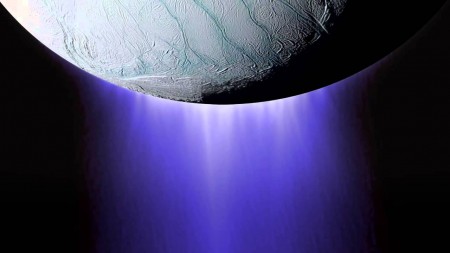
Today we know that Enceladus has more than 90 geysers (see image above) spewing salty water containing organic compounds into space. A mission to the moon doesn’t need to land there to discover if life exists. It just needs to fly through the geyser plumes and sample what it finds. The theory is that the geysers may produce bubbles of organic material including exotic biology that concentrate on the surface and get ejected when the subsurface water erupts. Any probe sent to Enceladus would have to include a biological laboratory capable of discerning proteins, amino acids and lipids in water samples. In finding this kind of evidence it would be definitive proof that Enceladus supports living organisms. Most scientists believe it would much harder to find the actual organisms themselves although some hope to devise technology that will capture images of Enceladus’ microbes.
Even more exotic would be the discovery of life on Titan, Saturn’s largest moon. Ever since Cassini and the Huygens lander gave us images of the landscape and lakes of Titan scientists have been speculating on whether a very different type of life could exist there in the extreme cold. A new study has focused on the presence of hydrogen cyanide (HCN) molecules in Titan’s atmosphere as evidence of life formed from polymers.
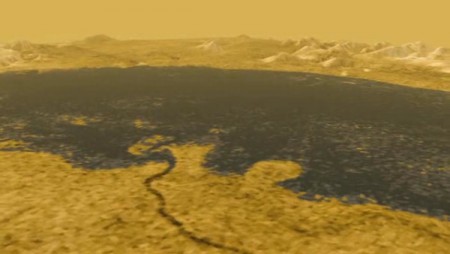
One of those polymers, polyimine is capable of creating complex molecules in the presence of light in a low temperature environment. Now consider that Titan’s surface is covered by lakes, rivers and substantial seas of methane (see image below) and you have an exotic chemistry for a different type of life, not water based as here on Earth, and capable of thriving at -180 Celsius (-292 Fahrenheit) degrees.
A probe landing on Titan would carry on board a chemistry lab that would be seeking evidence of a very different type of biology. And should it discover the building blocks of that life it will tell us that the Universe is far richer and more diverse in life than we ever imagined.
]]>
Kraken Mare stretches more than 1,000 kilometers (620 miles) across Titan’s surface. At its deepest the lake bottom is 300 meters (close to 1,000 feet) below the surface. The group would conceive a design for a robotic submersible to map the liquid methane domain, study its currents, chemical composition, waves and other phenomenon.
Currently the group is calling their concept, the Titan Sub. If successful similar submarines could be designed to explore the suspected water oceans under Europa and Enceladus and the asteroid Ceres.

For whatever the reason the voyage of the joint mission of Cassini and its companion Titan probe, Huygens, continues to amaze us with imagery and telemetry on the Saturnian system. NASA, the European Space Agency and the Italian Space Agency developed the technology that was launched in October of 1997. Seven years later the spacecraft arrived at Saturn entering into orbit around the planet. In 2005 the Huygens probe landed on Titan’s surface. Huygens transmitted images and data from the surface for a short period before falling silent. In its descent and landing we gained a great deal of knowledge about Titan.
Today Cassini continues to operate its cameras, spectrometers, magnetometers and analyzers as it swings around the planet visiting the moons and giving us spectacular images of the entire system including Saturn’s amazing rings.
The Challenge of Getting to Saturn
The technique deployed by Cassini to get to Saturn involved gravity assisted acceleration. In the diagram below you can see the indirect route taken. It involved a Venus flyby in 1998 and then Venus, a second time, followed by Earth in 1999. Next was a close encounter with Jupiter in 2000 and from there it travelled to Saturn arriving in 2004. Each planetary flyby provided a gravity assist to Cassini gaining speed with each pass. Total flight distance equalled 3.5 billion kilometers. This method allowed Cassini to save fuel and made it possible to keep its launch weight under six metric tons. Without gravity assist the spacecraft would have required a much larger compliment of fuel.

Designing a Spacecraft for Long Distance Communication and Survival
Cassini had to be designed to operate with a high degree of autonomy. On average it takes one hour and 24 minutes for a transmission from Earth to reach it. That means a 3-hour round trip between Earth and Saturn. The images Cassini transmits back to Earth give scientists a visual means of understanding the orientation of the spacecraft and its location within the Saturnian system. Instructions are then sent from Earth to orient the spacecraft’s instruments for whatever the planned objective whether a moon, the rings or the planet itself.
With the Cassini mission planned to continue for another five years until 2017, power and fuel consumption are paramount concerns. Cassini relies on three plutonium fuelled RTGs for power and heat in the extreme cold near Saturn. As the plutonium decays Cassini slowly loses power. But it has sufficient capacity to keeps its instrumentation in operation for the foreseeable future.
Propellants are another matter. Cassini is fuelled with two types of propellants, a mono-propellant and a bi-propellant. The mono-propellant, hydrazine, is used to do small maneuvers such as positioning and alignment. The bi-propellant, a mono-methyl hydrazine with nitrogen tetroxide has been used for course correction and other large maneuvers. When Cassini started out it had 132 kilograms of hydrazine, 1,131 kilograms of mono-methyl hydrazine and 1,869 kilograms of nitrogen tetroxide on board. Much of the fuel was spent getting to Saturn and for orbital insertion. The remainder is seldom used and as a result the spacecraft even with less than 10% of its original bi-propellant remaining can continue to fly.
What We Have Learned So Far About Saturn and its Moons
How do you sum up what we have learned from Cassini? The science and discoveries have been incredible. Here are some highlights:
With Cassini, we are not done yet but once the mission is over expect a return to Saturn’s neighbourhood with missions that will land and explore Titan and Enceladus.


