When robots were first introduced into production lines they were single purpose automatons such as those on automotive assembly lines doing spot welding or repetitive builds. These robots were simple servomechanisms programmed to do one thing and do it precisely and repeatedly with no human intervention. But with the onset of robots like Baxter, a multi-purpose, teachable robot, calling the machine a simple servomechanism is no longer apt.
So what is the current and near future state of human-robot interaction in manufacturing and service industries? Professor Thomas Sheridan of MIT addresses this subject in a paper appearing on April 20, 2016 in the journal, Human Factors. Entitled, Human-Robot Interaction: Status and Challenges, it looks at current research from a human factors perspective. In a Kurzweil News summary of the paper it poses the question “Would you trust this robot?” under the picture below showing Baxter working side-by-side with a human.
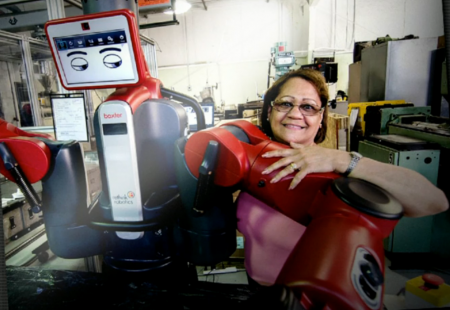
Among the concerns raised when talking about robot-human interaction is safety. Sheridan talks about Baxter, a product of Rethink Robotics, a Boston company. Baxter is designed to work in close proximity to humans. Baxter isn’t going to swing his arms and connect with the head of the human next to him causing damage. But Baxter doesn’t intuitively know how to do a task along with a human laborer. Instead he has to be taught. For this purpose Baxter is mechanically compliant. His display is designed to communicate to the humans with whom he is working. And his co-laborers don’t have to be programmers to teach Baxter. They can show him how to do a task by moving his arms and body to teach the robot a job. As such Baxter represents the leading edge of human-robot interaction a new field where general purpose automata can be trained by human laborers to work with them.
In Sheridan’s paper he covers the full range of robot-human interactions including:
In his assessment of human-robot interactions Sheridan raises the issue that robots may enhance work and not be the dreaded job stealers that are described in the press today. Those headlines that warn us of the millions who will no longer be employable may prove to be fantasy as humans and robots assist each other in the workplace both in the present and near future.

