Today’s solar photovoltaics are made from crystalline silicon and cadmium-telluride. These cells continue to be expensive to produce, use both scarce and toxic materials, and are at best 20% efficient in converting light into energy. The cells are inflexible and limited in deployment to rooftop surfaces or in ground-based arrays.
The ultimate goal of the industry is to develop solar technology that works like plant cells. This means finding an equivalent to chlorophyll. A first step was made in 1991 with the development of Gratzel Cells. These cells use an organic dye and nanoparticles composed of titanium dioxide to mimic chlorophyll. The dye acts as a solar absorber converting sunlight into free electrons. The inventor is Michael Gratzel, Director of the Laboratory of Photonics and Interfaces at the Ecole Polytechnique Federale de Lausanne.
Gratzel Cells have unique advantages that include:
But Gratzel Cells have suffered from a number of challenges including:
The first commercial product using Gratzel Cells came out in 2009, a solar array backpack for charging portable electronics.
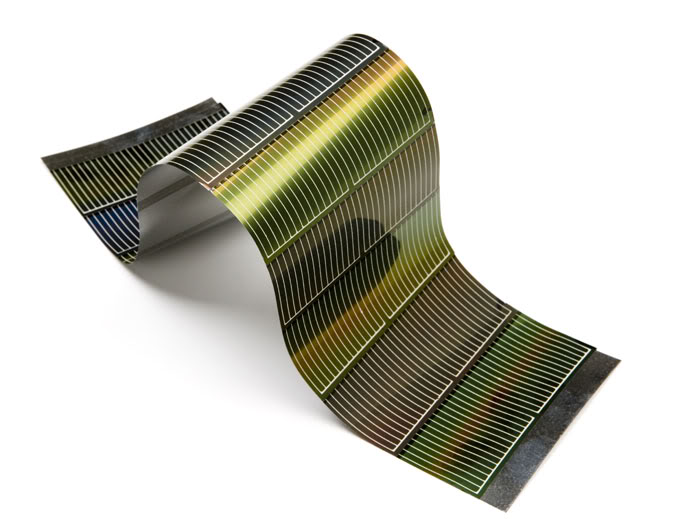
Researchers at Northwestern Universityhave been experimenting with a replacement to the organic liquid dye using a solid electrolyte. The result is the Kanatzidis-Chang Cell, named after two of the research scientists who developed it, made from cesium, tin and iodine. Each cell measures 0.5 centimeters (less than 1/4″) square and about 10 microns thick. A cell contains billions of nanoparticles, each 20 nanometers in diameter, creating huge surface areas for interaction with sunlight. Current performance is half the efficiency of top-of-the-line silicon-based photovoltaics but improvements of 1% per month have been demonstrated in the University’s lab.
The new cells have many advantages over Gratzel Cells.

]]>