Geologists and engineers, however, are finally unlocking the secret of Roman concrete.
The Romans made concrete by mixing lime with volcanic rock and seawater. The mineral characteristics of the rock contained pozzolan, a substance derived from volcanic ash. Pozzolan today can be found in lots of places around the globe.
In addition the binder in Roman concrete contains a substance given the acronym CASH, standing for a combination of Calcium, Aluminum, Silicate and Hydrate.
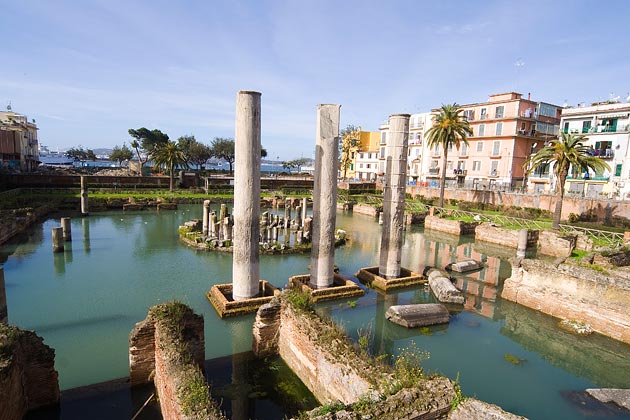
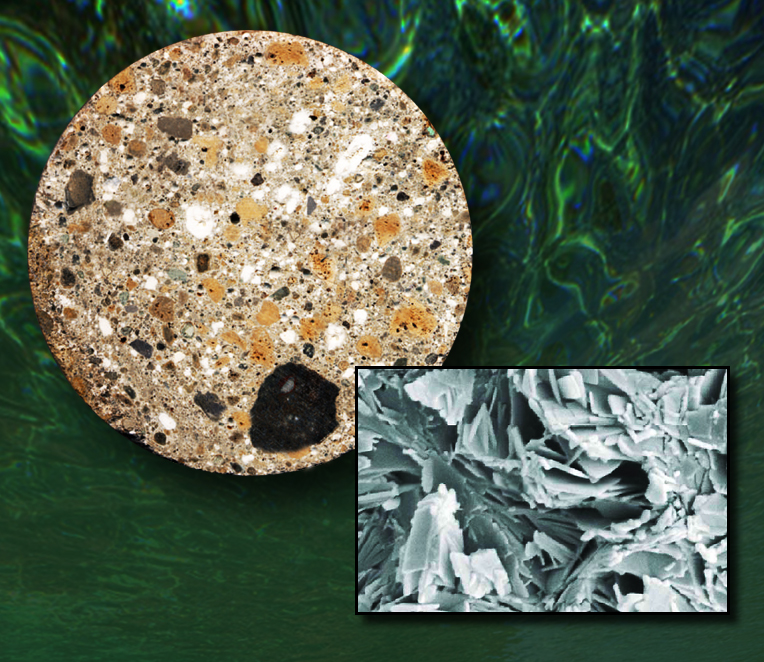
The researchers, in extracting a core from a 37 B.C.E. concrete breakwater found in the port of Baiae, Bay of Naples, across from Mount Vesuvius, found aluminum-tobermorite crystals. The crystals appear to have formed as the concrete was set by Roman engineers when poured into wooden forms. It is these crystals that produce the concrete’s superior quality. You can see them in the electron-microscope inset image on the right taken from the core. The latter appears to the left in the image below.
Other unique characteristics of Roman concrete:
Back in February concrete was the subject of one of my blog posting in which I talked about concrete and climate change. In that posting I indicated that today we produce 12 billion tons of the stuff annually and that concrete is the third largest contributor of human-produced greenhouse gases on the planet today. That 12 billion tons number may be low balling it. In the latest information I have read the number is more like 19 billion tons. That’s a lot of concrete accounting for 7% of the CO2 industry puts into the air annually.
What Rome’s engineers produced, however, has not only stood the test of time, but also may be one answer in our current quest for a sustainable, greener future.