Aisa and Raphael Mijeno created and launched their invention, SALt, standing for Sustainable Alternative Lighting, last year.
Aisa, who is the sister in this family act, has an engineering degree and is on the faculty at De La Salle University – Lipa. As a member of Greenpeace she was inspired to invent the lamp while visiting the Buscalan, a mountain tribe in Kalinga, the Philippines. Being off the grid, the Buscalan were using kerosene lamps for interior lighting. To get kerosene it meant traveling for several hours to find a source and then hiking back to their mountain homes. The kerosene was also a fire and health hazard.
Raphael’s contribution has been on the business side. He has a Bachelor of Science in Business Management with a background in accounting, finance and sales. He is big on social engineering and startups.
How does SALt work?
The lamp consists of a multiple-LED light fixture and two metal electrode rods immersed in a small receptacle of water to which two teaspoons of salt are added. If you live by the ocean SALt runs on plain ocean water. The ratio of salt to water at 35 parts per thousand is perfectly adequate. A bottle of seawater in reserve and you can operate the lamp continuously. Just replace the seawater electrolyte.
The electrodes are made of two different metals, composition not disclosed, with the lamp deriving its power from what appears to be a saltwater battery. Metal anodes contact the saltwater electrolyte. This leads to the emission of free electrons which travel between the two electrodes generating the current which then is transmitted by wire to power the LEDs. The prototype features a USB port to do double duty, recharging a smartphone or providing power to other small electronic devices. A single glass of sea or saltwater provides up to 8 hours of light. The electrodes need replacement on average every 6 months. Current estimated cost to NGOs – about $20 U.S. Initial production, about 600 units to go to local Philippine communities. Future plans include larger production and distribution including online purchasing.
SALt is one of a number of innovative gadgets, that I have previously described at this blog site, aimed at solving the problem of between 1.1 and 1.5 billion living without access to reliable and continuous electricity. Other innovative solutions are deploying inexpensive, portable and maintainable renewable energy for isolated communities. The World Bank identifies affordable, sustainable energy as the single most compelling issue to help people rise out of poverty.
SALt could be part of an elegant and inexpensive solution. On their website the brother and sister state, “This isn’t just a product. It’s a social movement.”

IRRI manages the longest-running rice research project on the planet and note that higher night time temperatures tend to suppress rice yields. According to Grace Centeno, a scientist at IRRI, “Average night temperature over 23 degrees Celsius can lead to yield loss due to the increased need of the rice plant to expend its energy to maintain its biological health.”
In a previous release of the study showing data from 1979 to 2003, rice yields declined by 10% for every Celsius degree increase in nighttime temperatures. Since then the study has continued and negative impact on crop yields is becoming more pronounced. The critical threshold for rice appears to be 23 Celsius (73 Fahrenheit). At these temperatures rice grains have trouble forming properly. Hence reduced yields. A 1% increase in temperature translates to a 6% yield decline.
At 10% yield reductions amount to 0.5 tons of rice per hectare (2.47 acres). In countries where rice is the principle food staple and where population growth appears to be greatest on our planet today, declines of this magnitude can mean the difference between a fed population and famine.
Without remediating climate change all that agriculturists can do is find new varieties of rice that can tolerate these increased nighttime temperatures. And if they cannot then in many countries such as The Philippines and others in South and East Asia, declining yields could play havoc with national stability.
The Case of The Philippines
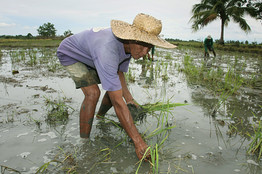
Today in The Philippines where the IRRI study was done rice is grown on small family farms (like the one in the picture above) that average in size from 0.5 to 4.0 hectares. These are largely subsistence operations with small surpluses. There is no new land for farming and with high population growth demand continues to rise.
In 2006 the country produced 11.2 million metric tons of rice with yield growth at that time fairly flat. Once upon a time the country was self-sufficient in rice. But in 2006 it only grew enough to feed 90% of its population which meant the country had to import rice from other Southeast Asian countries producing surpluses. Since then the gap has widened.
Now as rice yields continue to be flat or in decline by as much as 10% based on the study, The Philippines will need to import even more of its major food staple. But from where? If other neighboring countries are also experiencing yield declines who will provide the rice to feed the country?
In 2006 daily rice consumption amounted to 33,000 tons and accounted for 20% of the cost of food per household. Scarcity will only mean higher prices and a greater percentage of the household food budget. Imported rice will certainly cost more as well. Rice is the main staple food for these people as it is for so many other countries in South and East Asia. And what happens when their yields are affected by the same problem, rising nighttime temperatures?
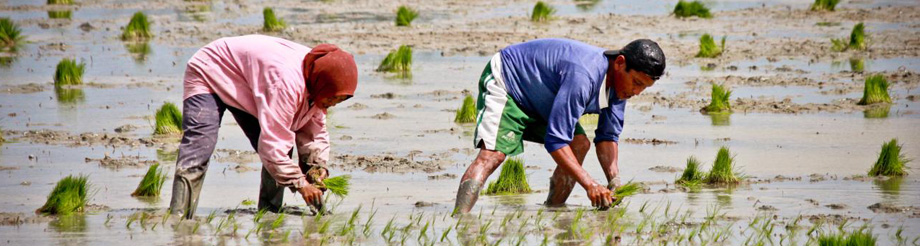
And none of this takes into consideration extreme weather events like the recent Typhoon Haiyan with its devastating impact on the rice crop. In the picture below you can see farmers replanting rice in fields where the typhoon inflicted significant damage.
All in all the situation in The Philippines is not a pretty picture. One solution for the nation is to alter the eating habits of its people moving them from rice as the major staple to another crop. Such a change would be difficult to institute. The most likely outcome at the minimum would be social unrest. The much more threatening scenario is famine.