Keeping one person alive on Mars indefinitely is a tall ask for agencies like NASA, let alone for a private company like SpaceX. If you watched the 2015 movie or read the book, The Martian, you get to see just how challenging prolonged human survival on the Martian surface could be.
An Open Access Scientific Reports article published in June 2020 calculated that the minimum number of human colonists needed to build a self-sustaining community on Mars was 110. This was a downward revision from previous speculative articles that set the number as high as 1,000. Whether 110 or 1,000, the idea behind Martian settlement, as Elon Musk professes, is to ensure humanity’s survival should an extinction event destroy life on Earth.
What has always perplexed me is the go-it-alone idea of only humans leaping to Mars along with a few domesticated plants and animals to be food sources for the continuation of human civilization. I cannot imagine human existence without the natural world to sustain us, without hearing bird song in the morning, or watching butterflies in flight. But I haven’t yet been invited to the International Space Station to find out what living without nature is like for short, let alone longer periods.
But the latest number for human Martian survival is 22 coming from a study produced by George Mason University Department of Computational and Data Sciences researchers in Fairfax, Virginia. At the link provided, you can download the preprint PDF article entitled, “An Exploration of Mars Colonization with Agent-Based Modeling.”
In coming up with their minimalist number of 22, the researchers looked at high-performing teams working in high-stress environments such as submarines, Arctic and Antarctic exploration sites, and small units fighting in wars. It noted that for a habitat on Mars to be largely self-sustaining it will need to find the resources locally for air to breathe, water to drink, fuels and energy for operating life-support technology, and building materials for habitats and infrastructure. These prerequisites were not considered in the study. Rather the focus was going beyond the “incredibly complex engineering problem,” to look at the mix of colonists that could pull this off. The study, therefore, focused on human attributes that would make for a successful demographic mix of talents and personalities. Hence, agent-based modeling (ABM). So what is it?
A Columbia University definition describes it as computer simulations “that study the interactions between people, things, places, and time…built from the bottom up meaning individual agents … are assigned certain attributes. The agents are programmed to behave and interact with other agents and the environment in certain ways. These interactions produce emergent effects that may differ from effects of individual agents.”
This type of modeling is seen as useful for understanding the optimal demographic mix required for the conditions that would exist at the outset of a Martian human settlement.
Looking at team successes here on Earth in extreme environments was therefore the focus of George Mason’s researchers. They studied “the ability of people, organizations and systems, using available skills and resources, to manage adverse conditions.” Unlike any Earth-based extreme environment, the future Martian settlement would experience unique challenges including distance from Earth, and radiation exposure that over four years will have exceeded the safety thresholds for humans to survive here on Earth.
The George Mason researchers posed several questions:
Earth and near-Earth space equivalent environments such as Antarctic bases, and the International Space Station represent the closest analogs. But unlike these, a Martian colony will not be able to rely on Earth to provide food, fuel, oxygen, and water. Waste disposal, recycling, mining of in-situ materials, and other secondary considerations, all part of a self-sustaining Martian settlement, cannot be duplicated by Earth equivalents.
In running the numbers five times through their ABM to determine the minimal colony size looking at a range from 10 to 170, the George Mason researchers concluded that a bare minimum of 10 could exist as long as Earth replacements continuously provided new personnel to make up for deaths. But the number 22 came up as the optimal minimum to maintain humans on Mars for the long run describing it as capable of bouncing back from accidents, stresses in human interactions, and other destabilizing events.
The study’s assumptions included a steady availability of energy (most likely nuclear) as well as sufficient initial water, air, food, and two-year resupply runs coming from Earth.
In Jean-Marc Salotti’s 2003 paper, he stated, “The scenario where you can simply send X number of people somewhere and just let them survive is very unlikely.” The number 22, far removed from Musk’s one million, therefore, based on current technological capabilities seems farfetched and more likely a death sentence rather than a mission to extend our human species to a second planet.
]]>
According to NASA, based on more than two decades of atmospheric data gathering, the low atmospheric pressure on Mars makes dust storms unlikely to meet the ferocity seen in the movie. At their most intense storms produce wind speeds reaching 100 kilometers (approximately 60 miles) per hour. But in the low atmospheric pressure (1% of Earth’s) that’s not enough wind to get a kite to fly let alone to break a telecommunications mast and send it flying into an astronaut impaling him.
Mars does get dust storms that we can see from Earth-based telescopes. Some are as expansive as a continent-wide cyclonic storm should one happen here on Earth. Of course storms that size only happen in movies like The Day After Tomorrow, another good movie that is not good science.
The reality is about once every 3 Martian years (5.5 Earth years) Mars gets significant dust storms. The largest storms on Mars are more common to the planet’s southern hemisphere when it is summer and the planet’s orbit is at perihelion (closest to the Sun). In the past some have gone rogue and encircled the entire planet. When Mariner 9 reached Mars in November of 1971, the entire planet’s surface was completely obscured. The last big one occurred in 2007. Scientists believe Mars is overdue for the next one.
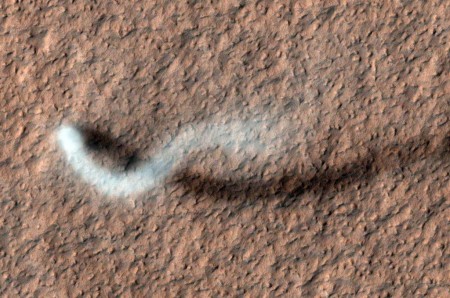
But that’s not the biggest concern for any human crew that arrives on Mars. The Watney experience is highly unlikely. When the movie depicts Watney outside the habitat or his rover, his suit should be covered in Martian dust based on what scientists have observed from rovers and landers on the planet’s surface. Dust on Mars is electromagnetic and clings to equipment. It settles everywhere interfering with photovoltaic panels cutting the amount of energy they yield. Dust devils captured by Spirit’s, Curiosity’s and Opportunity’s cameras can cover equipment in a layer of the stuff or do the exact opposite and clean the surfaces to an almost pristine condition. Dust devils as captured in this image taken by the Mars Reconaissance Orbiter courtesy of Jet Propulsion Laboratory-Caltech and University of Arizona, shouldn’t be confused with dust storms. The former appear to be common daily occurrences produced by local surface heating. They are short duration.
Another fact about Martian storms is they are unlike any that occur here on Earth. As soon as a storm gets going it produces the seeds of its own destruction. The mechanism driving it is sunlight reaching the Martian surface producing radiative heat. When it arises it effectively begins to block the heat source diminishing it within a short period. During a storm dusty Martian air can be as much as 35 Celsius (63 Fahrenheit) degrees warmer than clear air within the vicinity.
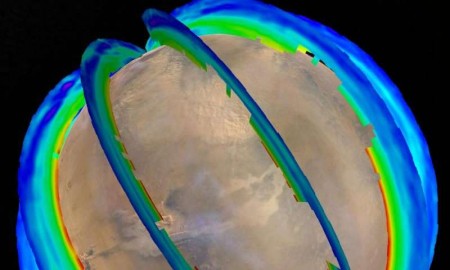
The data used to produce the paper has been accumulated from Mars orbiters in continuous operation around the planet since 1997. The image below graphically presents what happens to the Martian atmosphere during a regional dust storm. Temperature is colour coded with the warmest appearing in red near the surface and the coldest in the deep blue at about 80 kilometers (50 miles) up. Temperatures depicted here range from minus 23 Celsius (minus 9 Fahrenheit) at the surface to minus 153 Celsius (minus 243 Fahrenheit) at 80 kilometers. The image was produced by NASA and the Jet Propulsion Laboratory-Caltech.
]]>
In anticipation of this latest space movie I downloaded Andy Weir‘s compelling novel, The Martian, upon which the film is based, describing a stranded astronaut’s ordeal on the surface of Mars. Weir’s book first self-published in 2011 has become a global bestseller. It describes how a very smart and tenacious American astronaut named Mark Watney uses his own ingenuity and NASA tools and technology designed for human missions to Mars to stay alive when stranded on the Martian surface. Starring Matt Damon as Watney, this tale of woe is believable because Weir stays true to the science and technology that exists or is in the planning stages for future off world missions.
Watney is left for dead by the rest of his crew when a dust storm forces an emergency evacuation of a future NASA Mars mission landing site. With him separated from the rest of the crew and the telemetry from his spacesuit malfunctioning the unconscious Watney gets left behind. But he survives the storm to find himself alone. With a will to survive he displays incredible inventiveness. He turns left over hydrazine fuel into freshwater. He takes potatoes brought along during the mission and plants them inside the Martian habitat that was designed to support the mission crew for a month-long stay. He uses the human transportation systems abandoned by the crew to explore his immediate surroundings and to haul materials back to the habitat. He cobbles together solar panels and battery storage to extend the range of his transport systems with a goal to reach the next human mission landing site to await rescue.
One NASA staffer monitoring images satellite images from Mars notes his activities and alerts alerts the organization to the fact that Watney is very much alive.A bold rescue plan unfolds. But until it can happen Watney has to stay alive modifying technology at hand to help achieve that goal.
The story is a riveting read. If you haven’t had a chance to get a copy or have yet to see the movie I have no intention of being a spoiler. I recommend you download the book, buy it, or get it from your local library, and of course, considering the movie reviews that came out last week, I think a visit to your local theatre may be in order in the near future.
NASA couldn’t help but get into the action with the movie release. The agency is helping to promote the new film as a way of publicizing its own plans to mount missions to Mars in the fourth decade of the 21st century. The next rover mission will include an instrument for harvesting oxygen from carbon dioxide in the Martian atmosphere. The technology is featured in The Martian.
The Space Launch System (SLS) will be undergoing its first proving ground missions before the end of this decade. NASA is also developing the self-sustaining life support systems including the testing of human endurance in space in a current year-long mission on the International Space Station (ISS). Even farming in space is being developed on board ISS so growing potatoes on Mars is far from being far fetched.To get human-sized payloads and habitations that humans can live in on Mars, NASA is testing new heat shield inflatable decelerators, rocket systems capable of soft landing, and parachute systems designed to protect payloads during descent to the planet surface. And between now and the mid-2030s NASA plans for additional orbiters and rovers to accompany its existing robots – Opportunity, Curiosity, Mars Odyssey, Mars Reconnaissance Orbiter and MAVEN, to further explore the Martian surface and study it from orbit with specific goals to test support technologies, discover Martian resources of use to future missions, and select human landing sites.

Speaking of the Mars Reconnaissance Orbiter (MRO) and what its on board instruments have detected we now know from published findings in the last week that Mars today has surface water that flows in the relative warmth of its summer every year. MRO and other orbiters have taken pictures like the one seen below that show surface changes in the form of streaks on down slopes (see lower part of the picture). These dark stains appear when surface temperatures rise to minus 23 Celsius (minus 10 Fahrenheit) degrees or warmer. Analysis indicates that the stains are subsurface water on the move with enough of it reaching the surface to cause a color change. The water is salty which is why it can be in liquid state even with temperatures well below freezing.

The timing of the information release is, in my opinion, no coincidence. We have known since the Phoenix Lander reached Mars that there was water in Martian soil. When Phoenix first scraped the soil of Mars uncovering a white substance beneath, analysis showed that this was ice. Over days the exposed ice eventually evaporated. Analysis by Phoenix showed that this was briny water containing perchlorate. We also have known from Earth-based observations that Mars contains a legacy of frozen water in its polar ice caps. And orbiters have provided us with tantalizing evidence of glacier-sized deposits of ice under Mars’ surface. But the mystery of the seasonal streaks on Martian canyon slopes was not fully explained until now.
So it seems a confluence of events and discoveries is driving the agenda to get humans to the Red Planet in this century despite the many challenges. I for one think that we need to establish permanent human habitation in space before we decide to people Mars but this seems to be ignored by space agencies like NASA when looking at the next steps in our outward urge. Proving we can create self-sustaining communities in space, building artificial gravity systems that ensure our bodies adapt, finding technologies to deal with the threat posed by cosmic radiation and solar flares – all these challenges must be met before we consider setting foot on another planetary orb in this Solar System. It seems the cart is being placed before the horse in this drive to get to Mars.
]]>