Today we take data from observation satellites to do pattern analysis and this allows us to derive some pretty interesting conclusions. What we are learning is how climate influences us and how we influence it. And in addition we are learning that a physical phenomenon that is not weather happening in one area of the globe can have significant impact on climate elsewhere. For example, here are some interesting observations from studying El Nino events in the Pacific Ocean over the last few decades. El Ninos correlate directly with extreme weather patterns from Australia to California to eastern North America and beyond. Here are just a few of those correlations:
Since we are using the El Nino as the example, exactly what is it? First observed off the coast of Peru and Central America it refers to a warm ocean current that appears near Christmas (hence El Nino, referring to the birth of the baby Jesus). The Peruvian fishery collapse associated with this invasion of warm water has an enormous impact on those countries dependent on this food and revenue source. But the impact of an El Nino is far more pervasive than that. It influences the path of jet streams over North and South America. It raises sea levels causing storm associated higher than normal coastal flooding and erosion. It changes winter in western North America making it warmer and drier and encourages the opposite impact on winters in eastern North America which become colder and wetter (remember the recent winters eastern North America has experienced and you begin to see what I am talking about).
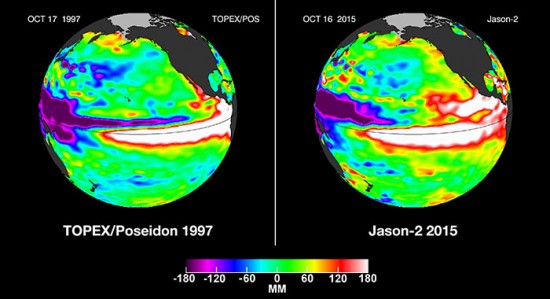
Where El Nino events in the past might have occurred in cycles of up to seven years, now it appears the time between cycles is shortening. A new El Nino event for the Christmas period of 2015 has been observed by current Earth observation satellites, one of them Jason-2, a NASA and NOAA joint project. This new El Nino appears to be the most significant since the late 1990s and is expected to impact precipitation and temperatures across all North America.
NASA’s fleet of Earth observations satellites are tracking the impact of this El Nino. For example, one satellite measures precipitation every three hours. Another reports surface soil moisture levels. Data collected will help scientists, engineers and farmers put into place adaptation and mitigation strategies to offset El Nino climate impacts.
To get a sense of how significant this year’s El Nino will be take a look at the comparison based on data collected from 1997 with that of the present. The large white bands spanning the Earth’s equator show the extent of the ocean surface warming and this year’s is bigger than what was observed in 1997, the former record holder.
Researchers at the Ocean University of China and University of Hawaii are using the data to study a previously little known phenomenon called mesoscale ocean eddies. These are spinning masses of water that can be 80 to 500 kilometers (50 to 300 miles) in diameter. Not to be confused with gyres or the eddies caused by passing ships, these phenomena form depressions in the ocean surface as they spin. They are found in sub-tropical waters and tend to flow east to west following the direction of the Earth’s spin. They typically last months but in some cases years moving masses of ocean water and trapping floating debris and chemical pollutants within the water column.
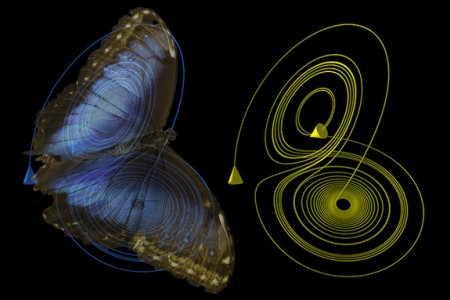
We have a lot still to learn about the ocean. We know that the ocean currents alone are not responsible for the mixing and distribution of water across the planet. Some other factors are involved. For example, the so called Butterfly Effect, where the wing flaps of a butterfly on one side of the globe can spawn a hurricane on the other side, has a parallel in our oceans. And oceanographers are studying it looking at the smallest movement of zooplankton, and jellies, as well as larger ocean life to determine how all impact ocean circulation.
Mesoscale ocean eddies appear to be another ocean mixer. Much bigger than the Butterfly Effect of ocean life, these water vortices are contributing to the distribution of seawater and all that is contained within it possibly even more than our more familiar ocean currents like the Gulf Stream. And as a result, these eddies may influence El Nino and La Nina southern ocean oscillation events that have such a profound impact on climate thousands of kilometers away.


