But in Bexar County, San Antonio, Texas, that’s the plan in the works – to open a library without physical books this fall. Called Biblio Tech, the library would be located in an under-served area of the county. Sounds strange but maybe not. Other U.S. cities have made similar attempts. In 2002, Tucson, Arizona opened a bookless library but five years later, because of customer requests, they added physical books. A 2011 proposal to build a similar facility in Newport Beach, California, ended when public outcry resulted in the project’s cancellation.
Publishing and books are changing. Of that there is no doubt. I recently wrote a blog on the evolution of textbooks in which I described how e-Textbooks because of the cost of academic publishing, represent a significant alteration in the way information of this type is provided. That’s because textbooks in post-secondary education can individually cost hundreds of dollars.
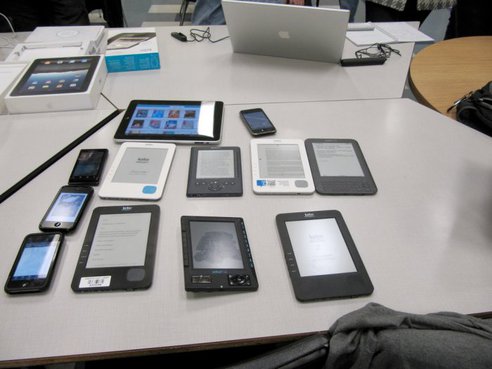
That may explain why San Antonio s home to an academic bookless library at the University of Texas which opened in 2010 and is winning accolades from students. The proposed public library, however, unlike its academic cousin will carry a limited number of titles all available to library visitors who will be able to check them out loaded on an eBook reader. Biblio Tech initially plans to have 100 eReaders available with 10,000 titles to choose from. eReaders can be checked out for two weeks and will time out and go dead if not returned. The Biblio Tech will also feature onsite computers, study areas and meeting rooms.
It will be interesting to see if bookless has staying power or like in Tucson, library members will eventually ask for physical books as well. As an avid user of my local library branch, I enjoy all of the resources that facility has which include computers, audiobooks, films on DVD, CDs, and thousands of physical books all organized and classified by subject area. And my library gives me the option of being able to go online and reserve books by author and title search when they are not available at my local branch. These then get delivered to the branch and I get notified by email, drive over and pick up my selection. I have even downloaded eBooks from the library to my Kobo eReader and my Samsung tablet. How much more convenient and accessible can a library be?
I just don’t see Biblio Tech as a long-term success. Certainly a novelty for the short term but checking out an eBook reader? How different is that from checking out a physical book?

I grew up in a world of books. It is reflected in the thousands of books that line the shelves in my home to this day. And when I couldn’t get a teaching job upon graduating from university in 1973 I naturally gravitated to the publishing industry where I became, first a seller of textbooks and then eventually an editor who worked on new product acquisition and development. As an editor I learned to build what were called managed books, textbooks that reflected local curriculum demand. A managed book had a guaranteed audience because the content was written to the requirements of those instructors who would eventually recommend the text to students. It was a sure fire method for publishing success and I got pretty good at pushing out new product to schools across the country. It also taught me about shaping content to the learner.
I saw a change coming in publishing with printed words giving way to the digital age as the personal computer made its entry on the scene. And when I was asked to present my ideas on the future of textbook in publishing to to industry executives in 1980 I talked about the impact of the digital revolution on publishing. What I described as the industry’s future was knowledge databases with contributions by authors, each an expert in particular subject matter. I stated that instructors in the future would mine these databases and assemble the content they wanted for their students. Publishers would have to put a value on not whole textbooks but on chapters, or novel research and develop new royalty and accounting models to manage the new paradigm. Would publishers continue to print books? I thought not. Instead the assembled content picked by the instructor would be downloaded electronically and printed at local print shops associated with the university textbook store. Did I get the model right? No. I didn’t anticipate in 1980 what truly disruptive technology was about to impact the world, the dawn of the Internet, the development of Google Search, and the knowledge revolution created by the worldwide web.
The age of the textbook as I remember it is truly coming to an end. Educational publishers can feel the heat if they are not already out of business. That’s because educational publishers have never adapted to the way learning has changed because knowledge delivered is no longer the way young people learn.
So it was interesting for me in my online search this week to uncover Principles of Science, Textbooks for the 21st Century. Published by the journal Nature in association with Scientific American, the goal of this series is:
Provide research-oriented, interactive learning
The first “book” in the series is Principles of Biology, containing 196 customizable modules covering chemistry, cell biology, genetics, evolution, animal and plant physiology, ecology and biodiversity. Each module is designed to be self-contained with instructional text, self-tests, interactive exercises and of course formal testing. The text is electronic, accessible from the cloud, downloadable to a tablet or computer in digital version, compatible with Linux, Windows and Macintosh systems, and printable in full colour. It remains current and constantly changing as new research gets published. For teachers the textbook comes with 100 current research papers from journals, a test bank containing 1,000 questions, an instructor’s guide, and electronic slides containing all of the text’s artwork. The electronic edition is listed at $49 U.S. As one reviewer states that makes it not just affordable, but lightweight and it never goes out of date because it constantly gets enhanced and updated through its interactive web content. In a sense the textbook give students and instructors a license to lifetime learning on the subject matter.
Learning in the Age of the Internet Has Changed

Principles of Biology has taken the first step in understanding the nature of how learning has changed in the age of the Internet. A few years ago I read a paper entitled Textbook Publishing in the 21st Century: Changing the Higher Education System. Written in 2008, the authors state that for publishers to succeed in the 21st century they have to discard the old learning model their textbooks were designed to support – the lecture and test methodology, that is, learning delivered and regurgitated. They go on further to state that learning needs to be learner-centered and problem-based, and that the classroom becomes a place to apply basic knowledge to advance learning, no longer a place for instructors to stand and deliver.
Are the publishers of Principles of Biology alone in understanding the implications of learning in the age of Wikipedia and Google Search? In my recent research I found very few of the traditional publishers who have recognized the changed learning paradigm. I have taken note of one, McGraw-Hill, an old rival of mine when I was in the industry. They have launched the first all-digital, cloud-based textbook series for the elementary and high school market. Called the CINCH Project, this new learning model was released in 2011. It embraces all the methodologies described in the paper I referred to in the previous paragraph. Will McGraw carry this approach beyond high school publishing? Only time will tell.
For textbook publishers survival in the 21st century, let alone within the decade, will require much more than publishing electronic versions of their standard print books. Sites like CourseSmart today offer all kinds of e-textbooks. But these are largely designed to support the stand and deliver lecture and test learning model, a methodology that has little traction for today’s learners with their exposure to social media, unlimited web search and Wikipedia. Will these old-school, traditional publishers survive disruptive technological and methodological change? Not many I fear.
]]>