Observed shifts in crop plantings between 1970 and 2010 are analyzed. The findings show that warmer temperatures and drier conditions impact some crops more than others. Temperature effects cotton, rice, sorghum and winter wheat. Farmers when confronted with drier conditions plant more sorghum, winter wheat, spring wheat and hay. When wetter the move is to corn, cotton, rice and soybeans.
The analysis of crop shifts correlated to climate change varies widely. By latitude climate change may explain between 7 and 50% of changes in crops planted. By longitude, 20 to 36%. And by elevation 4 to 28%. These are significantly large variables.
The authors of the study, however, see a trend in future crop mixes pointing to an overall shift in farming production moving north and east from current centers.
The analysis compiled almost 100,000 records from 2,693 U.S. counties in 41 states to determine land use and crop types and covered 96% of the country’s farmland.
Historic crop mixes and planting shifts can be linked to changes in climate with a westward movement noted for cotton, hay, spring wheat and corn, a northern movement for winter wheat, soybeans, corn and hay, and higher elevation movement for hay, soybeans, spring wheat and corn.
Future shifts based on current climate change models and climate data trends can be seen in the infographic displayed below. Each crop label displayed shows a starting point and the directional shift expected based on climate change models. The charts to the right of the map indicate expected elevation shifts in ten-year period increments.

Of the primary crops grown in the United States, the study indicates the least impact to be on corn. All the rest are far more susceptible to a warmer and drier Midwest which today represents the agricultural heartland.
The research methodology was developed by Sung Ju Cho, Korea Rural Economic Institute. The study was set up by Bruce A. McCarl, Department of Agricultural Economics, Texas A&M University.

These class of drugs when administered in comparable doses to what a human would ingest extend the lives of fruit flies, yeast and worms by 15%. And not only do they increase lifespan, those given the drugs appear to be much healthier.
The research comes from the Buck Institute and the biochemistry department of Texas A&M University. The peer-reviewed paper describing a three-year study appears in PLOS Genetics this month. Beginning with Baker’s yeast and then progressing to fruit flies and worms, the study shows that a particular NSAID, Ibuprofen, interferes with cells picking up a commonly occurring amino acid, tryptophan.
Tryptophan is an essential amino acid that we humans do not produce. We get it from eating plants and animals. When we ingest it, our bodies turn it into serotonin, a chemical regulator that combats depression.
C. elegans, the species of worm used in the study (see image below), normally lives about 3 days. When treated with Ibuprofen, not only did the worms live longer, but they also swallowed food faster and were far more active. One additional note, Ibuprofen-treated worms showed inhibited deposition of amyloid β peptide, a marker in humans for Alzheimer’s disease.
On yeast treated with Ibuprofen the researchers observed slower development and reduced cell size. In every other respect, however, the cells appeared healthy and lived much longer.
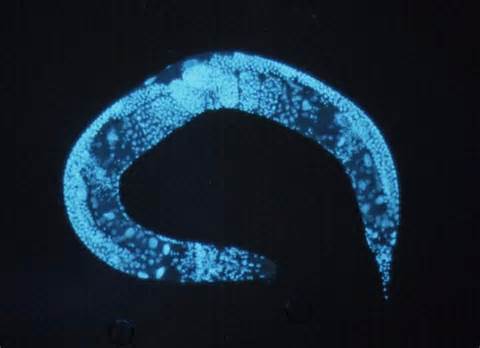
The researchers are now seeking out other NSAIDS and anti-inflammatory medications that may produce similar or even better results.
A note of caution, however…..we may live longer and be more active, but without the benefits of tryptophan and its serotonin conversion we may all be more depressed.
]]>
If you think of the most recent disasters that made headlines in 2010 and 11 you can begin to envision how robots can play a part in prolonging life in emergencies. From the earthquakes in Haiti and South Island, New Zealand, to trapped miners in Chile, the tsunami in Japan, and most recently the foundering of the cruise ship, Costa Concordia, engineers get inspired to come up with new ways of supplementing human intervention and rescue efforts using robotic systems. In some of these recent tragedies robotic devices were deployed. But that is not the only use for robots in emergency medicine.
The Robot Will See You Now
Robots are used in emergency medicine in many ways. One is as patient screening tools, marrying robotics with computing science. Hospital emergency rooms represent bottlenecks with patients spending long hours waiting for a doctor or nurse. Shortening the wait times using a triage robot has inspired engineers at Vanderbilt University to develop TriageBot,

A smart kiosk, TriageBot takes a medical history, measures vital signs and detects problems. The robot prioritizes patients based on severity of symptoms and history and can connect to on site staff even outside the emergency department should they be needed. The form of TriageBot is still under development. It could look like the fanciful and friendly robot displayed above or resemble an airport check-in terminal, or it could be built into a hospital waiting room chair. Designed to continuously monitor the patient before being seen by a member of the medical team, TriageBot represents an innovative use of robots in hospital settings.
But not all emergencies happen in the waiting room of hospitals. TriageBot systems when hooked up to a telecommunications network can provide both screening as well as monitoring of patients in remote areas. As the software evolves this type of emergency medical robot should prove invaluable.
The Japanese have a way with robotic systems and not to be outdone, Kyushu University has been experimenting with a robot prototype mobile monitoring system. (Click on the hyperlink in the last sentence to watch the movie. Although the narrative is in Japanese, you quickly get an understanding of how this apparatus works.)
Built for AICHI Expo 2005 this mobile chair features remote control driving done by emergency medical staff off site, vital signs monitoring, emergency first aid and even a defibrillator. The remote operator can talk and see the patient, communicate with bystanders and give them information on how they can help a person having a seizure, fainting or heart attack.
The Robot Will Find You Now
CRASAR is the Center for Robot-Assisted Search and Rescue at Texas A&M University. On its website it lists participation in using rescue robots going back to the collapse of the World Trade Center buildings in 2001. One area of development focuses on using robots as human proxies to provide communication with a trapped person that cannot be reached immediately after a disaster.
Survivor Buddy can work with medical staff to interact with a survivor during the period when help is not yet able to extricate the person. The robot includes a monitor that displays non-verbal human attributes by rotating and moving in a human-like way.
Sandia National Laboratories have been working on robots that can deliver food, water, oxygen and medical supplies to trapped miners underground while encountering environments that could prove lethal to human rescue workers. Designed to withstand flooded areas and explosions from pockets of methane gas the Gemini-Scout Mine Rescue Robot comes equipped with a range of sensors as well as pan-and-tilt, and thermal cameras that elevate to see over obstacles. It travels on flexible treads that climb over obstacles. Using a game controller, Gemini-Scout is designed to work with first responders and can be outfitted for earthquakes, fire and other disaster scenarios.

The Snakebot employs biomimicry to do search and rescue for trapped victims of disaster. An active scope camera that slithers, this robot was used to find trapped people under the wreckage of the 2011 earthquake and tsunami that struck Japan.
But snakebots can even go beyond search and rescue. Carnegie Mellon University roboticist, Howie Choset, has designed a snakelike camera device that with 102 joints is capable of imaging and mapping internal organs such as the heart muscle. Although not a search and rescue application, these types of robot designs demonstrate flexibility with capability to serve multiple biomedical applications.
Nowhere have emergency medical robots been studied more than in the military where they are seen as extraction and evacuation tools that reduce collateral casualties. The United States military increasingly uses robots in all of its field operations including drone aircraft as surveillance and strategic strike weapons, as well as robotic land vehicles. With the goal of having 1/3 of its land vehicle fleet unmanned by 2015, robotic medical evacuation will become a common feature. The American army is testing both robotic evacuation and extraction vehicle technology to move patients from fire zones to hospitals. This includes using humanoid robot designs like the one pictured below.

Using robots capable of picking up an injured soldier on a battlefield represents a way of reducing deaths associated with casualty recovery operations.
The military is also testing unmanned aerial systems that can land and working with casualty extraction robots, remove wounded soldiers from environments where radiation or toxic gas would make it impossible for human intervention. Unmanned aircraft are also being tested to provide surveillance and medical response. To provide the human touch, robot extraction systems include telepresence so that a soldier remains connected to a medical support person even though they are not physically on site.
In our next blog we look at the emerging field of robot exoskeleton technology and its biomedical uses.
]]>
