Our Biological Limits
In the latter part of the 18th century the average human lived 24 years. By the end of the 19th the average lifespan had doubled. In the second decade of the 21st century we are approaching a doubling again. Is there a biological limit?
We are the sum of our genetics. How long your parents lived may indicate how long you will live. But then again it may not. We know that altering genes can alter the lifespan of animals and plants we study in laboratories. We have doubled the lifespan of mice by splicing genetic material into their chromosomes.

In an earlier blog we described the structure of DNA, genes, base pairs and chromosomes. It may be helpful to click on the link provided as a quick refresher before reading further.
We have two DNA repositories in every cell in our body (blood cells not included). That DNA is found in the nucleus and mitochondria within the cell. The DNA organizes itself as chromosomes. When cells replicate the chromosomes divide and copy themselves. This is called mitosis.
Telomeres are repeating DNA base pair sequences that sit at the end of each chromosome. They act as buffers to ensure that DNA replication during mitosis remains accurate. A ribonucleic protein enzyme, telomerase, maintains the telomeres. As cells divide some telomere information does not replicate, usually between 25 and 200 base pairs. The average telomere can be as long as 15,000 base pairs so what is lost is not significant until the cells divide many times. The accumulation of lost base pairs starts adding up.
Why do we lose telomeres? This may be a reflection of our natural aging process, the unwinding of our biological clock so to speak. Or telomeres may shorten because of external forces such as exposure to toxins, disease or injury. Ultimately when chromosomes no longer have a telomere buffer cells they no longer can divide and we call this cellular state senescence. The Hayflick limit, named after the scientist (see the image below) who, in 1961, first discovered this phenomenon, is the natural limit of a cell’s life after multiple replication.

Do all cells have a Hayflick limit? Apparently not as scientists have observed in studying cancer. Tumor cells do not suffer from DNA strand shortening. They can infinitely replicate because in cancer cells telomerase remains active restoring telomere length. Other cells that don’t exhibit the shortening of telomeres include sperm and egg cells. Hormones may impact telomerase activity and telomere lengths. It is believed that estrogen plays a role and may explain why women live on average longer than men.
If we were to alter the behaviour of our normal cells by stimulating telomerase could we reverse the aging process, ending senescence? This is possible. Use of telomerase in laboratory settings has shown that it can confer “immortality” on several types of human cells. That same capability makes telomerase one of the key factors in cancerous tumor cell growth and is leading to research into telomerase inhibitors that would transform cancer cells by starving them of the protein and putting them into senescence.
Telomeres alone do not extend life. If they were the sole means by which we could stop aging we have the technology to produce on mass altered cells containing high levels of telomerase and bank these for use to cure incalculable diseases. Right now scientists believe that stopping telomere shortening may add 10 to 30 years to the average life span. That would mean a child born today could expect to easily achieve an average lifespan of a century.
Other Factors to Consider that Impact Aging
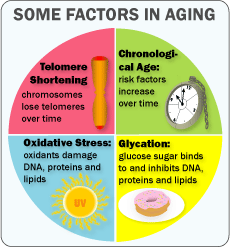
If you are over 60, which I am, your risk dying doubles every 8 years. Research shows that shortening of telomeres only accounts for 4% of the difference. Chronological age and gender account for an additional 33%. The remaining 63% can be attributed to:
Oxidation sounds like a strange contributor to aging. After all, we need oxygen to breathe and a byproduct of this basic life function is oxidants. Oxidants result from oxygen combining with sugar to produce energy and byproducts called free radicals. Not all free radicals are internally produced. They can also come from infections, inflammation, alcohol, smoking, excessive sun exposure, radiation from x-rays and environmental toxins. Free radicals can have a negative impact on individual cells, proteins and fatty tissue. Free radicals over time can build up in the body and are associated with aging. In a recent study the lifespan of worms was increased by 44% by neutralizing oxidants.
Glycation involves excess glucose binding with our DNA, proteins and fats. Excess glucose begins to interfere with normal body tissue functions. The older we get the more the glucose creates health problems contributing to aging let alone body mass. Research shows that restricting calorie intake and selecting foods low in sugar leads to reduced age-related disease and extended lifespans in mice to monkeys.
Inflammation is the body’s natural response against infections and injuries. It also contributes to tissue injury and ultimately to aging. Chronic or persistent inflammation without significant infection is evidence of an immune system that no longer recognizes host body tissue as its own. As we age autoimmune conditions including chronic inflammation become more prevalent. Chronic inflammation destroys normal cells and contributes to the aging of the cardiovascular and nervous system. Inflammation contributes to age-related neurodegenerative diseases, such as Alzheimer’s and Parkinson’s.
Stress harms DNA and speeds the aging process. A study in 2004 showed that psychological stress shortens telomeres in immune cells. Evidence shows that stress, the endocrine system response and the occurrence of disease define age more than chronological aging. Certain diseases occur when anabolic hormone levels start to decline and catabolic hormones start to increase. The latter, such as Cortisol, can contribute to the breakdown of body tissue. As proof of just how much stress contributes to aging and premature death, interviewers who spoke with centenarians found that they exhibited healthy coping strategies in dealing with illness describing their behaviours as accepting, non worrying and taking life one day at a time.
Immune Response refers to the specialized cells generated by our bodies to fight off disease. Researchers in Israel at the Technion studied the natural decline in the immune system as we age. This inability to fight off diseases when we are older is one of the reasons for the statistics about the risks to humans when they reach 60 and over. By suppressing B-lymphocyte immune cells in aging mice and using a drug commonly used to treat rheumatoid arthritis, the mice were able to manufacture healthy replacements using bone marrow. Clinical trials have begun in human populations suffering from B-cell lymphoma.
What are the prospects for human immortality?
The SENS Foundation is dedicated to re-engineering our bodies to end aging through rejuvenation biotechnology. These biotechnologies cover major research areas including cell loss, tissue atrophy, nuclear and mitochondrial mutations, immunotherapy, and targeted ablation. The goals are:
If we eliminate all of these physical processes inherent in aging and develop appropriate delivery systems for restoration and repair some scientists project that we can live 1,000 years. Will someone born in the 21st century be the first millenarian?
]]>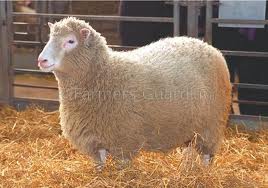
Her journey from the petri dish to birth began as a cell taken from a mammary gland of a 6-year old female donor. The technique included putting the cell into a suspended state to extract its DNA. A host egg cell came from another female donor. With the egg cell nucleus removed the DNA from the mammary cell was inserted. Then an electric current was applied to simulate the energy accompanying fertilization and embryonic development. After 148 days, Dolly was born.
It wasn’t all that simple a task. The researchers tried this with 277 fused eggs. Only 29 embryos survived and of these 13 were successfully implanted, but only one, Dolly, was born.
Cloning is not new to nature, just new to humanity. Many creatures practice asexual reproduction, or parthenogenesis, producing exact copies of themselves. Many plants reproduce themselves by sending out roots laterally and sprouting exact DNA copies of themselves. Researchers studying Aspen trees in British Columbia, however, report that this form of cloning leads to an increasing likelihood of creating some bad genetic material. We call altered genes mutations. The scientists studying Aspens counted the accumulated mutations of 20 different male Aspen trees and noted that cloned trees were less hardy than their parents. The same can be said about Dolly. She aged prematurely and passed away after 6 years.
Dolly wasn’t the first vertebrate to be cloned. That honour belongs to a carp, cloned in 1963.
The first cloned mouse, named Cumulina, was created in 1997 and died in 1999.
Mira the goat, born in 1998, was actually 3 goats, all identical. Their DNA was modified so that their milk produced recombinant human antithrombin (rhAT), a protein that prevents blood from clotting.
Cow clones, made in Japan, appeared in 1998. Recently, a newspaper in the United Kingdom described some of the challenges related to cloned farm cows with reports of pain, ill-health, organ defects and gigantism.
The first cloned guar (an Indian bison) named Noah was born in 2000 and died 48 hours after birth.
Pig clones have popped up in the United States, the United Kingdom, Japan and other locations, the first appearing in 2000. In 2001 scientists produced the first pig clones genetically modified to grow organs suitable for human transplantation. This feat was accomplished by knocking out a pig gene that produces the coating on organs containing sugar molecules that trigger acute rejection when transplanted.
Talk about copycat, scientists in Texas successfully cloned a cat born in December 2001.
Joining all the above we have cloned dogs, rats, mules, horses, water buffalo, camel and a Pyrenean Ibex, a species of antelope that was declared extinct in 2000. Unfortunately in the case of the latter, it died shortly after birth and remains extinct.
Why Do We Want to Clone? – 10 Reasons. the Why and the Why Not
Cloning has great biomedical potential to help humanity tackle and cure diseases. In cloning animals we may yield enormous medical and agricultural benefits. But cloning also presents ethical challenges. The following lists the most commonly expressed reasons for cloning:
1. For medical research to create transgenic animals bred with genetic mutations that cause specific human diseases to study and find cures.
In 2009 a team at Seoul National University created the world’s first transgenic dog to model human diseases. The researchers cloned a red flourescent gene produced by sea anemones and inserted it into the dog genome producing Ruppy, a beagle pup who glowed red in ultraviolet light. A virus was used as the gene transport mechanism to introduce it into a cell nucleus. That nucleus was then removed and then inserted as a replacement nucleus in a dog egg cell. A few hours later the egg divided to become an embryo which was then implanted into a surrogate mother. The red flourescent gene serves no medical purpose other than a validation that this technology works. But currently the failure rate is better than 98% in taking altered egg cells and successfully producing cloned offspring that survive through pregnancy and birth.
2. For creating human stem cells, a perfect match from donors, banked and withdrawn when needed to insert into and repair damaged or diseased organs and tissue.
In October 2011, scientists at the New York Stem Cell Foundation Laboratory announced the first successful cloning of human stem cells to treat conditions such as diabetes and spinal cord injury. Researchers used a method similar to the one that created Dolly. The adult somatic cell source used came from skin. This field of study shows great promise.
3. Therapeutic generation of matched tissues and organs for transplant back into the donor.
Therapeutic cloning remains in the laboratory using animal studies with early successes treating neurodegenerative diseases like Parkinson’s, generating blood vessels and skin to deal with severe burns, producing endocrine cells to generate glucagon and insulin within a pancreas to cure diabetes, corticospinal axon regeneration to repair severed spinal cords, and photoreceptor regeneration to treat blindness.
4. For genetically engineering animals to generate life-saving drugs or proteins for use in humans.
In this area of research we are already seeing significant results. See my earlier comments about Mira the goat.
5. To create domestic animals with superior genetics by copying livestock with desirable traits.
Regarding genetically superior domestic breeding using clones, we have yet to prove we have mastery in this field. Today the success rate in cloning of less than 2% is very low. Cloned animals that make it to term tend to be larger than average. Called Large Offspring Syndrome or LOS, cloned animals with this condition have abnormal organs. Many have breathing and blood flow problems. Even normal-sized clones may experience kidney, brain and immune system health issues. Our early experience with adult cell nuclear transfer may be the reason why clones on average don’t live as long as normally bred animals because the nuclear material being used comes from an older donor cell. Our research shows that when normal human cells continually divide, the DNA sequences at the end of each chromosome shorten. The older the animal, the shorter the chromosome. We call these chromosome ends telomeres. Are the shorter telomeres affecting the lifespan of clones? Researchers continue to study the phenomenon because we have yet to see consistent outcomes in the DNA of cloned animals.
6. To recreate extinct or copy endangered animals to restore biodiversity.
We may be closer to resurrecting an extinct species after some of the pioneering work done in the last decade. In 2008, researchers cloned a mouse from one that had been frozen for 16 years. Although the cloned Pyrenean Ibex died from defective lungs, the Spanish scientists who carried out this resurrection attempt showed us the potential for bringing back an animal from extinction.

In Russia, scientists at the Siberian Mammoth Museum, in association with Japan’s Kinki University, have extracted marrow cells from a woolly mammoth and are planning to use an elephant egg cell as a host for cloning an animal that disappeared well over 10,000 years ago. Considering the failure rate in successful clone births the opportunity to recreate the mammoth will require a large enough sample to produce a successful baby and that is without consideration for other conditions such as the size of the animal in utero and the potential for birth complications for the surrogate mother elephant.
7. To duplicate a favourite pet.
If I told you TLC, the cable television channel, launched a reality TV program called “I Cloned My Pet,” would you believe me? It’s true. Just launched on January 11, 2012, each episode features a pet owner reminiscing about their animal friend who has passed on. The pet owner has saved locks of hair, or harvested cells and has sent them to a Korean laboratory offering pet cloning services. Scientists in South Korea have cloned dogs since 2005, not just for bereaved pet owners, but also to recreate highly prized working dogs. View the link to read about cloned airport security and drug detection dogs. This is big business in Korea.
8. To duplicate a dead child.
Although a positively Frankensteinian idea, in an article published in 2009, a fertility doctor claimed he had created 11 cloned human embryos made from adult skin cells and placed them in the wombs of four of his patients. In the same article the doctor claimed he created clone embryos of dead people, one of them a 10-year old girl. The attempt to reproduce the girl involved a sample of her blood. The doctor at the time claimed it was not his intention to actually bring the dead girl back to life.
Attempts at the United Nations in 2005 to create a worldwide ban on human cloning of this kind failed. Instead a resolution passed which stated “all forms of human cloning inasmuch as they are incompatible with human dignity and the protection of human life” should be condemned.
But if we can bring back an extinct animal then what is to stop someone, somewhere, from cloning a lost loved one?
9. To create a child for infertile couples and not use adoption or a surrogate.
If we can clone other animals then theoretically we can clone humans. In 2001, at the Human Therapeutic Cloning Conference in Rome, a consortium of doctors proclaimed they were in agreement on the question of human cloning as a medical treatment for infertile couples. The agreement recognized that sterile men could pass along their genetic attributes to offspring only this way and should be given the opportunity. The scientists at this conference recognized that “the genie had already been let out of the bottle,” and better that they were the ones to do this then some “quack.”
10. To create a duplicate of an individual as an alternative to a surrogate for those who are not married but want an heir who is an exact match.
I recently visited a website called Clonaid. At first I thought this has to be a hoax. But Clonaid is real and claims its first human clone baby, named Eve, was born on December 26th, 2002. The juxtaposition of the date so close to Christmas made me even more skeptical.
Since 2002, Clonaid has made unverified claims that include four other clones including a second birth to a Dutch woman, and a third to a Japanese family who had their lost son cloned. Clonaid may be perpetrating a fraud but they are not alone in pursuing human clones. China’s Xiangya Medical College, in Changsha, is one of three research centres studying human cloning. In one Clonaid case the company described the desire of a homosexual couple who wanted to have sons, duplicates of themselves and that Clonaid was capable of fulfilling their wishes.
Indeed it seems that with Dolly the genie has been let out of the bottle and we are, at this point in the 21st century, wrestling with the demons that may follow.
]]>