The infographic appearing below comes from the Climate Institute report. It displays the distribution of coffee around the world and its importance to national economies particularly in Developing countries.
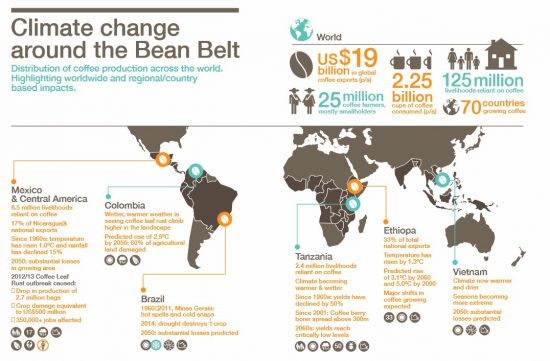
Today 25 million coffee farmers, mostly smallholders, are dependent on the crop. They have little capacity or financial means to adapt to the hotter world projected by climate scientists. Climate plus market volatility, therefore, will work against these small farming operations. It will also work against the more than 120 million people in 70 plus countries involved in the industry at various stages of production. Among these Honduras, Nicaragua, Vietnam and Guatemala may be most impacted.
Climate change deniers who argue that rising CO2 levels means coffee plants will grow faster have buried their heads in the sand. Although the increase of CO2 may prove advantageous to some plants, it comes with consequences that include changes in air current movements, extreme temperatures and rainfall patterns.
The Climate Institute report cites the following challenges:
Strategies for adaptation include developing new production processes, diversifying coffee crops, and wholesale relocation of plantations. The expectation is that climate change will likely push many producers out of coffee altogether.
For coffee growers today a change of half a degree at the wrong time can alter the yield, flavour and aroma of the product. For coffee drinkers it maybe time to start cultivating a taste for tea.
But wait an equivalent study on tea production and climate change is in the works looking specifically at Northeast India, the Green Belt associated with names like Assam and Darjeeling and responsible for 17% of global tea production.
Now I’m alarmed because I’m a tea drinker.
The Climate Institute is based in Australia and describes itself as a a think and do tank focused on climate change with expertise in three vital areas: international accountability, economic transformation and societal leadership.