Diamandis selects three technologies that he believes will have the greatest impact on dealing with the aftermath of or the prevention of disasters. These include:
When it comes to immediate and high-precision emergency response, data is gold. The meteoric rise of space-based networks, stratosphere-hovering balloons, and 5G telecommunications infrastructure is connecting every last individual on our planet. Aside from democratizing the world’s information, this upsurge in connectivity is granting all of us the ability to broadcast detailed geo-tagged data, which is particularly valuable in the face of natural disasters. Armed with the power of data broadcasting and crowdsourcing, disaster victims can now play an important role in emergency response, turning one-way blind rescue operations into a two-way dialogue, connecting the crowd to smart response systems. With the skyrocketing abundance of collected data comes a new paradigm, one in which we no longer have few answers, but rather now can ask the questions needed to ensure we can address the disaster in near real-time.
In the case of emergency response, we can strategically map an almost endless amount of incoming data points. We can begin to predict the dynamics of a flood and identify a tsunami’s most vulnerable targets even before it strikes. And we can trigger automatic aid using surveillance drones which can immediately alert volunteers to take action. Already, a number of organizations are leveraging AI, crowdsourced intelligence, and cutting edge visualization to improve crisis response and speed up relief efforts.
One of these is One Concern. Conceived by victim survivors of past catastrophes and geologists studying volcanoes, this organization leverages AI through analytical disaster assessment to calculate damage estimates. So far One Concern is partnering with a number of California cities including Los Angeles and San Francisco to create unique ‘digital fingerprints’ for every element in an urban area. Their AI platform creates robust models which then help to monitor site-specific impacts from climate change, earthquakes, and other natural disaster events. The collected data when combined with information from these cities including their histories of previous disasters, is then used to predict future damage providing recommendations on structural improvements for prevention and mitigation. Since its inception four years ago One Concern has grown in its ability to make predictions with 85% accuracy in under 15 minutes.
Besides handling natural disasters, there are other uses for crowdsourced intelligence for mapping potential crises. The story of Ushahidi is a case in point.
Ushahidi is the Swahili word for “testimony.” The technology came from a local blogger’s idea to collect reports of violence in Kenya in the 2008 post-election period and map their locations. He sent out a request to techies to create a mashup of where violent and destructive episodes were being reported. Within days, four techies built a platform to crowdsource first-hand reports through short message services (SMS), collecting over 40,000 verified reports and sending back alerts to locals on the ground and viewers around the world.
Ushahidi today is being used in more than 150 countries, with over 100,000 deployments impacting 20 million people. Its open-source crisis-mapping software is accessible to anyone, mining millions of tweets, hundreds of thousands of news articles, and geo-tagged, time-stamped data from countless sources all posted to the Cloud.
Aggregating one of the longest-running crisis maps to date, Ushahidi’s Syria Tracker has proved invaluable in crowdsourcing witness reports, providing real-time geographic visualizations of all verified data, and enabling civilians to report missing people, civilian casualties, disease outbreaks, and relief supply needs all while avoiding the government-controlled cellular network.
As mobile connectivity and abundant sensors converge with AI-mined crowd intelligence, real-time awareness will only multiply in speed and scale. Within the next 10 years, spatial web technology may even let us tap into mesh networks. While traditional networks rely on wired access points and wireless hotspots, the spatial web connects entire cities using hundreds of dispersed nodes that communicate with each other and share network connections non-hierarchically, which means that individual mobile users can establish a local mesh network together using nothing but the computing power of their handheld devices.
If taken further, a local population of strangers can collectively broadcast countless 360-degree feeds across a mesh network. So imagine a scenario in which armed attacks break out across disjointed urban districts. Eye-witnesses and at-risk civilians will be able to broadcast an aggregate of 360-degree videos, all fed through photogrammetric AIs that will build a live hologram in real time to create complete information for first responders. The technology could help a community facing failing infrastructure from a hurricane’s landfall providing a collective live feed of verifiable data in real-time to inform first responders about specific relief needs.
With all the right technology pieces in place, first responders will be able to use drones for automated deliveries. Imagine crowdsourced intelligence, cross-referenced with sensor data and verified algorithmically, along with AI to determine the specific needs and degree of urgency with precision coordinates. Within minutes swarm robots can rush to collect requisite supplies, equip size-appropriate drones and provide rapid-fire delivery.
But wait, there are other breakthroughs on the horizon with AI-geared robots paving the way in emergency response for some of today’s most dangerous environments. These include autonomous robots and swarm solutions.
As hardware advancements converge with AI we will see the emergence of fully autonomous disaster relief robotic responders. A prototype is the Cheetah III, a product of MIT’s Biomimetic Robotics Lab. Cheetah III is capable of running at a 6.4 meters (21 feet) per second pace, can leap heights of 60 centimeters (almost 2 feet), and has sophisticated collision and obstacle avoidance capability. Robots like this may form the first line of defense in disaster responses to earthquakes for search-and-rescue missions, or for surveillance in high-risk radiation zones. Future plans for the robot include payload carrying capability, enhanced range of motion, and increased dexterity. Stated Biomimetic Robotics Lab Director, Associate Professor Sangbae Kim, “the short-term goal will be sending the robot where we don’t want to send humans at all.”

Joining the Cheetah III are a number of other robots designed for working in hazardous zones. In February Japan’s Tokyo Electric Power Company inserted a robot into the damaged Fukushima Nuclear Reactor to retrieve a number of samples of radioactive fuel for analysis and cleanup planning on the site. This robot was guided by human operators and was able to operate in an environment where no one could safely go.
Also in Japan, Mitsubishi Heavy Industries (MHi) has built a firefighting robot called the Water Cannon Bot designed to put out fires at sites considered too dangerous for human entry. It can deliver foam or water at a rate of 4,000 liters (over a 1,000 gallons) per minute and at pressures of 1 Megapascal (145 PSI). The robot can be accompanied by a companion Hose Extension Bot extending the firefighting range by 300 meters (almost 1,000 feet). Imagine using this kind of robot to fight wildfires when combined with predictive AI forest fire mapping and autonomous hauling vehicles, and you have a solution for what is becoming a growing problem as climate change dries out many forest areas. Deployment in anticipation of wildfire would mean the avoidance of population displacement, unnecessary deaths, and significant damage to natural environments.

There are RoboBees developed at the Wyss Institute, Harvard University. These autonomous flying micro-robots have the potential to be used for crop pollination, search and rescue missions, surveillance, and high-resolution weather, climate, and environmental monitoring. They feature self-directed flight and swarm behaviour, that is the RoboBees can work together as a single unit for co-ordinated surveillance operations.

There is Snakebot, developed at Carnegie Mellon University, and designed to navigate in environments completely inaccessible to human responders. Driven by AI, a Snakebot can maneuver through densely packed rubble to find survivors and has onboard cameras and microphones to aid in communication.

Advancements in drone technology will revolutionize disaster response whether to natural phenomena or wars. Drones provide high-resolution imagery for real-time mapping and damage assessment and are already outperforming ground-based rescue teams in locating isolated survivors of a catastrophe. In the aftermath of Hurricane Harvey, a team led by Texas A&M Computer Science Robin Murphy flew 119 drone missions over Houston, to monitor levee infrastructure and identify people left behind by rescue teams.
But drones are capable of much more than surveillance. At the University of Science and Technology of China, engineers have built a first responder temporary mobile wireless broadband network facilitated by airborne drones. And drones are being used to supply remote areas of the planet with lifesaving medicines. One of these is Zipline, a drone delivery system operating in Rwanda and Tanzania that is delivering vaccines, HIV medications, blood products, and intravenous supplies to 11 million living in remote locations. Zipline, a California-based company, has far outpaced any ground-based supply transport, in many instances providing lifesaving biomedical products in under an hour.

Larger capacity aerial drones are being developed for the U.S. Military. Logistic Gliders is using plywood-constructed gliders costing only a few hundred dollars to provide the U.S. Marine Corps with aerial resupply capacity at 816 kilograms (1,800 pounds) per flight. Flying at speeds of up to 250 kilometers (135 nautical miles) per hour, and a 140 kilometer (80 miles) range, these drones can be released from an aircraft or helicopter and are disposable. They can operate autonomously or be guided remotely.

Perhaps one of the most consequential and impactful applications of converging technologies is their transformation of disaster relief methods. While AI-driven intelligence platforms can crowdsource firsthand experiential data from those on the ground, mobile connectivity and drone-supplied networks are granting newfound narrative power to those placed in need because of natural or human-caused disasters. It is this rise of robotic responders, swarm technology and aerial drones that are giving us unprecedented response capacity to catastrophes. Empowered by these new tools, how much can we improve humanity’s overall plight when everyone has similar access to relief supplies and immediate resources in times of disaster?
]]>This shouldn’t come as a surprise considering the present use of drones by military operators in a number of countries. But to date drones still have human operators and a command hierarchy to make the decision on when to take a shot. The fear in the not-too-distant future is what will happen when military developers decide to give the robots autonomy to make their own decisions on when to fire.
Back in 2013 a group of 1,000 scientists, technologists and prominent media persons led by Steve Wozniak, Stephen Hawking and Elon Musk, drafted an open letter to governments calling for a ban on autonomous weapon systems capable of making independent kill decisions.
The letter which has attracted more than 20,000 signatures, begins by stating that “most chemists and biologists have no interest in building chemical or biological weapons,” and further asserts “most AI researchers have no interest in building AI weapons.”
The signatories call for the same kind of “broadly supported international agreements that have successfully prohibited chemical and biological weapons” to be implemented for robotics and AI. They conclude, “we believe that AI has great potential to benefit humanity in many ways, and that the goal of the field should be to do so. Starting a military AI arms race is a bad idea, and should be prevented by a ban on offensive autonomous weapons beyond meaningful human control.”
Earlier this year at a conference sponsored by the United States Department of Defense this subject was openly discussed. Should the U.S. develop autonomous armed robots capable of fighting alongside human troops and acting on their own. A concept operations document is in the works to be presented to the U.S. military with a stated 2035 deployment goal. The authors of this document are tasked with looking at semi-autonomous weapons similar to the U.S. Marines test robot seen in the image below. To date, no one in the U.S. Department of Defense has indicated an intention to delegate the autonomous right to kill to a military robot. Nonetheless the option is not yet off the table largely because of concerns about what the other guys might do.

Who are the other guys? The Russians and Chinese for sure. The same thinking about semi-autonomous and autonomous weapon systems is happening in Moscow and Beijing. The Russians in the last month displayed their latest killing machine capable of being human-controlled or making autonomous firing decisions. Built for the Russian Strategic Missile Force to protect launch silos, it resembles a small tank (see image below) and has the capability of detecting enemy movement up to 10 kilometers away, and can fire with lethal accuracy at distances of 400 meters. And China just announced their intention to incorporate AI into military drones.

Weapons such as the marine and Russian prototypes seen above are not the sole concern of those fearing the spread of autonomous robotic systems in the military. Robots don’t have to come in big packages. A malevolent AI deployed within communicating microrobots that display swarm intelligence could be unleashed on an unsuspecting population. Such a weapon could be self-replicating using resources by living off the land and spreading through an entire nation. Swarm intelligent weapons don’t have to be lethal to human lives. They can be used to attack and destroy infrastructure and thus be just as effective in grinding an entire country to a halt.

It is no surprise, therefore, that the United Nations is being tasked to seek international agreement on such weapons. Under its Institute for Disarmament Research (UNIDIR) is hopes to come up with a global ban on lethal autonomous weapons technology. The most recent step in this direction occurred on December 16th in Geneva, with 123 participating nations voting to create an expert committee to work towards that goal. To-date only 19 countries have called for an outright ban. The United States, Russia and China are not among these.
]]>
Zarkadakis holds a PhD in AI. In exploring the sophisticated computers of today such as IBM’s Watson and its predecessor Deep Blue, he distinguishes human intelligence from that of the machine. We humans are more than our brains.
What do I mean by that?
The brain may be the source of human intelligence but it is intimately interconnected with the feedback mechanism that is our body. Compare that to hardware and software. Computers separate the two. Humans integrate the two. We are not the sum of our programming.
Will AI surpass us one day?
When Elon Musk and Stephen Hawking recently raised the specter of a malevolent future AI with the former dedicating some of his millions to found an institute to ensure this never happens, he was repeating a pattern seen in past human revolutions. The Industrial Revolution of the 18th century led to a backlash against machines in many parts of the world. But today we are through the Internet and sophisticated computing technology experiencing a second Industrial Revolution. Hence a push back.
But as long as computers distinctly separate hardware from software intelligence Zarkadakis believes they will never become conscious machines. They certainly will exhibit AI but not free will. He describes them as mindless agents capable of powerful computational processes. In other words they can handle metadata and parse it. They can be repositories of collective human wisdom, our science, our intelligence, but that’s not the same as consciousness.
Zarkadakis, however, has a caveat. It is neuromorphic computing.
What is neuromorphic computing?
This is computer technology that is capable of learning because it mimics neuro-biological processes through electronic circuits. Software and hardware are no longer separated. I have written about neuromorphic chips, memristors, and the Human Brain Project in the past. This is technology capable of duplicating our brains and our capacity to learn. A neuromorphic AI would start it life like a human baby responding to external stimuli. It would learn by observing. It would grasp the fundamentals of language. And ultimately it would have endless capacity to absorb information and observe us. This AI will likely surpass us in time but we are not close to realizing the technology as of yet.

Another Zarkadakis caveat is swarm technology.
In the natural world we can see evidence of swarm intelligence in the behavior of termites, ants, bees, flocks of birds and schools of fish. If we humans build the equivalent to an ant and ant brain a single unit will be perceived as non threatening. Make it self replicating and capable of interconnecting with other units and we would have another story. As Zarkadakis describes it we would see intelligence of the swarm emerge.

In crowdsourcing where problems posted online get the benefit of input from millions of human brains tackling the challenge we see the intelligence of the swarm. Whether it’s finding new ways to fold proteins, or solving complex mathematical problems, the intelligence of the swarm can be significantly greater than any one individual.
Machines capable of swarm AI , although not conscious, may pose a collective threat to humanity once the genie is let out of the lamp. Michael Crichton‘s science fiction novel, Prey, paints such a picture.
So are we doomed to create an AI that will surpass and subjugate us?
More than likely not because we have the means to put brakes on AI research, the kind that Musk and Hawking want to see enforced.
But there is a more likely scenario and that is the integration of AI with human intelligence where we facilitate the former’s capability to help solve human problems. Using crowdsourcing AI is already demonstrating benefits. Zardakis talks about the Galaxy Zoo project where 150,000 human volunteers classified 50 million galaxies in its first year of operation by using computers and database software to compile the information. Machines don’t have to be conscious to display AI. It’s intelligence but it is of a different kind than ours.
Could we one day merge human and machine, what Ray Kurzweil calls the singularity? Zarkadakis believes we can develop technologies to better communicate with AI partners, exploring symbiosis of human and computer minds. But should that computer mind evolve consciousness? That is the outstanding and problematic question.

]]>
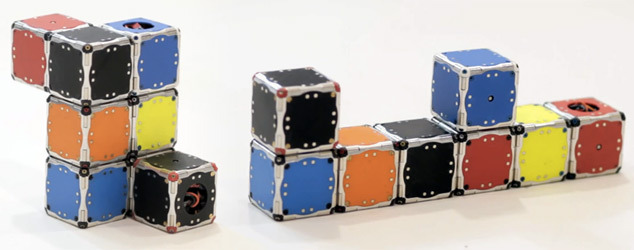
Two schools, the Massachusetts Institute of Technology (MIT) and the Ecole Polytechnique Federale de Lausanne (EPFL) have come up with adaptive robot modules that can create new structures by self-assembling just like LEGO (TM) blocks.
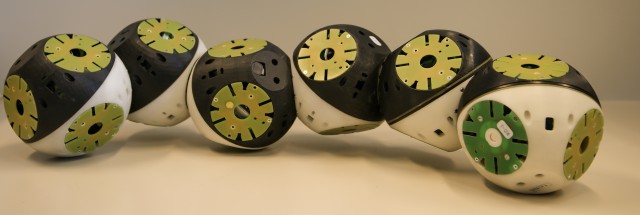
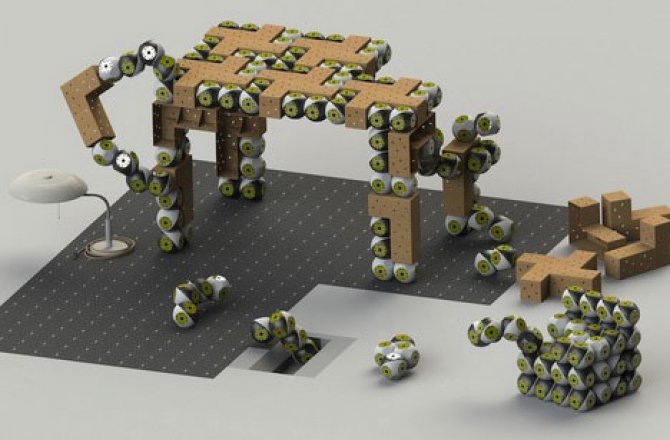
In the case of MIT they call them M-Blocks, magnetic robotic cubes. At EPFL they call them Roombots, large dice-like cubes with retractable claws and servomotors. In both cases the idea is for these little boxes to self-organize and create useful larger objects such as a chair, a table, a ladder, a desk, or a shelf. The M-Blocks magnets when aligned help them to snap together. The Roombots retractable claws when extended help them grab on to each other.
Both devices can roll, climb and snap together. With on board intelligence or instructions remotely broadcast to them, a swarm of these devices could be used to investigate an emergency such as an earthquake, maneuver through areas inaccessible to humans, and then assemble to build a bridge for rescue operations. A swarm could serve those with disabilities producing and delivering the right object at the right time. For example a needed table, or a support for the person to stand. Versatility and mobility make these smart swarm robot cubes invaluable.
How do they work?
M-Blocks (seen below) contain a flywheel that rotates at speeds of up to 20,000 revolutions per minute, on board wireless communication and actuators. Current designs do not include on board intelligence but that is planned for the next iteration of these devices. Braking in the flywheel motion is used to impart angular momentum. On board magnets, including several strategically located to provide roll capability, act as the connectors for other M-Blocks. When M-Blocks detect each other they align the polarity of the magnets to form connections or jump over one another.
Roombots (seen below) contain three on board motors and wireless connectivity. The motors provide mobility. The on board wireless allows programmers to communicate with them and for them to communicate with each other. The retractable claws give them the means attach to each other or to passive structures such as walls or floors that have appropriate built-in claw receptacles.
Both are somewhat analogous to the technology depicted in the movie Terminator 2 where a disassembled android uses smart liquid steel to reassemble. But somehow M-Blocks and Roombots appear a lot more human friendly.
Humans Started Developing Global Intelligence Thousands of Years Ago
The invention of pictorial characters and symbols to represent objects, actions and ideas is thousands of years old. It appears to have happened simultaneously in human populations all over the planet and appeared as cuneiform in Babylon, Phoenician, Greek and Latin alphabets in the Mediterranean, hieroglyphics in Egypt, Hebrew, Aramaic and later Arabic in Southwest Asia, Sanskrit in South Asia, and pictorially throughout China, Japan and Korea. Whether etched on tablets of clay, or carved into stone and cement, or inked on papyrus, sheepskin or paper, humans began gathering and sharing a body of knowledge to pass along from generation to generation.
When Gutenberg took Chinese block printing and redefined it in movable type and the printing press, modern publishing emerged. Newspapers, pamphlets, and books appeared in Europe and as European explorers reached the Western Hemisphere, soon became common throughout the Americas. The cost of preserving knowledge dropped dramatically making it much easier to assemble vast quantities of information in libraries and archives.
In the latter part of the 20th century computers turned printed words and images into digital information. Local Area Networks or LANs let users share the printed words within businesses and organizations. Then with the arrival of the Internet and search tools like Google, the knowledge dissemination paradigm changed forever. Where research in the past had me spending hours in libraries and reading journals and newspapers, today I construct a search request in natural language which yields a treasure trove of information that I can quickly scan and sort. I do this at my desktop computer, or on a laptop, a netbook, or a tablet, or on my daughter’s iPod or, on my smartphone. When I get my Internet LED TV next year I’ll even be able to do it there. For global intelligence gathering and information sharing it has never been easier.
Defining Global Intelligence
As a species we humans have developed skills for collaboration to help solve basic human needs – food, shelter, and survival in an often hostile world. Our social grouping began confined to families and then extended families and finally to tribes and villages. But knowledge sharing remained within close proximity to the owner of the knowledge. As we developed better means of survival, living longer, more of us could share experiences and pass this information long from generation to generation. As our numbers grew and organized living units got bigger we developed print and pictorial technology as a means of preserving knowledge. We developed institutional learning to share knowledge through schools and libraries. We created special knowledge keepers, librarians, who served as intermediaries between ourselves and our accumulated wisdom. We organized our knowledge, developing catalogs in which we could search on our own for the knowledge we sought. Some of my best memories of university life involved doing extensive searches for esoteric subject matter and then descending into the university stacks to pluck a rare book or primary source from where it was hidden.
But all of this collected knowledge remained accessible to only a fraction of humanity, that is until the Internet and the digital revolution. Today university libraries around the world are seeing their entire collections digitized and made accessible through web browsers.
Global Intelligence to Kick Start the Developing World
How much information sits on the Internet today? According to EMC, the storage company, we were at 1,200,000 petabytes of data as of 2010. (A petabyte is equal to a million gigabytes.) My hard drive is 1 terabyte and it currently is 30% used. So if I do the math correctly, that 1,200,000 petabytes equals 1.2 billion 1 terabyte drives. By 2020 that number is expected to grow to 35,000,000 petabytes or 35 billion 1 terabyte drives.

Not only are we witnessing a learning revolution brought to you by the creators of the Internet and delivered over smartphones to users in the Developing World, we are also seeing an explosion in knowledge creation.
Now add 3 billion new users and an environment on the Internet that encourages group think, shared problem solving, and a collective means of generating solutions to everyday and exceptional problems, and you can begin to fathom the potential growth in global intelligence.
Creating Collective Wisdom
We define intelligence as an ability to learn, reason and problem solve. When we add the Internet and social networking applications we suddenly create a forum where we can deposit vast amounts of information that becomes accessible to billions of us. In addition we can use the interactivity of the Internet to create brainstorming on a global scale. That is what collective wisdom is all about. And we accomplish this using a number of Internet tools that provide an environment for breeding:
