It wasn’t until the 1960s that heat pump models for homes first appeared in North America. An oil crisis in 1973 stimulated sales with adoptions in places like Japan, the United States, and Europe. This generation of heat pumps used inverter-driven compressors to save electricity while running continuously to provide heat or cooling as needed.
Today, variable-capacity ground, water and air-sourced heat pumps are found in homes and businesses, an alternative to using fossil-fuel-based heating.
In the village of Swaffham Prior in the United Kingdom, a centralized heating network has been installed (see picture above) to warm homes. The use of a large-scale centralized pump is a pilot project to demonstrate the effectiveness of this type of deployment which is aimed at reducing the cost of moving homes off oil and gas heating while saving costly home retrofits associated with individual heat pump installations.
The heat pump in combination with solar panels, electric boilers and underground storage is generating 1.7 megawatts to produce heat that travels through pipes installed underground with village homes connecting to them and their existing home radiators and hot water appliances. No home retrofits are needed. So far, one-third of the village has been connected with 200 remaining homes to be added. Before this heating network existed, Swaffham Prior homes used oil furnaces.
In the United Kingdom today, fossil-fuel-home heating predominates with 74% of homes heated using natural gas. The heating of homes and buildings accounts for one-third of the country’s greenhouse gas emissions. In ramping up heat pump use, the country is looking to go from 55,000 annual installs in 2023 to 600,000 homes by 2028.
What makes heat pumps so attractive? I can think of 4 things right away.
The International Energy Agency (IEA) recognizes that heat pumps are critical for decarbonizing heating. It estimates that heat pumps can eliminate 500 Megatons of carbon dioxide (CO2) emissions annually by 2030 which equals the carbon emissions of all the cars on the roads in Europe today.
The following IEA-created graph shows the percentage growth in heat pump deployment for 2021 and 2022 in selected countries and by type.
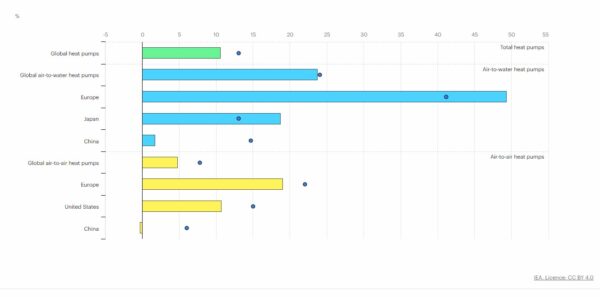
Overall deployments last year grew 11% with record adoptions in Europe, Japan and the United States. But what will be needed to accelerate the decarbonization of heating is heat pump adoption to triple between now and 2030 to cover 20% of global heating needs.
The impediments to heat pump adoption include:
The IEA in presentations at COP28 is recommending:
It sees district heat networks like Swaffham Prior as low-cost alternative solutions to individual home and building installations for use in cities and rural areas. Large-scale heat pump installations are less expensive to implement and remove retrofit costs from the equation.
The IEA is asking those attending COP28 to develop stronger international collaboration, more data collection, and sharing of best practices to accelerate decarbonization through global heat pump adoption.
]]>