According to a recent study by Gartner, Inc., smart agents will facilitate 40% of mobile interactions and usher in a post-app era by 2020. Virtual personal assistants and agents will analyze available data and consumer behavior to predict what you will need.
Do customers want artificially-driven engagement? The trends all point to a resounding “yes.” Consumers increasingly want omnichannel service experiences that allow them to pick up and continue a customer service interaction from social media and chat, to text and talk, without missing a beat. In order to meet this consumer demand, technology is continuing to develop more personalized interactive experiences.
The Gartner study doesn’t make any customer service predictions beyond 2020, but it is easy to see that industry will focus on three key ingredients to make the interactive experience ubiquitous:
Self-Service
Today’s consumers already use self-service options. They withdraw money from ATMs, use automated checkouts at grocery stores, and go online to get support questions answered. According to Fast Company, an American technology and business magazine, 70% of consumers expect company’s websites to include self-service where they can shop by browsing through product displays and get instant help without waiting around for a reply.
Tools like interactive voice response are enhancing the online experience. Aspect’s IVR solutions using advanced speech recognition can gather customer information and match it with data from customer relationship management tools. Once the information and data get collected, the technology is capable of delivering a highly personalized service.
The Internet of Things
Reuters, the newswire service reports that Europe’s biggest software firm, SAP, and German car parts maker, Robert Bosch, have teamed up to connect products, ranging from screwdrivers to cars, directly to the Internet. The partnership plans to harness a real-time database for Bosch customers to monitor the production process of orders and request customizations.
After customizing their order, customers will also use online self-service tools to reorder products or track shipments and delivery. Meanwhile, there are already services on the market to help companies reorder supplies or report technical issues. For example, a new connected Brita smart pitcher can reorder its own filters from Amazon without any human involvement.
The Interactive Experience
Self-service and the Internet of Things open a door to highly personalized, interactive experiences. Recently Bloomingdale’s Manhattan flagship store created an app that lets customers shop through an interactive window display. Customers stop, preview, and tap on the window. The interactive display allows them to place and customize orders without even entering the store.
And customers looking for an interactive fitting room experience to “blow your mind,” can step into Ralph Lauren’s flagship store in New York City where they can try on items, and browse through store inventory using the fitting room’s interactive mirror. Using the interactive display will summon a sales associate to complete the customer experience.
Regardless of how hyper-connectivity changes consumer behavior, customers will always demand quality and reliable customer service. Today’s companies are racing to leverage technology to create instant service and answers, while still producing a quality interactive customer experience. Will it dehumanize shopping, or will it enhance it? The jury is still out.

The Internet of Things is already upon us with Gartner Research reporting that by 2020, an estimated 25 billion “things” will be in use. We’re already seeing advancements in smart home technology through the hyper-connectivity of Internet of Things (IoT) devices and appliances from smart fridges that inventory what is in them and then place reorders, to ovens that turn themselves on and adjust temperatures to what is being cooked.
But there’s more to the future of homes than automated kitchens. There is a next generation of technology and tools to impact our lives daily and revolutionize the places we inhabit. From subterranean communities to bio-enhanced security, here is what the home of the future might look like by 2100.
Subterranean Communities
Samsung’s Smart Things Future Living Report predicts we will see the introduction of “Earth-scrapers,” subterranean homes and buildings where we will work, live, and play. The report highlights a planned 300 meter-deep building in Mexico City, proposed by Bunker Arquitectura, and you can also learn about the latest London trend, building multi-storey “super basements.” Is this evidence of where urban dwellers may live in 2100? Or will it be aquatic cities in the ocean that include housing complexes, recreational areas, gardens, and an ocean playground and resource for the next urban wave of sustainable communities?
Bio-Enhanced Security
We’re already living in a world of home automation enhancements with wireless security cameras, high-definition image recording, and the ability to monitor our residences from anywhere. Doorbell Home, a blog written by a tech geek called Casey (no last name), reports that keyless home entry systems will soon be capable of telling family members apart as well as recognize guests using biometrics like body temperature and heartbeat. Bio-security enhancements could be the keys that automatically open doors to family members and approved guests while shutting out unwanted intruders.
Central Hub Control
Today’s smart homes are run from a centralized computer hub. Nest, the smart thermostat, can learn our home environment desires adjusting temperatures to meet our needs by knowing when we get home from work and turning down the thermostat when we are not. In the future homes will include more gadgets like Nest that will be tied to a centralized communication console, capable of running the house without us. Imagine our house doing everything from maximizing energy efficiency to turning appliances on and off as needed, ordering groceries, and sending out requests for support when an appliance malfunctions. Instead of waiting for us to determine what needs to be done, the home running with a central hub controller will figure all of this out for us and act accordingly.
Robotic Helpers
It’s now mainstream to have robots in our homes such as the Roomba vacuum that can run on a schedule, maneuver past furniture and avoid stairs. Techradar, a technology buying advice website, predicts we’ll see more robots and devices doing our dirty work in the near future, from cleaning windows to making minor home repairs. In a recent Fortune interview of Rob Coneybeer, Managing Director of the venture capital firm, Shasta Ventures, describes his vision of what life in our homes will be in the next 20 to 25 years, with humanoid robots taking care of day-to-day work in homes, from cleaning rooms, doing laundry and folding and putting away clothes.
So What Choices Should We Make as Future Technologies Change Our Homes?
Make smart choices by avoiding the gimmicks and gadgets that don’t improve your daily life. Focus on how the technology can help reduce daily chores and home maintenance. The real value of the future smart home will be about quality of life, not on whether the eggs get replaced in the refrigerator, but more about spending time with loved ones and relaxing after a long day.

———-
Information technology research and advisory firm Gartner predicts that by 2016, roughly 48 million applications will be available on the cloud. Meanwhile, cloud computing management firm RightScale reported 93% of organizations surveyed are already running applications and experimenting with infrastructure-as-a-service in the cloud. Enterprises and individuals alike are rapidly adopting to the cloud and changing the landscape of how we do business and store our information. Soon relying on hardware and drives will become a thing of the past. Here is what the future of cloud computing and storage has in store for us as the industry continues to evolve.
An Increase in Hybrid Multi-Clouds
Businesses have traditionally used private clouds to run applications and house their digital information. This can prove costly both in terms of equipment used and IT staff needed to maintain it. We’ll see an increasing amount of enterprises switch to hybrid clouds, combining both private and public until the latter becomes the industry standard. Businesses can use multi clouds to efficiently scale up as their needs grows; keeping the process cost effective and fluid.
A Decrease in Computing Hardware
Computers like the Chromebook [Editor’s note: I have one and it is fantastic] already rely on cloud-only applications to stay up and running. Word processing is done in the cloud with Google Docs or Microsoft Word Online. More services from video editing to project management all offer cloud-based applications instead of downloadable apps. With the rise of cloud computing, the need for hardware and related computer processing will fade. Instead, the computing process will happen in the cloud without the need to manipulate hardware to keep businesses up and running.
New Advances in Video
Instead of relying on third parties to help host content, companies can run their own on-demand video and streaming needs on the cloud. Live video has already steadily grown in popularity with the ability to watch sports and shows in real time. More online media channels and services like Amazon Prime instant video will continue to crowd the marketplace. While major networks already offer some streaming video, they’ll no longer be the king of television content as more players democratize the market.
A Spike in Demand for Better Cloud Security
Security has always been an issue for weary cloud converters who fear their personal information and customer data will be compromised. While public cloud computing can reduce costs and streamline efficiency, a business has less control over it. Cloud security will need to evolve along with cloud computing and storage to keep up with the sensitive demands of both company and individual cloud use. Encrypted passwords will need to grow stronger and evolve to deter hackers and lock down vulnerabilities. Identity theft protection services like LifeLock will only grow in demand and popularity and become the norm when working with the cloud.
More Personal Storage Options
As enterprises explore more options with the future of cloud computing and storage, we’ll also see a rise in personal use. According to Global Cloud Index forecast, over half of the global population will use cloud storage as personal storage by 2018. More people will adopt services like Dropbox and Amazon cloud storage instead of storing personal photos, videos and other information on their devices or hard drives.

———-
According to Pew Research, hyper-connectivity and expanding technology leads to a need for instant gratification and loss of patience. Some experts speculate that it will make humans unable to address complex challenges. While this may be true, you also can argue that it may make people more innovative to find quick solutions that make them more productive and save them time. Whichever way you look at it, it’s unlikely anyone will turn down the offer to streamline their daily tasks with the help of the latest gadget.
Here’s some of the best technology of 2015 that could change your life.
Wireless Furniture
In 2015, IKEA launched a line of furniture that charges your smartphone wirelessly. There’s no need to go hunting for your charger and find a spot to plug in. Designated spots on IKEA’s bedside tables and lamps make it easy to charge your devices while you hang out with friends or catch up on work.
Skip packing your charger altogether and head out for a cup of coffee. Starbucks started offering wireless charging stations in their coffee shops last year. However, in 10 years, this technology will probably seem antiquated as devices will probably be charged without ever having to take it out of your bag or place it on a wireless spot. As soon as you walk into an establishment with an electrical hotspot, your device will start charging.
Smartphones make day-to-day tasks like taking videos, navigating new cities and keeping tabs on friends easier than ever before. But, with all that activity, it can take a few hours to fully recharge your device. However, the new Google Nexus 6 houses a supersized 3220 mAh battery that makes it possible to go longer and charge faster. In just 15 minutes, you receive up to six hours of battery life.
3-D Printers
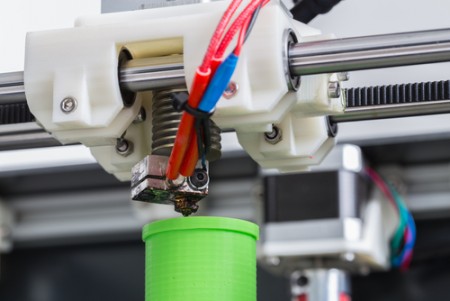
3-D printers are no longer a fantasy of the future or limited to medical supplies and heavy manufacturing. The New Matter MOD-t 3-D printer offers everyday consumers the chance to make small 3-D objects about six inches in size. Once you load up the device and set up a few options, you’re ready to print with the help of poly-lactic acid plastic filament. Just pick a product from the New Matter store and click print.
It’s likely that 3-D printers will offer consumers more flexibility and control over their purchases in the future. You won’t need to argue about producing products overseas or rush out to the store to pick up a last-minute gift or household necessity. Instead, you’ll just load up your 3-D printer and hit print.
Pocket Printer
Instead of hunting down a printer at the office or copy center or trying to set up your home office, carry a pocket-sized printer with you. The Zuta Labs Pocket Printer swiftly moves across a document and prints it. You can connect it directly to your tablet, laptop or smartphone, or you can connect wirelessly to any device. Then, all you have to do is lay any-sized piece of paper flat on a table and watch the pocket printer go.
Smart Wallet
Eliminate the need for carrying around a wallet stuffed with cards that are difficult to access when you need them. The Wocket Smart Wallet houses a Wocket Card to replace all of your credit and membership reward cards in one place. Just swipe it at any retailer and select whichever card you want it to be. You can even house your voter registration card in your Wocket Wallet with its card reader or enter it manually.