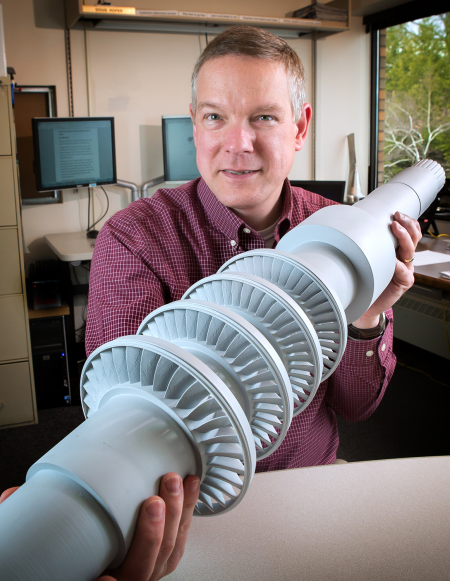
Recently researchers at the Sandia National Laboratory Kirtland Air Force Base in the United States demonstrated a closed-loop Brayton Cycle engine technology as it delivered power to the electrical grid continuously. Sandia has been working with the Brayton Cycle technology for power generation for some time now because it is seen as having significant energy conversion advantages over conventional steam turbines by as much as 50%.
George Brayton, a 19th-century American inventor experimented with internal combustion engines. The Brayton Cycle Engine is his invention dating back to 1878. The engine worked by heating compressed air in a closed space before releasing it to power a rotating shaft. Substitute a turbine for a rotating shaft and you get the picture. States Darryn Fleming, at the US Department of Energy (DOE) Supercritical Transformational Electric Power Program, the Brayton Cycle is “basically a jet engine running in a closed loop with supercritical CO2 as the working fluid.”
Sandia’s use of supercritical CO2 (the gas under very high pressure) is more than just happenstance. Supercritical CO2 is chemically stable, non-flammable, non-toxic, and should increasingly be available as carbon capture projects increased promoted by incentives and subsidy programs contained within the recently US-passed Inflation Reduction Act.

A diagram showing the Brayton Cycle can be seen above. The gas is heated to temperatures much greater than steam at water’s boiling point, 100 Celsius (212 Fahrenheit). In fact, heated CO2 can reach temperatures seven times greater (700 Celsius or 1,290 Fahrenheit). That’s what makes the energy conversion 50% more efficient than using steam which loses as much as a third of its energy potential as it converts back to water during the process.
This past April, a Sandia team heated CO2 to 315 Celsius (600 Fahrenheit), a little less than half the optimal temperature. Their Brayton Cycle engine was able to send continuous power to the grid for 50 minutes. Although only 10 Kilowatt-hours, less than a third of what the average American home consumes in a day, it was the first demonstration of the technology as a reliable energy streaming source for the electrical grid. The test included three controlled shutdowns and restarts and the technology aced it.
Scaling up from 10 Kilowatts to 1 Megawatt appears to be doable by 2024 based on the Sandia Labs team. They plan to double the temperature of the supercritical CO2 in the next iteration of the Brayton Cycle engine. It requires upgrading materials and parts to withstand these changes in heat and pressure. A 1-Megawatt demonstration technology will be enough to power up to 1,000 homes or could be used to replace diesel generators in remote locations such as communities in Alaska or Northern Canada.
The Sandia Labs team goal along with industry partners is to increase the capacity of their Brayton Cycle system to generate up to 5 Megawatt-hours continuously to the electrical grid. They see that as being a technology that grid operators will be more willing to allow. That’s because those operating and maintaining the grid don’t take kindly to anyone disrupting it in any way. For utilities, the work being done at the Sandia Labs could prove to be a game changer in what is a power industry moving away from its heavy reliance on fossil-fuel thermal energy production.
]]>
December 10, 2018 – Energy storage remains the chief inhibitor in our quest to move from fossil fuel-derived energy to that which we can glean from the sun, wind, and waves. These three energy sources suffer from one common problem, intermittency. If we can store the excess energy we can derive from them then intermittency goes away. But until now we have been trying to use chemical-based batteries the primary storage method which means we add a level of complexity to energy solution. What’s needed is simplicity.
Think of it this way. If the sun heats water in a tank next to an array of photovoltaic panels, then we have captured the energy of our star twice. When the sun goes down, the water with its trapped heat is, in fact, an energy storage sink, albeit not a terribly useful one except for taking a shower or bath. So find a medium other than water that is more efficient at transferring solar energy and converting it to heat and we have a potential storage technology that can be used to power our lights, heating, and air conditioning after the day is done.
So what are likely candidates to create adjunct storage for renewable energy technologies to create a continuous, reliable supply of electricity?

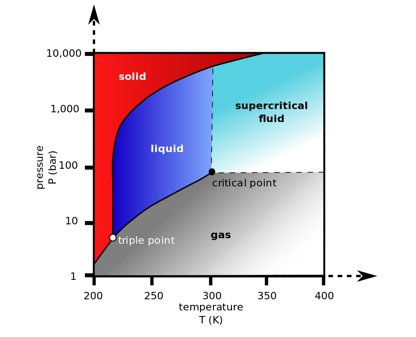
Supercritical is defined as a state above a critical threshold. In reference to a fluid, it is the state when one cannot distinguish between gas or liquid phase for the substance. The graph below shows the critical point when a gas or liquid enters supercriticality. In this state produced by exposure to high pressure and high temperatures supercritical fluids such as ScCO2 display interesting properties. For a demonstration of just what happens watch this YouTube video.
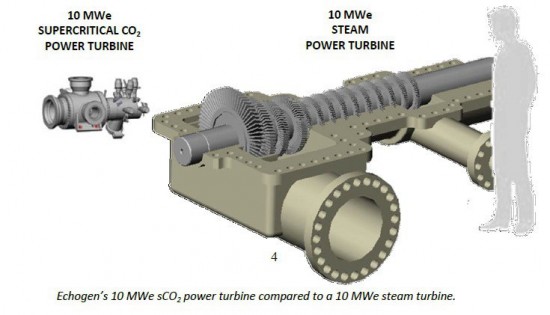
Using ScCO2 in power turbines has been of interest to the energy industry for a number of years. Why? Because as an energy driver ScCO2 remains stable compared to steam. It also packs more punch per square meter because of its small form factor as you can see in the illustration below. In addition to being more stable, ScCO2 turbines produce more energy because of 20% higher efficiency rates than steam.
So why haven’t we seen mass adoption of this technology by power utilities?
The challenge in the past has been to find the right materials capable of withstanding the elevated temperatures and pressures required by ScCO2 turbines. That’s what GE’s engineering team set out to do. And they think they got it right in developing a ScCO2-powered turbine prototype capable of generating 10 Megawatts in a form factor no bigger than a desk. There next step is to scale it to 33 Megawatts.
ScCO2-powered turbines do not require as much energy input to reach supercritical phase and they can be up and running within a minute or two. That’s up to 30 times faster than bringing a steam turbine on line.
ScCO2 has another advantage. It doesn’t corrode or fatigue materials like steam. And the technology is lower maintenance because it has no associated water quality and treatment costs which are necessary for steam-based turbines.
GE believes this technology is a good fit for providing spot-power generation for utilities during peak demand periods. It also sees it as a substitute for storage batteries at solar thermal plants where it can use heat from the molten salt reservoirs to fire up and provide continuous power even when the sun is not shining.
But GE is not alone in using ScCO2-turbine technology. Another company, NET Power has been building a power plant that generates zero emissions employing a similar technology to that of GE.
How does the NET Power technology work?
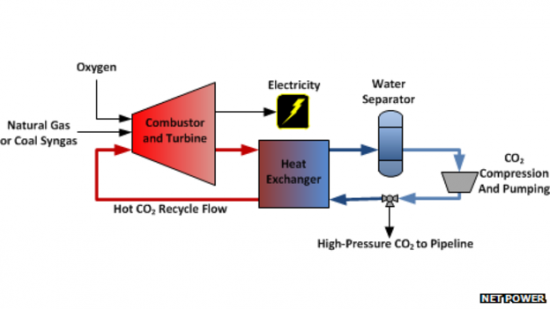
The above diagram illustrates the process. The source of fuel can be coal or natural gas. When burned with pure oxygen produced in an Air Separation Unit it also produces CO2. The latter is subjected to high pressure and heat in an oxy-combustion process. That turns the CO2 into ScCO2 which then powers a turbine.
The byproducts of the energy generation include water and CO2. Both are captured and go through a heat exchanger where the water condenses and is recycled while the CO2 either loops back to the turbine or gets sent through a high pressure CO2 pipeline and pumped underground into oil wells to enhance petroleum recovery.
Like the GE technology, NET Power doesn’t require a large footprint saving significant space compared to traditional coal-fired or natural gas power plants. A 50 Megawatt demonstration power plant, the first of its kind, is expected to be up and running in Texas by the end of 2016.
Imagine the potential this represents for both addressing energy demand while utilizing fossil fuel sources for power. The potential big fly in deploying lots of NET Power technology is the viability of a strategy where sequestration of CO2 is a key component. That may limit site selection because proximity to oil fields or to a stable underground rock formation where the CO2 when pumped underground in a super critical state would bind with the existing minerals. The last thing the industry would want to do is potentially create a CO2 leak to the surface negating the purpose of the sequestration effort.
