Christiana Figueres who I interviewed back in 2019 at a Collision conference, and who formerly headed up the United Nations on the climate change issue, is a native Costa Rican. She described her government’s introduction of a permanent ban on fossil fuel development and extraction legislation as a way “to remove the temptation….for there to be any current or future government who might think that returning to fossil fuels of the past century is actually a good idea.”
Costa Rica is by no means a fossil-fuel powerhouse. The country’s major source of electricity comes from hydro, geothermal, and wind renewable energy. So in some respect, this legislation is symbolic.
But could it become a template for other countries in helping to speed up the conversion of the global economy from fossil fuel dependence to a net-zero emission, low-carbon future? Figueres told Reuters “Just because Costa Rica is tiny, it doesn’t mean that we don’t have a voice.” The vote to enact the bill is expected in October.
Costa Rica is by no means the first country to take this step. In 2017, France was the first to announce a ban on oil production on its territory. This was largely symbolic as well because the country has very little oil and gas and imports 99% of the fossil fuels it uses. And the ban wasn’t immediate, with it to take effect in 2040.
In 2018, New Zealand announced an immediate end to future offshore oil and gas exploration. Stated Jacinda Ardern, the country’s Prime Minister, “We must take this step as part of our package of measures to tackle climate change.” Also in 2018, Belize pledged an immediate end to exploration and drilling for oil and natural gas on its land territory and surrounding waters. Belize is home to the second-largest barrier reef in the world and has feared offshore exploration would decimate its flora and fauna.
Denmark announced in 2020 that it was ending fossil fuel exploration in the North Sea immediately and ending extraction from its existing assets by 2050. The significance of this announcement cannot be underestimated since Denmark is the largest oil producer in the European Union. (Note: the UK and Norway are not EU members and produce more oil and natural gas than Denmark.) At the time of the announcement, the government cancelled an oil lease auction and described its decision as one that will “resonate around the world.”
In February 2021, Eire (Ireland), another EU member, approved a ban on new oil and natural gas exploration to take place immediately. Stated its Minister for the Environment, “By keeping fossil fuels in the ground we will incentivize the transition to renewable energy and put ourselves on a pathway to net-zero by 2050.”
In May 2021, Spain announced plans to end fossil fuel production by 2042. Its Prime Minister stated, “For the planet, for our future and for the next generations…from today, Spain has a climate law on which to build a green, sustainable, fair and prosperous future for all.”
And this July, Greenland, which operates with a high degree of autonomy from its parent country, Denmark, announced its plans to abandon oil exploration with the government making the following statement, “The Greenlandic government believes that the price of oil extraction is too high…This is based upon economic calculations, but considerations of the impact on climate and the environment also play a central role in the decision.” For Greenlanders, the willingness to strand both west and east coast seabed assets with more than 50 billion barrels of oil and trillions of cubic feet of natural gas is a statement in making the entire planet safer.
National governments aren’t the only ones focused on ending the fossil fuel industry. In 2020 I noted that the Bulletin of Atomic Scientists was in the process of drafting a non-proliferation treaty to end the exploration for and use of fossil fuels globally. The Fossil Fuel Non-Proliferation Treaty is a work in progress backed by 100 Nobel Prize laureates and the Dalai Lama who recently drafted an open letter calling on world leaders to begin the ordered transition to a net-zero emission world. Over 400 organizations along with the Bulletin have joined in this growing effort.
The non-proliferation treaty calls for a fossil fuel exit strategy with an orderly wind-down of these resources and a corollary build-up of renewable energy power generation. A report produced by the Institute for Sustainable Futures, University of Technology, Sydney, Australia provides some ammunition and guidance for the non-proliferation effort. It notes:
Even if fossil fuel expansion ended overnight, too many fossil fuels are already under production in existing coal mines and oil and gas wells to stay below the 1.5 Celsius threshold of the Paris Climate Agreement.
To keep warming below 1.5 Celsius requires there can be no more expansion in fossil fuel exploration and production, something the International Energy Agency (IEA) has fully endorsed.
There are more than enough renewable energy resources that can be scaled rapidly enough to meet energy demands on every continent to provide 100% renewable energy for the entire planet. With the cost of the technology for renewables continuing to drop and the technical potential improving and taking into account environmental safeguards, land constraints and technical feasibility, there is enough energy potential in solar and wind to power the world 50 times over.
Persisting with fossil fuel exploration and extraction locks the players and their supporters in the industry into investments that shortly will turn into stranded assets costing investors trillions of dollars.
In their open letter to the world in support of this treaty, the Nobel laureates make some interesting points. One of them is that the Paris Climate Agreement never mentions coal, oil or gas. This omission has given the fossil fuel industry continued license to develop new projects, and banks and insurers to keep underwriting and funding them. The non-proliferation treaty, therefore, needs to:
If you are interested in learning some more about what should be in this treaty, the journal, Climate Policy, in June of 2019, published an article entitled, “Towards a fossil fuel non-proliferation treaty.” It’s worth reading.
]]>Today, the world is awash in oil and gas while it is coming to terms with reducing carbon emissions. Oil and gas companies know, despite the federal U.S. decision to back out of the Paris Climate Agreement, that carbon reduction and the emergence of low-carbon emitting economies is the future.
So now seems the right time for a mid-course maneuver. The slowing demand for oil in the face of a global glut should make it obvious where the fossil fuel companies need to go. It is to renewables, particularly wind, solar and storage.
Wood Mackenzie, a research group that looks at the industry points out in its latest report that the move to renewables is “unstoppable.” States Dr. Valentina Kretzchmar, Director of Research, about renewable energy, “it is a megatrend; it’s not a fad, it’s not going away. There is definitely a risk to their core business.”
Wood Mackenzie argues that the fossil fuel companies need to spend $350 billion by 2035 on wind and solar energy projects to match the energy market share they currently get from oil and gas. Where Wood Mackenzie is advising the industry, Bloomberg LP, on the other hand is forecasting a significantly larger investment in renewable energy projects in the future, not just from current fossil fuel and energy companies, but from a raft of new players who may displace the oil and gas giants we know today. In a report last year Bloomberg forecasted $7.8 trillion in renewable energy projects compared to $3.2 trillion in coal, oil and natural gas by 2040. In its crystal ball gazing Bloomberg predicts that 60% of electricity generation by then will come from zero-emission sources.
So who is taking Wood Mackenzie and Bloomberg seriously?
Norway’s Statoil recognizes where its bread and butter future lies. The company is deploying the world’s first floating wind farm off the coast of Scotland this year and has launched an entire division focused on capturing and sequestering carbon.
France’s Total, spent $4.7 billion on solar, biofuels, battery storage and gas, and employing 13,000 of its employees in these areas in 2016.
And Royal Dutch Shell is building offshore wind farms in The Netherlands and has budgeted to spend in its new energy unit, $1 billion annually focusing on biofuels, hydrogen, and renewable energy.
Shareholders who have large equity stakes in fossil fuel companies are also taking note of what Wood Mackenzie and Bloomberg are saying.
For example, at the last ExxonMobil shareholders’ meeting, 62% voted to see transparent reporting of climate change risk in the company’s annual reports. Other oil companies are experiencing similar pressure from shareholders who want to know their risk exposure in continuing to hold fossil fuel shares.
Other oil companies are experiencing similar pressure from shareholders who want to know their risk exposure in continuing to hold fossil fuel shares.
And divestment pressures are mounting as university endowment funds are being pressured by academics and students to rid themselves of fossil fuel investments. These funds are not alone in divesting from fossil fuels. They are joined by major institutional investors, large asset holding funds, and other stockholders concerned about climate change.
Having said all that, the pressure on the fossil fuel industry to make the leap to renewables remains a challenge. Today fossil fuel companies earnings from oil and gas are 33 times greater than from renewable energy states Wood Mackenzie. That will narrow to 13 times by 2035. But even at 13 times that still makes oil and gas attractive to these companies.
So what other events on the horizon may tip the industry to renewables?
When governments institute policies that make it burdensome to continue to rely on fossil fuels for profits, that may prove to be the breaking point for the industry. Policies like escalating carbon taxes, or a cap and trade system that puts ever greater pressure on meeting annual emission reduction targets may hasten the low-carbon economic transition. It also may leave the industry holding what today we euphemistically describe as stranded assets. But stranded assets aren’t assets at all. They are enormous liabilities that could bankrupt the fossil fuel producers.
The only light of hope for the status quo lies in the latest moves by the Trump administration with its anti-climate change agenda. For the American fossil fuel industry it represents a temporary reprieve from facing the future for four years. But the reckoning is coming. Investment in fossil fuels is incompatible with a low-carbon future, while investment in renewable energy technology is not.


Among the organizations attending the Paris conference are Moody’s, Mercer, Accenture, Standard & Poors, MSCI, Solactive, Kepler-Cheuvreux, Mirova, Credit Agricole, Carbon Tracker Initiative, Asset Owner Disclosure Project, Council on Economic Policies, Global Footprint Network, New Climate, CO Firm, Ecofys, Beyond Ratings, UNEP-Fi, WRI, and IIGCC.
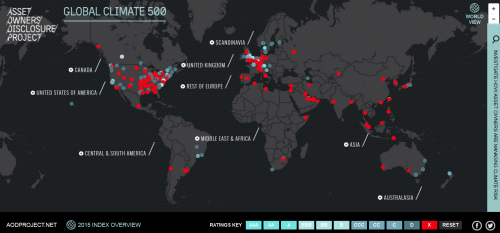
But these global low carbon leaders represent a small minority as many of the world’s largest investment firms continue to support high-carbon assets. In the most recent Asset Owners Disclosure Project (AODP), indexing the top 500 global asset owners managing $40 trillion U.S., 232 of them remained committed to high-carbon with no directive for investment into a low-carbon future.
As a retired person living off investment income I have been asking for full disclosure on my entire portfolio from my financial advisers. The bank to which my wife and I have entrusted our financial security is just beginning to address green and low-carbon businesses and this is happening to some degree because of social pressure from investors who read about climate change, stranded assets and the future.
AODP lists nine AAA best performers, all who measure climate change risk in portfolio decision making. These include by rank: Local Government Super (Australia); KLP (Norway); CalPERS (US), ABP (The Netherlands); Environment Agency Pension Fund (UK) New York State Common Retirement Fund (US); Australian Super; PZW (The Netherlands) and AP4 (Sweden). Note only one American and no Canadian asset managers make the list.
Julian Poulter, founder and CEO of AODP states, “People understand that governments will not regulate carbon properly but they now realise that these massive funds at the top our financial system have legal and financial responsibilities to manage climate risks.”
This third annual AODP report shows that business and the investment community still have a long way to go to make the paradigm shift to a sustainable low-carbon economic future. For example:
So it would appear that we, the public, and particularly those who rely on investment income, have an ongoing responsibility to make our investment and pension fund managers aware of our concerns related to climate change mitigation and adaptation. The adaptation includes a responsible transition to a low-carbon economy through green and sustainable investments.
Davey points to analyst estimates indicating $28 trillion US could be wiped off the books of fossil fuel companies in the next two decades because of global commitment by nations to reduce their carbon footprints.
Davey joins Mark Carney, Governor of the Bank of England, as well as the bishops of the Catholic church in pointing out that investors need to be told the straight goods about the future of their portfolios which for most banks and investment institutions are heavily vested in energy stocks.
The map below from Carbon Tracker provides a snapshot of just how the world’s stock exchanges are heavily invested in fossil fuel companies.

This week Catholic bishops called for an end to the fossil fuel era and a focus on a future of 100 percent renewables. In their announcement in conjunction with the current ongoing climate talks in Lima, Peru, the bishops released a statement with the following:
“In viewing objectively the destructive effects of a financial and economic order based on the primacy of the market and profit, which has failed to put the human being and the common good at the heart of the economy, one must recognise the systemic failures of this order and the need for a new financial and economic order.”
The bishops cited those front-line communities such as the island nations of the Pacific and Indian Ocean who are already suffering from the impact of a climate change. The bishops noted that the poorest and most remote people of the planet are the victims of nations that have exhibited little respect for environmental consequences stemming from consumptive behaviour.
Joining Davey, Carney, and the Catholic bishops are a number of large pension fund and asset managers who are joining together to urge fossil fuel companies to explain how they intend to address climate change. The California Public Employee’s Retirement System, U.S. public pension fund, and Aviva Investors released a statement this week in which they pointed out the following: “Investors are concerned that current business strategies being pursued by some oil and gas companies may not be sufficiently sustainable…..major trends are shaping a new direction in favor of low carbon energy systems and it is a critical time for the oil and gas sector.”
These asset managers urged fossil fuel companies to “embed stress testing for climate risk within key business processes.” And all of these urgent requests and statements are being made during a time when the price of oil is plummeting and throwing stock markets into a roller coaster of turmoil. What will happen to global investments when this next shock wave hits, when proven coal, oil and gas reserves on fossil fuel company books are declared stranded, unburnable, because the nations of the world in concert commit to a low carbon future?
Of course we may find technology solutions that let us continue to use carbon-based fuels without producing the climate-damaging CO2 and other greenhouse gas emissions. I recently wrote about one of these coming from the laboratories at Massachusetts Institute of Technology. And I am sure our human inventiveness will come up with others. But whatever we do as we recognize the need to address carbon in the atmosphere our entire energy infrastructure will need to undergo a retrofit.
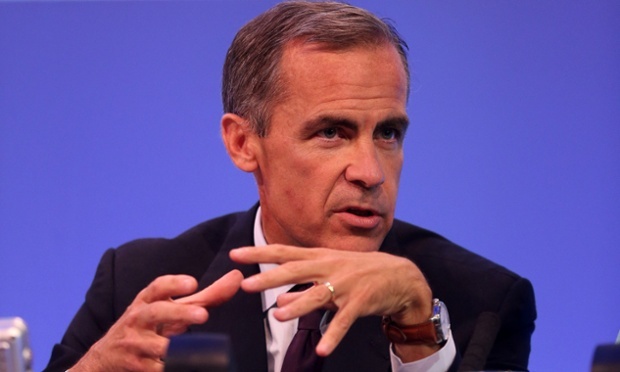
The move follows remarks made by Carney at an October meeting of the World Bank when he stated that analysis points to a future when fossil fuel reserves will be declared unburnable. He went on to point out the risk this poses for financial institutions and their investments.
The World Bank, representing 73 national governments, 11 regional governments and more than 1,000 business and investment organizations, has called for a global price on carbon emissions.
Others are reassessing their investment position in fossil fuel companies. Among these are:
The Rockefeller announcement follows an earlier letter sent in October 2013 to 45 fossil fuel energy company chairman and CEOs by a group of 70 organizations asking for transparency on the issue of “stranded assets.” These 70 included Fortune 500 managers, CEOs of pension funds, mutual fund managers and government officials, holding $3 trillion in energy company stock and they were asking for clarification on “reserve exposure to the risks associated with current and probable future policies for reducing greenhouse gas emissions by 80% by 2050 to achieve the 2 degrees Celsius goal.”
In a letter dated October 30, 2014, Carney wrote to Joan Walley, Member of Parliament and Chair of the U.K.’s Environment Audit Committee, further clarifying his World Bank remarks by restating his position, “that the majority of proven coal, oil and gas reserves may be considered ‘unburnable’ if global temperature increases are to be limited to 2 degrees Celsius.” He further stated, “I also referenced, on the basis of this analysis, how this may lead to ‘stranded carbon.’….These remarks were made in the context of…..highlighting the costs and benefits of tomorrow to inform the investment and credit decisions of today.”
Carney further pointed out that issue of stranded assets impacts insurance exposure from climate change and “the role of insurance regulation in supporting adaptation to climate change.”
Carney’s comments indicate that he is more than convinced that business needs to be candid about environmental impacts on operations and that a lack of longer-term thinking will lead to a “tragedy of horizons” and market failure.
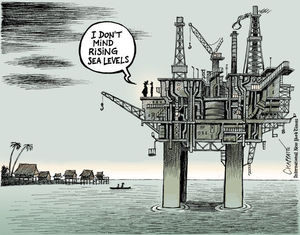
For many, like me, who rely on investment income from balanced portfolios that include a mix of Blue Chip dividend-paying stocks and bonds, energy companies are very much in play. Their perceived stock value includes both in-ground proven and estimated reserves. But it is those reserves that appear today to be on very shaky ground.
Unless the energy companies are society are prepared to invest in the rapid expansion of carbon capture and sequestration (CCS) capacity, then Carney’s warning of a “tragedy of horizons” is very real.
So far other than a few government-fund assisted CCS pilot projects, the exception being the Saskatchewan Boundary Dam project, the large energy companies seem to remain vested in old ways of thinking, the very issue Carney raised that could prove to be their undoing.
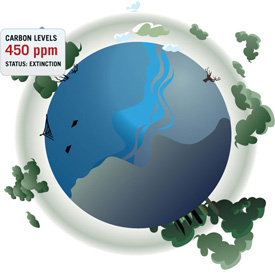
The magic number scientists believe we cannot cross is 450 parts per million (ppm) of CO2. That’s about a 50% increase in the amount of that greenhouse gas since 1950. Currently we are 400 ppm and inching upwards. The questioning by major shareholders and investors followed a 2011 report by Carbon Tracker, a not-for-profit based in the United Kingdom. Entitled “Unburnable Carbon – Are the world’s financial markets carrying a carbon bubble?” this document spelled out the amount of carbon we could continue to put into the atmosphere to remain under the 450 ppm CO2 level. At the time of the report, based on the amount that fossil fuel companies could still pump or mine it was determined that only 20% of existing reserves could be burned. Hence the term stranded assets was born.

In 2013 a second report, “Unburnable Carbon 2013: Wasted capital and stranded assets,” published by the same not-for-profit indicated that a carbon bubble was in the offing with $6 trillion US the number. This was the amount on the books of coal, gas and oil companies that could never be extracted and burned.
Since then stranded assets has moved to the forefront with a number of universities doing research papers and workshops on the subject. In May Carbon Tracker issued its third report, “Carbon Supply Cost Curves: Evaluating Financial Risk to Oil Capital Expenditures.” It looked a new capital expenditures on exploration, in particular, deep water oil, Arctic Ocean oil, and oil sands. These are areas of exploration where companies are expected to invest up to $13 trillion U.S. through 2050. The companies with greatest exposure include Petrobras, ExxonMobil, Rosneft and Royal Dutch Shell.
According to Carbon Tracker, in a world committed to action to not let CO2 atmospheric levels exceed 450 ppm, the industry would be facing a carbon bubble exceeding $28 trillion ($19.3 trillion for oil, $4 trillion for gas, $4.9 trillion for coal). The calculation is based on a floor price of $95 per barrel for oil and rising over the next several decades.
China, which has been gungho on coal-fired power plants, is not immune to the same issue. The latest report from Carbon Tracker, “The Great Coal Cap – China’s energy policies and the financial implications for thermal coal,” looks at stranded assets in coal-fired capacity. The U.S. Environmental Protection Agency (EPA) has also focused on coal in its latest regulatory policy focused on reducing emissions by 30% from 2005 levels by 2030. For China, so heavily invested in coal, it means stranded assets worth trillions. Energy utilities with an inventory of coal-fired power plants, and coal mining companies in the U.S. are equally at risk with stranded assets of greater value than those in China.
Carbon reduction policies are on a collision course with the financial reporting of fossil fuel and energy companies. That $28 trillion bubble, should it burst, will wipe out a large percentage of investors’ savings. And yet there has always been a way out for the fossil fuel and energy industry – diversification through investment in renewable energy including solar, storage, wind, tidal, wave and geothermal. Many of the fossil fuel giants have dabbled in the world of renewables but not to a point where they reduce their exploration budgets for carbon-based energy. Others in the fossil fuel community pay lip service to diversifying their mix of energy resources. BP is a great example having sold off its renewable energy investments.
Meanwhile, world leaders are being pressed by the overwhelming scientific evidence, and a growing majority of the public, to get serious about CO2, and when they do by bringing in hard targets, carbon trading and carbon taxes, what will ExxonMobil and Royal Dutch Shell do? According to their letters and disclosures to shareholders, it will be business as usual.


