Recently I had a cardiac ablation procedure that involved inserting a catheter through my femoral vein into my heart. The ablation would correct atrial fibrillation. an arrhythmia that happened after I was infected with COVID-19. During the catheter insertion, it nicked the vein wall creating a fistula, a small connection between my femoral vein and the neighbouring artery. The complication was discovered upon examination the morning after the procedure and one of the proposed solutions from the cardiology team was to put a stent in to block the hole which would stop the shunting of blood from the artery into the vein and a potential aneurysm.
It wasn’t the first time I had encountered stents. My daughter who was born with congenital heart disease in her last heart procedure had a stent containing a valve inserted into her pulmonary artery. She was born with an absent pulmonary valve among several other heart complications.
What makes the stent developed at North Carolina State different from any that I have read about or seen in the past is the fact that it uses exosomes from stem cells as a coating. The inventors call it the Exosome-Eluting stent or EES, the cell-derived material coating on the stent when implanted in a blood vessel counters the natural inflammatory response that automatically is triggered by our bodies to repair an injury. Stent-altered vessels often end up with post-procedure narrowing, a stenosis, caused by the body’s misguided attempts at healing. It’s a self-defeating proposition when trying to open blood vessels to support heart function when a narrowing occurs resulting from treatment.
The North Carolina team led by Ke Cheng, Professor in Regenerative Medicine and Biomedical Engineering, is using mesenchymal stem cell exosome secretions to camouflage the stent so that the body’s immune defenses cannot find it. The exosome-coating also promotes the growth of endothelial cells, the normal lining in blood vessels, which form over the stent.
Up to 60% of the coating is released within 48 hours after implantation which inhibits the effect of reactive oxygen species, unstable molecules produced by our cells that cause tissue damage at a post-operative injury site.
So far the studies have been done on rats to be followed by larger animals before human clinical trials. In a North Carolina State news release, Cheng states, “This bioactive stent promotes vascular healing and ischemic repair, and a patient wouldn’t need additional procedures for regenerative therapy after the stent is in place…The stent is the perfect carrier for exosomes, and the exosomes make the stent safer and more potent in tissue repair.”
A paper describing the EES appears in an April issue of Nature Biomedical Engineering.
]]>In the world of internal medical robots HeartLander is a giant. Researchers have much smaller in mind when they conjure up micro-robot designs. These researchers develop robots on a nanoscale. We have broached this subject before in a blog and stated at the time of writing that there were no existing biomedical nanobots. That remains true but researchers at ETH Zürich have been building what they call micro-robots that are bacterial-scaled measuring lengths of between 5 and 15 nanometers. Called Artificial Bacterial Flagella or ABF for short, these devices swim like bacteria with corkscrew tails.
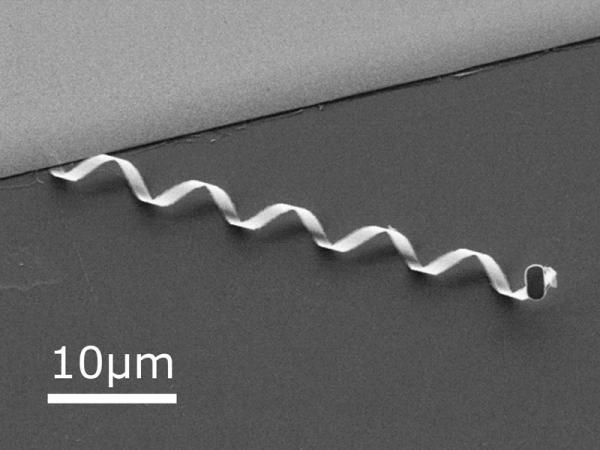
Made by depositing vaporized indium, gallium, arsenic and chromium onto a surface substrate a few atoms thick, the ABFs are patterned using lithography and etching. When thin sliced they naturally form the curled ribbon corkscrew you see in the picture above. The ABF head seen on the right contains a tri-layer film of chromium, nickel and gold. Nickel’s magnetic properties make it possible to use an external magnetic field to provide locomotion. The ABF uses helical propulsion (the same method of locomotion used by many bacterium) to swim through liquid at speeds of up to 20 nanometers at present with plans to increase it to 100 nanometers. Compare that to E. coli which swims at 30 nanometers per second.
To give ABFs autonomous power researchers are looking at thin-film rechargeable batteries. Currently these batteries can be manufactured and shaped with thicknesses of less than 50 nanometers. Chemical fuel sources may prove to be even more promising. An ABF running on energy it harvests from the blood would be capable of running indefinitely within a body harvesting glucose and oxygen to provide motive and computing power. Some researchers are looking at using bacteria as an ABF, modifying a living cell by attaching nanoparticles to it so that it can be mobilized for biomedical purposes.
What can ABFs do that current biomedical technology cannot?
Currently ABFs are confined to the research laboratory. But soon we will microscopically see these devices applied to all kinds of medical procedures reducing the need for surgical procedures, minimizing the side affects of cancer chemotherapy, and giving biomedical professionals a new set of tools for tackling conditions for which current medical practice has few solutions.
For those developing this technology it’s a question of tinkering with the power source to come up with the best way to deploy micro-robots.
]]>