It was no surprise to me to read the latest U.S. Government Accountability Office (GAO) report that questions NASA’s entire approach to the Artemis Program, an ambitious goal to send human crews to the Moon and establish a crewed habitat there before going to Mars. The GAO report questioned the affordability of the Program, NASA’s fundamental ability to manage U.S. taxpayer money, and what the final cost will be.
When I asked the above question in 2019, I wrote that other ways were far cheaper to accomplish the goals of the Artemis Program. These entail:
Since writing these three in 2019, I would revise the first point and replace the Falcon Heavy with the Starship.
NASA has done and can do all three of the items on the above list. But why no one at NASA has put an alternative plan to the SLS in place, would seem to defy logic.
The SLS evolved from several cancelled NASA programs designed to succeed the Space Shuttle. Its direction and design were first formulated in 2011 with the idea to use some of the technology from the Space Shuttle Program, and other technology on the drawing board in development from cancelled programs. This has always been one of the flaws in NASA’s approach which has been exacerbated by the four-year cycle of election politics in the U.S. leading to changes in presidential aspirations regarding space. Throughout regime changes, the return to the Moon has been the only constant. For a while, it was not to land on the Moon but to develop the horsepower to reach and go beyond it. Landing and establishing a crewed lunar base came later to explore the Moon’s environment for potential extractable resources to be used on missions on and beyond it.
SLS has never been a single rocket system. It comes in multiple iterations of which only the first has been built. So there is a lot more design and investment to make to this single-use system for getting to Deep Space. And NASA’s prime contractors have milked the Agency repeatedly for extended funds that go well beyond the original budgeted costs. In recent days, NASA has changed its contractor terms from cost-plus arrangements to firm fixed costs. But that hasn’t changed the boondoggle that is SLS. The GAO report questions the affordability of NASA’s entire approach to Artemis, and to continuing to support the SLS.
Meanwhile, SpaceX, the company that has taken over NASA’s low-Earth orbit taxi business, once the purview of the Space Shuttle and Russia’s Soyuz, has been building the completely reusable alternative to SLS called the Starship with its super heavy booster. Starship is indirectly funded by NASA since the Agency continues to buy services from SpaceX for satellite launches, supply runs and crewed missions to the ISS. The money earned from these projects has allowed SpaceX to plow it into the Starship. NASA has given SpaceX a contract for a version of the Starship to be used in the first and second Artemis lunar landings. Starship is demonstrating flexibility. Starship is reusable. And Starship comes in at a cost considerably lower than the SLS.
Here is a good example of the lack of cost awareness from NASA. The engines being used by SLS currently cost $100 million each. SLS uses several of these per launch. NASA has asked the prime contractor to get the cost down to $70.5 million each. Remember these are throwaways.
A comparable engine built by the American commercial space company, Blue Origin, comes in at $20.4 million per engine and is reusable. These could easily replace the existing SLS engines.
And then there is SpaceX and its Raptor engines which the company uses in clusters to populate the Starship and heavy launch booster. Each of these costs less than $1 million apiece and are reusable.
In the end, each Artemis SLS launch is going to cost NASA several billion dollars. Except for the Orion capsule, everything used in each of these launches gets thrown away.
SpaceX estimates each Starship mission will cost $40 million. All components of the Starship including its heavy booster will be reused repeatedly. If the current use of Falcon 9 first stages is any indicator, reuse should become a fundamental requirement for NASA’s space program including human space flight going forward. So I ask the question once again, “When will NASA abandon the SLS Project?” Or is this a case of “in for a penny,” in for billions with no escape?
]]>
A perfectly good alternative that is reusable and cheaper just demonstrated its effectiveness last week when SpaceX launched a Falcon Heavy mission. Two of the first-stage booster rockets returned to land and will be reused. The main core was never to be reused. The Falcon Heavy’s cost for the mission was but a fraction of what SLS will cost American taxpayers for each Artemis Program launch.
Another Boeing project that has proven to be overpriced and underperforming is the Starliner. Boeing and SpaceX were both awarded contracts to build space taxis to ferry crews from Earth to the International Space Station (ISS). SpaceX built two versions of its Dragon partially reusable module, the first to ferry supplies to the ISS, and Crew Dragon to send people. The Cargo Dragon version has been in operational use since 2012. Crew Dragons have been flying astronauts to the ISS since 2020. NASA pays SpaceX about US $55 million per seat for these flights. And now the Dragon is being used to fly commercial crews to space and the ISS.
Compare this to Boeing’s Starliner. Boeing and SpaceX both were awarded space taxi contracts by NASA at the same time. After that Boeing has demonstrated an ineffectiveness in fulfilling the terms of the contract in a similar fashion to the work it has done on SLS. Fraught with design flaws, Starliner has yet to carry a demonstration crew on board. Its first crewless flight never made it to the ISS because of software glitches. The second crewless attempt finally docked with the ISS in May of this year. Following that mission, we were told that Starliner would fly a crewed mission late in 2022. Then the date slipped to 2023, and this week NASA announced a demo mission for April of next year with the first operational mission of Starliner not happening until 2024 “at the earliest.”
This means Starliner has yet to launch an operational mission in fulfillment of its NASA contract and the reasons why remain only known to the Agency. One would guess that NASA has little confidence in Boeing’s technology. Too many glitches have been logged regarding Starliner’s May mission including ongoing thruster problems, parachutes, and other unresolved technical and software issues. “Inflight anomalies” is the term NASA is using as the primary reason for delaying the commercial operation of Starliner.
And by the way, NASA pays Boeing US $95 million per seat for every astronaut Starliner will carry to the ISS, a $40 million premium over its costs when using the SpaceX Crew Dragon. Yet Boeing says that Starliner is a money-losing proposition with total losses amounting to $883 million to date.
Meanwhile, NASA’s SLS Boeing partnership which was slated to come in at $2 billion per Artemis mission launch is now expected to cost $4.1 billion, and over the last decade since it was first announced has cost the Agency more than $23 billion to date. No doubt, Boeing is claiming it is losing money on this contract as well.
If NASA were to walk away from SLS and start the Artemis Program using Falcon Heavy, and later switch to using the SpaceX Starship once it’s declared spaceflight worthy, the cost to the Agency could be reduced dramatically. The latest Falcon Heavy launch cost more than the $150 million SpaceX price tag established in 2019, but certainly considerably less than Boeing’s SLS. Falcon Heavy provides about 25% less maximum thrust when compared to the SLS, but you could send several Falcon Heavy missions into Earth orbit and assemble components Artemis there for a fraction of the cost of launching one SLS from Earth’s surface. And when Starship goes commercial it will dwarf SLS in terms of maximum thrust and payload capacity and will be reusable and a lot cheaper.
So why is NASA sticking with Boeing? Can someone at the Agency explain this to the American public with a rationale that makes sense?
]]>SLS components include the Boeing-built multi-stage rocket, and other pieces contributed by Lockheed Martin (the Orion spacecraft not including the European Space Agency’s service module contribution), and Northrop-Grumman (the builder of the solid-rocket boosters which were recoverable for the Shuttle Program but will be throwaways for Artemis).
Boeing and Lockheed formed the United Launch Alliance (ULA) a number of years ago to compete for NASA launch contracts. ULA has received the lion-share of NASA money for its launch services when compared to SpaceX which continues to deliver better value per mission. And SpaceX has the Starship and Super Heavy, an alternative to SLS that NASA could use but chooses not to. The consolation prize has been to give SpaceX a contract for a version of the Starship to be used by Artemis for the first lunar landings.
Did NASA need the SLS? Back in 2019, I asked that question in a posting entitled, When will NASA abandon the SLS project? I argued against it for a number of reasons including: that SLS was old technology dressed up to look new, that with the exception of the Orion spacecraft, it was almost all a one-time use throwaway, and that the majority of money being spent was going to administrative overheads, in fact, 72 cents of every dollar according to NASA’s own budgetary audit.
Despite all the evidence of massive overspending and endless delays, NASA has stayed the course and is about to launch Artemis 1, an uncrewed mission to the vicinity of the Moon. This will be the first test on whether the tens of billions invested were worth it or colossal fiduciary malfeasance.
But talk about compounding on the error that produced the SLS, in the latest space news, NASA is prepared to throw even more money at a Boeing company. On July 26, 2022, the Agency issued a pre-solicitation request to sole-source Artemis future launch services going forward to 2036. The number of missions proposed is at least 15.
Since NASA loves to create project acronyms, this is no exception. The new service contract goes by the name EPOC, which stands for Exploration Production and Operations Contract. The likely sole recipient of this future budgetary largesse is Deep Space Transport LLC, a recently formed company with Boeing its premier partner, and Northrop-Grumman, as the junior associate. Since both companies are primary vendors for SLS, NASA justifies sole sourcing based on the infeasibility of involving other companies. In the pre-solicitation NASA explains its rationale stating, “To have another company manufacture the Core Stage and Exploration Upper Stage may take as long as 10 years, a duplicative cost to the Government not expected to be recovered through competition.” Instead, NASA believes that over time production and support costs per mission will go down with the hope that the number will be between $1 to $1.5 billion per launch.
Yet there is competition in plain sight that has proven flight worthy with crewed and supply missions to the International Space Station, and a fully reusable alternative with even greater lift capacity than SLS soon to go through its maiden flight.
The sole-sourced EPOC Artemis service contract is expected to be awarded by the end of next year. If costs remain at $4.1 billion per launch, the contract could deliver anywhere from $65 to $80 billion to Deep Space Transport LLC. But if cost-plus is factored in, as it has been in the SLS Program, the number could be substantially higher. So the boondoggle continues.
]]>One question asks:
“The VP indicated we’re in a space race with the Russians and Chinese. The Soviets/Russians have never had a manned flight beyond LEO, and the Chinese haven’t had a manned flight in years. How are we in a space race with them?”
This is a variation on the manufactured Border Crisis that has led to the declaration of a national emergency on the border and the circumventing of Congress’ constitutional budgetary authority by President Trump. If there is a space race today it is the one between SpaceX and NASA, not China, or Russia.
Another question asks:
“Over the past fifteen years, the Agency has been directed to go to Mars, then the Moon, then an Asteroid, then an Asteroid around the Moon, then Mars, then a space station around the Moon, and now the Moon again. What steps do you plan to take to reduce the programmatic whiplash that keeps us from actually accomplishing any of these grand plans?”
The human flight space program has always been driven by politics but with the building of the International Space Station, the rivalry that once drove the pace of human progress in space ended. U.S. administrations have come up with new programs and objectives only to be erased by succeeding administrations. You can certainly understand the cynicism that underlies this question. It speaks volumes about how many within NASA feel regarding the role of the Agency. In the U.S. presently only one space program has never veered from its objective. That is the one Elon Musk has proposed to establish a city on Mars by mid-century. Musk’s dream is shared with his employees at SpaceX who enthusiastically embrace the vision and have been working to achieve it through the development of a reusable space transportation technology. There is nothing in NASA that is anything like this.
Another asks should we be taking shortcuts to get to the Moon within the five-year deadline:
“Rockets in the late fifty’s were relatively simple. They fell over and blew up regularly. For every problem found – safety systems were created. As we learned more about getting men and women to space, every safety issue created more safety features. Now to man-rate the SLS we have so many safety features to stop the rocket from falling over and blowing up that modern computers have trouble keeping up. This rocket is being created in a much different safety environment than Apollo. Do we skip some tests and eliminate some quad redundant safety systems to get to the moon in 5 years?”
The problem is the Space Launch System (SLS) itself. A replacement for the successful Saturn V rocket, this giant didn’t need to be built in the first place, and now is years behind schedule and massively over budget. And NASA’s history of shortcuts in its human space program has produced two space shuttle disasters, causing the death of 14 astronauts. If something’s got to give when it comes to safety, it should be the timeline.
And a final very long question among the hundreds already submitted looks at current events in avionics, the SLS contractor Boeing, the recent Trump budget request, and the leadership of Bridenstine himself in what can only be described as a rant:
“Keeping in mind that the primary contractor for the SLS is Boeing, whose most popular airliner is grounded right now due to rushing and lack of oversight funding for the FAA leading to over 300 deaths, considering that the Trump budget proposal dramatically slashes NASA funding over the next 5 years and Boeing was just looking at a 2028 launch, four years later than what Pence just mandated, what are the chances the SLS will have a sensor malfunction and dive uncontrollably straight down to Earth, killing all of the astronauts onboard? Has anybody actually studied what agile development is really about? Really to pull off any real technical feat, you need effective, structured, multilateral communication with the good, bad, and ugly communicated, so solutions can be found and implemented. You can’t rely on the fly fixing these issues 300,000 miles from Earth by rushing out new, fixed hardware because what is onboard was never built right. Where is the real leadership? Why does it always seem to be “I am the hot stuff and I tell you what to do from the top down” and “my people handle this, not yours”, not let’s realistically coordinate a community of people to collectively get this thing figured out and built with all of the best minds effectively getting the best ideas out there and implemented so this thing will really work and work well? I haven’t seen this since Apollo when they let Wernher von Braun design the rocket and even at this they never allowed him to explore his particular ideas on reusing parts of the rocket, which he always wanted to do. So everything since has been sub-optimal, overly expensive, and even dangerous as evident by two whole shuttle crew loses and the shuttle ultimately canceled because the design could not be made safe nor could it be made cheaper like SpaceX’s Falcon 9, which by the way why are we ignoring their efforts funding-wise in recent years as they actually do implement good ideas in their rockets. So it is like we gave them a chance, they proved themselves, now we are ignoring them and not funding them on their bigger effort to get to full re-usability. Again I don’t see leadership and I would like to know what you are going to do to really lead this agency?”
The author of this series of observations and questions is really asking a question about how NASA has lost its way and how its leadership has failed the Agency and its employees.
Want to see some of the other questions, then click here.

It seems that Donald Trump, fresh from the Mueller Report’s conclusions that he was not colluding with Russia in 2016, feels that a second term will have him in the White House until 2024. So that’s the date he wants NASA to meet in returning American astronauts to the Moon’s surface.
The announcement was made yesterday at a National Space Council Meeting in Huntsville, Alabama, by Vice President Mike Pence, who gave a speech in which he called for “a major course correction,” in the country’s lunar timetable as well as plans to unleash “America’s private pioneers” in low-Earth orbit, giving over that area of space to them. He further stated that NASA “must focus on the mission over the means.”
In government parlance, the word “means” translates to money. So was Pence saying that NASA is expected to make the 2024 date using the dollars at hand to meet the President’s vanity project deadline?
The latest budget request from Trump certainly didn’t seem to reflect his new ambitions. But maybe that was because the Mueller Report hadn’t yet been tabled and he wasn’t sure he’d be around for a 2024 lunar landing. In fact, the Trump budget request gave NASA less than what it received in 2018. But Congressional budget appropriations signed February 15th, increased the NASA budget to $21.5 billion for this year, $1.6 billion more than Trump wanted, and $800 million more than 2018.
For Boeing and its much-delayed and over-budget Space Launch System (SLS), this could be the beginning of the end.
Pence stated in his speech that the administration isn’t “committed to any one contractor. If our current contractors can’t meet this objective, then we’ll find ones that will. If American industry can provide critical commercial services without government development, then we’ll buy them. And if commercial rockets are the only way to get American astronauts to the Moon in the next five years, then commercial rockets it will be.”
Other than Boeing there is only one commercial space company ready to fit the criteria established in Pence’s words. It is SpaceX, and it will be interesting to see if the SLS project is moth-balled, something that I conjectured in a posting earlier this month.
SpaceX’s Falcon Heavy is a likely replacement for SLS. Its second launch is coming up next week carrying a commercial telecommunications satellite to geosynchronous orbit. With proven reusability demonstrated in its demonstration flight, the Falcon Heavy could meet NASA’s 2024 timetable. Or the SpaceX Starship, the former BFR, currently in design and expected to undergo short-hop testing over the next few months, could become the 2024 launch vehicle. And SpaceX could accelerate Starship development if it were to receive a contract from NASA rather than continue to build the new launch system on its own dime. And it should be noted that SpaceX has had its own plans to send a Starship to land on the Moon with 2024 the potential landing date. So maybe this could become NASA’s 2024 lunar mission.
The only other contender is Blue Origin but the New Glenn rocket has yet to appear on the scene, and Jeff Bezos’ company with its current New Shepard launch vehicle is still a system designed to give rich tourists a ride to the edge of space and no more.
Before the Pence speech, NASA had announced 2028 as the timeline for American astronauts to return to the Moon. An in-orbit space station called the Lunar Gateway was to be the next big project along with a test flight to cislunar space using an unmanned Orion capsule. Whether the Lunar Gateway is needed has been questioned by some former NASA astronauts and administrators. So with these new marching orders from the President, will the Agency dispense with it and go for a landing in Apollo-style? or maybe Starship style?
For Trump, it isn’t just bragging rights but rather a statement to Russia, China, Europe and other spacefaring nations that the United States owns the high-ground of space.
And on the Moon, not just any space, because Pence announced the location for that 2024 landing, the Moon’s south pole. The evidence of ice located in deep craters at the pole is a compelling argument for a mission there even though navigating to the locale is far more complicated than anything attempted by the Apollo Program. But once there the ice would serve as an in-situ resource to be harvested for oxygen, hydrogen, and water.
And just to make it even more interesting, Pence announced in Huntsville that NASA step up efforts to build a nuclear-powered rocket, something NASA abandoned over four decades ago.
Why now? Because Russia recently announced its plans to build a nuclear-powered rocket. Now this is coming from a country and Roscosmos space agency that has insufficent funds to do much more than service ISS, and which has yet to build a next-generation booster rocket for human spaceflight, or complete the construction and testing of its next-generation capsule designed to carry cosmonauts and replace the more than 51-year old Soyuz.
And of course there is China with its latest feat, landing a robotic spacecraft on the far-side of the Moon, and plans announced to build a nuclear-powered propulsion system for a future a space shuttle to be launched by no later than 2040.
Pence’s exact words on nuclear power in space call for it to be used “to extract water from the permanently shadowed craters of the South Pole; and to fly on a new generation of spacecraft that will enable us to reach Mars not in years but in months.”
Delivering a small modular reactor to the surface of the Moon is viable. NASA has some experience in using nuclear materials to power some of its missions, for example, the Mars rover Curiosity, and the New Horizons robotic spacecraft that flew past Pluto and Ultima Thule. But neither of these systems contained the size of power plant Pence is talking about that would be used to power up a lunar colony, and convert lunar ice to water, oxygen, and hydrogen.
The 2019 NASA budget for its nuclear-powered rocket technology is $150 million Compare that to the $14 billion already spent on SLS, and the more than $2 billion in this year’s budget for the Boeing-built rocket, and you realize that the Agency may have to do some quick fiscal retooling if the Vice President’s words are to be turned into reality.
Nuclear Thermal Propulsion (NTP) technology would cut travel times to and from Mars by half. That means far less exposure to cosmic rays for the onboard crew. And also means less need for in-situ resource extraction to create the chemical fuels that would be needed for a return to Earth. There would still be a need for Mars resource extraction for oxygen, water, and hydrogen, but not to the same extent.
The latest NTP design calls for the use of low-enriched uranium fuel rather than plutonium, and new materials to eliminate corrosion, a problem that occurred in NASA’s NERVA project more than forty years ago when the Agency made its first attempt at nuclear propulsion.

]]>
Why NASA continues to believe in this project boggles my mind. Why?
The schedule for NASA’s rollout of SLS originally planned for a December 2017 launch with the Orion in an uncrewed voyage around the Moon. Now the target date is June 2020 and no SLS even close to ready to meet the launch window.
The second mission with a crew aboard was to happen in mid-2021. Now that date has slipped to 2022 and will likely be put off even further into the future as SLS continues to see completion dates slip.
In the latest audit of the SLS contract, published in October of last year, it states that Boeing will have spent $8.9 billion, double the budgeted amount for delivery of the core stage of the SLS. That’s not even the whole rocket.
Why has this happened?
The audit points to “Boeing’s poor performance.” How so?
The audit further points out that NASA oversight has been seriously lacking or slipshod with Boeing performance rating reports of “excellent” and “very good” issued leading to money being released to the company without work shown results that warranted these ratings. Nowhere in the audit does it refer to the 72 cents per dollar being spent on Agency administration of the contract which seems a bit strange. Instead the audit points out that NASA has been making attempts to implement better oversight (at what cost?) to ensure Boeing meets the SLS program objectives. Despite these changes, the audit concludes that contract performance in the future remains uncertain.
The audit proposes solutions that include a corrective task-based action plan, a renegotiation of the contract, federal government involvement in costing, a contracting officer in charge of and monitoring Boeing performance, and separate fixed-price, end-term deliverable payouts based on completion of each task.
What is an alternative launch strategy?
NASA has the ability to do all these three strategies. Why no one at NASA has put this plan in place defies logic.

In the Donald Trump era, with Jim Bridenstine, a politician who is neither scientist nor engineer, now in charge of NASA, the agency has set a politically-motivated agenda to return to the Moon and from there to go on to Mars claiming the high ground of space.
Returning humans to the Moon has been the dream of many in NASA’s astronaut corps. The decision, therefore, is popular in the agency and NASA’s administrators have started putting together a plan to develop new spacecraft and a space station to add to the agency’s Orion space capsule and Space Launch System booster.
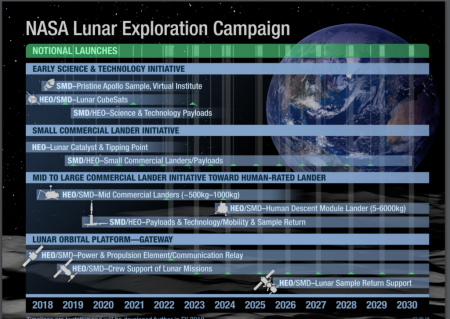
The spacecraft needed are ones that will fly in the cislunar space. They will be reusable descent and ascent modules in the tradition of the Lunar Excursion Module (LEM) of the Apollo era.
The Lunar Gateway
The space station program, named the Lunar Orbital Platform-Gateway, essentially will be a miniature version of today’s International Space Station (ISS). The plan is to place it in an elliptical polar orbit from 1,900 kilometers (1,200 miles) to 75,000 kilometers (47,000 miles) above the Moon. The Gateway will be rendezvous and docking facility for human travelers coming from the Earth, and from those going to and from the Moon.
The Gateway will also serve as a testbed for developing and experimenting with the tools and technology needed to go further into Deep Space, in other words, to get to Mars. More than likely a similar Gateway will eventually orbit Mars.
Of course, on NASA’s current $20 billion annual budget, none of this is possible. And even if commercial space companies were to get involved they would be looking for NASA contracts to fulfill on the deliverables the agency will need to fit all the mission pieces together.
This Gateway is expected to be about one-sixth the size of the existing ISS. Some speculate that ISS parts may be flown to cislunar space to be used to build it once the existing station is decommissioned in the mid-2020s.
Right now the likely structures will include:
The docking port will be universally adapted to allow almost any commercial or other space agency’s spacecraft to dock with the Gateway. It will initially accommodate between 4 and 6 humans at any time. The polar orbit would be most advantageous to humans wanting to go to the Moon’s surface because from that perspective they can reach anywhere on the lunar surface including the side we never see from Earth (the Moon is in tidal lock and always presents the same face to observers here on the ground).
The ISS cost $150 billion to make. The Gateway, being more remote and having learned from ISS construction, should cost no more and possibly considerably less. Commercial alternatives to the aluminum canisters of the ISS, may prove to be the better way to go for Gateway construction. For example, using Bigelow’s inflatable modules of which is currently attached to ISS, can be launched in a small volume package and upon arrival in cislunar space be inflated to create substantial accommodation, much bigger than two school buses.
So when will this all happen? Right now the NASA budget for 2019 has assigned over $4.5 billion to Deep Space exploration systems. And budgets for 2020 through 2023 amount to nearly the same annually. If we go by the 2023 budget, money for the Gateway which could cost $150 billion when completed will be in such short supply that the likelihood of it being built within the decade is virtually nil.
The Space Launch System
Today NASA’s non-science program budget is being eaten by two big-ticket items of which the biggest is the Space Launch System (SLS). The ISS annual cost represents a paltry $2.9 billion while SLS has cost since inception in 2004, nearly $18 billion. Just firing one a year adds between $1.5 and 2.5 billion to the NASA budget.
So what is the SLS? Designed to replace the Saturn V rocket behemoth of the Apollo era, the SLS is an old-style monster liquid-fuel rocket that is not reusable. It serves one purpose, to launch to orbit or beyond huge payloads out of the gravity well that is our Earth. NASA describes the SLS as its ticket to Mars. But others have their doubts including veteran astronauts like Canadian, Chris Hadfield, who sees chemical rockets as a dead-end solution to interplanetary travel. Hadfield argues that SLS is just a bigger version of the technology that took us to the Moon in 1969. Using it to get to Mars would be suicide for the astronauts according to him. There is nothing appreciably new about SLS. It is just a bigger version of the Saturn V providing incrementally more horsepower to launch bigger payloads. But for a journey to Mars states Hadfield, the SLS with an Orion payload on top would be equivalent to crossing the Atlantic Ocean in a canoe.
The Orion Exploration Vehicle
The last of the legacy pieces from the Bush and Obama eras is Orion, a space command capsule that supposedly will be a successor to Apollo and meet Deep Space requirements for human crews. Orion was designed initially for a different rocket, not the SLS. Its crew module can carry four into Deep Space for missions lasting up to 21 days in its simplest configuration mated to an accompanying cargo and logistics module. It is outfitted with the latest communications, safety, radiation, and life-support systems. And when mated to a complex of other modules can become the bridge of a spaceship for longer missions of up to 1,000 Earth-days in space. In other words, Orion is NASA’s choice in a voyage to Mars and back.
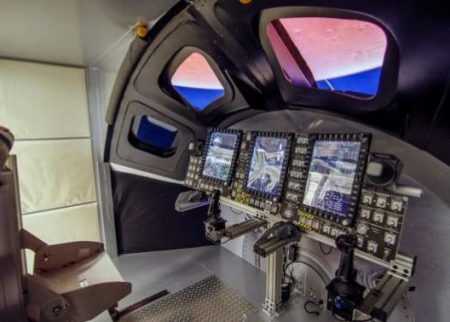
An uncrewed test of Orion and the SLS is currently slated to happen sometime in 2020. It will take Orion to the Moon where it will enter orbit about 100 kilometers (62 miles) above the surface. It will then do a maneuver to attain a retrograde orbit 70,000 kilometers (40,000 miles) above the Moon where it will stay for six Earth-days. After that, a close flyby combined by engine firing will insert Orion into a trajectory back to Earth were it will splash down in the Pacific Ocean. Total elapsed Earth time will be 21 days.
The building of the Gateway will follow so that a future Orion with a crew of four aboard will dock with it and begin the planned return to the Moon by the mid to late 2020s. The Moon is a good objective for NASA to re-engage. Missions to it will teach the agency about its planned technology and its limits. It will also be a good test for human crews who will for the first time since Apollo be exposed to the hazards of Deep Space. The leap to Mars will be a whole different ballgame.
]]>

So what is the reason for NASA to return to the Moon?
NASA has invested its future in a heavy-lift rocket, the Space Launch System (SLS). This is the successor to the Saturn 5 rocket of the Apollo Program. Its first test flight is scheduled for 2018 with an Orion space capsule atop in a crewless test of both the new rocket and the crew capsule’s capabilities. The destination would be the vicinity of the Moon. The next mission with a human crew, scheduled as early as 2021 would duplicate the first mission.
But NASA is not alone in targeting the Moon. China, Russia, Europe, India, SpaceX, and Blue Origin, the latter two, commercial U.S. space companies, have all got designs on the Moon. Commercial U.S. space companies like Bigelow Aerospace are planning lunar habitats and space hotels. SpaceX, Elon Musk’s reusable rocket company will launch the Falcon Heavy, its competitor to SLS, early in 2018. Its current plans include sending two paying customers on a trip to orbit the Moon and return possibly by the end of next year. So NASA’s lunar interest is far from unique.
Where President Obama saw a return to the Moon as a been there, done that mission, it seems the majority of those in the space business see lots of good reasons to make the Moon a place for humans to further explore and even settle. Russia’s Roscosmos and Europe’s ESA have announced a collaboration to establish a lunar colony before the end of the decade of the 2020s. NASA has been invited to participate.
The cost of establishing a lunar colony could easily exceed $100 billion over the lifetime of the project, even with the space launches getting cheaper because of reusability. The return on investment in building a human presence on the lunar surface could come from exploiting the Moon’s resources. The Moon has water in the form of ice which can help sustain a lunar colony with minimal need for resupply from Earth. The Moon has significant quantities of Helium 3 lying on or near its surface, a material of great interest and high worth to those developing commercial nuclear fusion reactors. This could earn a lunar colony venture hundreds of billions of dollars. And who knows what else can be extracted from the lunar regolith. The old United Nations peaceful uses of space doctrine, and the preservation of moons and planets we humans reach is all out the window in this new rush to exploit space. But with Mars seen as the ultimate destination for NASA’s humans-in-space program, the most obvious reason to return to the Moon is to create and test the technologies that ultimately will make a mission to Mars a success. The Moon is close by. A technology we put on its surface that doesn’t work can be replaced or improved upon at a site less than 5 days away. You can’t do that when Mars using current transportation technology capability is as much as six months distant.
When President Obama revised Bush’s directive in 2010 he substituted for the Moon with an asteroid redirect mission in cislunar space in the mid-2020s to be followed by a mission to Mars sometime in the 2030s. I always felt that this was a bit short-sighted and it appears that the spacefaring community was similarly inclined. Now Trump has agreed with the larger community and reversed Obama’s mission objectives.
But his motives may be far different than those who will benefit from the change. For Trump, a real estate mogul before becoming President, one could suspect he has designs on ownership of the high ground of space, as well as a commitment to “America First” in all things. For the space community the Moon has always been seen as a necessary stepping stone to Mars.
What appears to be lacking in Trump’s new directive is funding, and commitment to milestone dates. The wording changes in the old 2010 document are small. Trump has changed Obama’s words from “crewed missions beyond the moon” and “humans to orbit Mars” as the primary objectives to:
It will be interesting to see how a U.S. government with a projected ballooning multi-trillion dollar debt, will find the money to have NASA achieve such lofty goals. Follow the money and you may find out what will be NASA’s actual future in human spaceflight under constrained budgetary circumstances.
Meanwhile, expect many private U.S. companies like SpaceX, Blue Origin, Planetary Resources, Virgin Galactic, and others to fill the gaps left by NASA’s budgetary shortfalls. And likewise, expect other national and international programs to compete at achieving the same objectives.
One wonders when humanity will finally make space a global space project with cooperation replacing competition, similar to the effort that created the International Space Station, and akin to what science fiction writers often describe when telling stories about our species’ future beyond Earth.
]]>