To reserve your hotel room Orion Span is already taking deposits of $80,000 US per person. That puts you on a waiting list for what will be a future 12-day space experience at Aurora Station, the name of your hotel. In the FAQs section of the website iitstates that prices for the entire stay start at $9.5 million. This is for all-inclusive accommodation plus travel to and from Aurora Station. Nowhere does it say if the 12 days includes the launch to the station which could eat up as much as two days of your space vacation based on what astronauts go through to get to the International Space Station more often than not. Orion Span does offer a money-back guarantee up until the actual launch. After that there is no mention of returning your money if you are not entirely satisfied.
The hotel is to be modular in design with each unit a room. Current configuration will include two guest modules and a crew module with total accommodation for 4 and a crew of two. States Frank Bunger, CEO of the company “our goal is to make space accessible to all.” And by all he means those who have $9.2 million to spend on a vacation.
What about launch preparation? According to Orion Span its guests will undergo a three-month regimen to get them up to speed and in good physical shape for the visit. Compare that to the three-days training Virgin Galactic plans to give its space tourist on future flights of SpaceShip Two, or the two years training every astronaut undertakes to go to the ISS.
Your $9.5 million buys you 384 sunrises and sunsets as your hotel room orbits the Earth every 90 minutes over the 12 days. You also get high-speed wireless Internet access to talk and video chat with those back on Earth. Your room is equivalent in size to the interior volume of a Gulfstream G550 jet, approximately 47.26 cubic meters (1,669 cubic feet). The module containing your room is 10.7 x 4.3 meters (35 x 14 feet).
Look at the picture below of a Gulfstream G550 cabin and you see approximately the space you will be living in for 12 days. Of course in microgravity there will be no floor or ceiling so you can take advantage of the entire wall space while you bounce off of them.

Orion Span is still raising money from investors to make Aurora Station a reality, and it has yet to contract a launch provider or the builder of its first module. But its chief architect, a former NASA employee, has come up with the design specification configured to most current commercial rocket companies and agencies including Arianespace, SpaceX and United Launch Alliance (ULA). I’m betting even Roscosmos may want to get in on the action.
So is this the beginning of another space race? Will Orion Span, Bigelow Aerospace, or Roscosmos be first to offer commercial accommodation for space tourists.
If everything falls into place for Orion Span, the plans are to add many more modules to Aurora Station in the years to come and eventually offer them to buyers as condominiums.

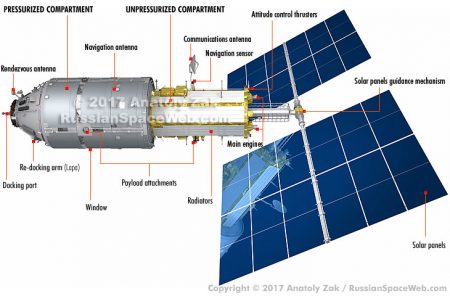
The cost for an up to two-week stay is currently listed at $40 million with $4 million upfront to guarantee your reservation. If you want to stay a month add $20 million. A spacewalk will cost you an extra $4 million. Roscosmos will require those booking this ultimate Christmas vacation lead times of at least two years.
Where will the hotel be? As seen in the circled area in the image below, this is the likely location for Russia’s first space hotel, attached to Russian modules that are planned to be added to the International Space Station (ISS).
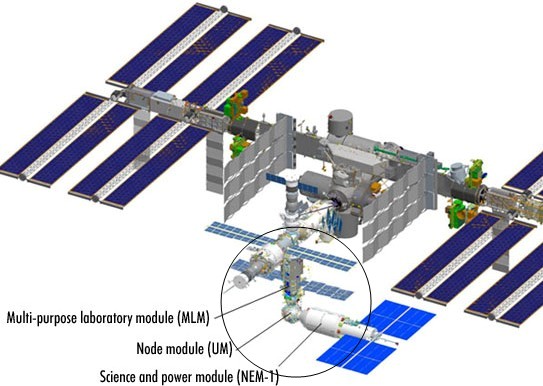
There is a bit of a problem with this plan. Since the current plans for ISS are to decommission it in 2028, that gives this Russian venture a six-year year shelf life. RKK Energia hopes it can sign up 12 to start which may cover the cost of construction.
Why is Russia getting into the space tourism business and making such a bold announcement? Probably to beat the competition to the punch.
Who are the competitors? Six are corporations and two are government-based programs. A summary of each follows:
Virgin Galactic – Richard Branson has ambitions to launch tourists to the edge of space within the next two years. His SpaceShipTwo, now rechristened the VSS Unity, is designed for suborbital flights. Recently Saudi Arabia has agreed to invest $1 billion initially in the venture with an option for an additional $485 million to follow. Virgin hopes to get FAA clearance to begin a point-to-point sub-orbital aerospace line to fly tourists halfway around the world in 40 minutes. So far no space hotels are in the plans but that doesn’t preclude Virgin becoming a space taxi to take tourists to future orbiting 5-star resorts.
Bigelow Aerospace – Robert Bigelow sees humanity’s future in space and with his hotel background has focused on creating technology capable of providing accommodation in orbit, Deep Space, or on the Moon. Bigelow has been experimenting with inflatable modules for more than a decade and currently has one attached to the ISS in a long-term test which so far is going very well. Larger versions of that module are on the way with one equal to one-third the size of the current ISS and capable of accommodating up to six tourists. When ISS is decommissioned, Bigelow has plans to use his inflatable modules as private space stations and hotels, and eventually to build a city in Deep Space. If he has his way his modules will serve as the first lunar and Mars accommodations.
SpaceX – Elon Musk has plans to put a million of us on Mars before the end of the century. He has unveiled an interplanetary rocket system capable of carrying hundreds at a time to the Red Planet each paying $200,000 for the privilege. His Falcon Heavy rocket will fly two space tourists in a Dragon 2.0 capsule to the Moon before the end of 2018. Musk sees the Moon as a stepping stone to his larger Martian ambitions. So that means a lunar colony is in the works. Meanwhile back here closer to home, he has proposed suborbital rocket flights between Earth cities to compete with Virgin Galactic’s plans.
Blue Origin – Amazon’s Jeff Bezos has announced plans to take tourists to space by April 2019. The goal is to operate frequent inexpensive flights to the edge of space. But future plans include much more powerful rockets capable of sending humans to the Moon and Mars. First launch is planned for 2020.
Lockheed-Martin – as part of the United Launch Alliance has recently unveiled its plans for a Mars space station and surface lander. The company is heavily involved as a contractor for the space Launch System, NASA’s mega-rocket. The Mars timetable has the company establishing a base station there by 2033. The company is not considering becoming a space hotelier.
Boeing – The CEO of Boeing this month announced its plans to get to Mars before SpaceX. The company is the prime contractor for the Starliner, the capsule designed to carry a crew of five to the ISS. And since NASA intends to only send four astronauts at a time to the space station, the fifth seat will be Boeing’s entry into the space tourism business.
European Space Agency – ESA plans a lunar village that will serve as both a science base as well as a holiday resort. To be completed by 2030, the Moon village will be located near the lunar south pole. It will be designed for versatility acting as a hub for lunar mining, as a launching point to deeper space, and as a recreational base for visits and further lunar exploration.
The United Kingdom – Britain is about to go to space with its own plans for tourism. A British spaceport is planned to create a space industry and eventually flights to space carrying humans. Britain’s approach is built around an innovative technology called Sabre, a synergistic air-breathing rocket engine that will allow for rocket planes to take off from runways, using the jet technology, and then turn on the rockets when reaching the edge of space. These rocket planes will fly between London and Sydney, Australia in a few hours.
]]>