In a paper being prepared for publication in Acta Astronautica, Zephyr Penoyre of the University of Cambridge’s Institute of Astronomy, and Emily Sandford of Columbia University’s Department of Astronomy, point out their alternative to the classic space elevator which they believe is impossible to build using today’s materials because the motion of the Earth would put such stress on it that it would snap. Instead, by anchoring a space elevator from the surface of the Moon, and constructing the cable to an Earth geostationary endpoint, the cost of payload deliveries to Deep Space and the lunar surface would be considerably lower.
A cable from the Moon would circumvent the problem of trying to build something strong enough to overcome the centrifugal forces exerted on it if it were extended from Earth to an orbital endpoint. The researchers state that “a cable which only hangs into Earth’s gravitational well need not be thick or massive.” Instead, it can be tapered (see schematic that follows) to be of varied thickness as it traverses from the Moon to an endpoint depot above Earth. The key to ensuring the Spaceline’s endurance would be to keep maximum tension on the entire length of the line.
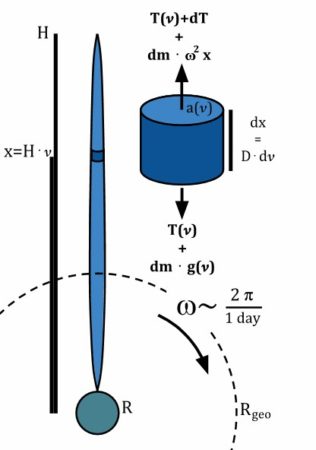
The researchers don’t envision just a one station Spaceline. A second depot would be established at a Lagrange libration point in the vicinity of the Moon where the forces of motion and gravity would be neutralized to ensure the durability of the line. From there a uniform cable would descend to a destination depot on the Moon’s surface.
In their paper, the researchers argue “that we have the materials and technology today…necessary to support a spaceline construction.” All that remains to be addressed is “the practical constraints on such a construction and its potential uses.”
It could cost billions of dollars to construct but would we gain a long term advantage in building it? These are some of the dividends:

Located near Ottawa, Canada’s capital, Thoth was founded in 2001 and is principally known for design and development of payloads for satellites and robotic systems. The patent for the space elevator is the company’s first foray into large-scale systems.
The elevator would be a freestanding space tower reaching 20 kilometers (12 miles) above the Earth surface. It would measure 230 meters (755 feet) in diameter and would be pneumatically pressurized to maintain structural integrity.

Why 20 kilometers high? Commercial aviation can only get to about 15 kilometers above the Earth surface. And above 19 kilometers atmospheric pressures are so low blood would boil upon exposure to the outside. At 20 kilometers much of the atmosphere and atmospheric drag lies would be below the launch platform, and that would deliver huge cost advantages for getting to near-Earth orbit (NEO). Fuel savings alone would amount to 30%.
But is what Thoth is patenting truly a space elevator? Not quite the same as that foreseen by Konstantin Tsiolkovsky and Arthur C. Clarke who described a space elevator tethered to a satellite in geosynchronous orbit 36,000 kilometers (22,000 miles) above the Earth. Instead Thoth’s invention is more modest, a far less costly compromise that uses known materials and if built could prove advantageous for launching payloads to space. It could be built with multiple decks for rocket launchings delivering satellites to NEO at an estimated $220 per kilogram ($100 per pound). Compare that to today’s costs at $25,000 per kilogram ($11,000 per pound).
Made of inflated core segments forming the inner and outer walls, the tower would feature a hollow middle to provide for the elevator which would not use a cable system. Conventional materials today could not support a 20 kilometer tether. Instead elevator cars would grip and climb the interior walls of the hollowed shaft.
Manufacturing would be a significant challenge. The patent describes the proposed method of construction including extruding core segments from a fluid core material, and embedding the control and stabilization machinery (flywheels) within each segment as extruded. To raise the tower the filing describes a system of rollers and pneumatics.
What would prevent it from collapsing? The flywheels (gyroscopes like those incorporated into rockets and satellites but much larger in scale) which would compensate for all the forces exerted upon it including the Earth’s spin and wind shear.
There is no mention of the cost to build. But there is no doubt that elevators such as this could prove highly advantageous not just as launch platforms, but also as a stationary Earth observation towers capable of providing significant scientific benefits. And because the cost is anticipated to be far less than the Tsiokovsky-Clarke space elevator, Thoth’s design could usher in a new age of space.
The images appearing below are from the 19-page July 21, 2015 filing #9,085,897 B2.

]]>
And what exactly has been delivered since the Kickstarter campaign closed in September of 2012? What the Kickstarter campaign money was to fund was a lunar space elevator. But not much has happened since 2012 when you look at the website. Click on Space Elevator and there’s nothing there. Click on other pages and you get vision and mission statements, and a bit of discussion about the physics and science behind a lunar elevator. The progress reports are anything but.
But NBC News in the last couple of days has suddenly put LiftPort Group back in the headlines with a story about an upcoming test involving the launching of a high-altitude balloon with a 7 kilometer (4.5 mile) vectan-polymer string attached. The goal – to have a multi-wheeled, solar-powered robotic climber (see image below) do a high-wire act by ascending that string to the balloon as a proof of concept. The balloon experiment still needs approval from the U.S. Federal Aviation Administration but once that is given LiftPort will launch somewhere on the Olympic Peninsula in the state of Washington.

It was Arthur C. Clarke, one of my favorite sci-fi writers, who first popularized the notion of a space elevator. At the time it seemed far reaching to say the least. But Clarke also had predicted earth communication satellites back in the 1940s and saw them realized by the 1960s. So maybe the space elevator will one day come of age just as Clarke predicted.
If the upcoming balloon experiment succeeds, the LiftPort Group will next attempt to put a nano-satellite counterweight in space with a trailing tether and have their robotic climber make the trek from Earth to it. But the balloon launch is still pending. And the website talks about deployment of a working space elevator infrastructure by 2019, a mere five years away. What’s needed of course is material produced in quantity that is both light-weight and strong and can support a robotic climber carrying a payload.
Carbon nanotubes appear to be the material of choice. According to ISEC (the International Space Elevator Consortium) a cable 7 centimeters (2.75 inches) thick could support the daily lifting of 1,000 tons of payload from the Earth’s surface to space. ISEC even projects a time in the future when space elevators would be used as launch platforms for interplanetary space travel. At its most recent annual conference at the Musem of Flight in Seattle, Washington, teams of scientists from all around the world gathered to discuss progress in the field. Europe, Japan and the United States are in the forefront of this technology. The ISEC peer-reviewed journal, CLIMB, published since 2010 provides the latest science on the subject. Trust me, no one at the conference was laughing about what at times seems to be a somewhat bizarre idea.
And why aren’t they laughing? Because a working space elevator would make access to space cheap and simple. It would be like riding the elevator in a high-rise building. With a space elevator building a space infrastructure and human colonization would be far more affordable than what we humans are doing currently with throw-away chemical rockets and limited payloads.

Fifty-five years with so many advances in our knowledge, but very little in the way of advancement in the way we send humans and payloads into space. Because we continue to rely on chemical-based propulsion systems to climb out of the gravity well that is Earth. What if there were another way to get off the planet? What, if instead of putting the propulsion system at the tail end of the payload we want to launch we remove it entirely?
In past blog entries we have talked about the future of rocketry with heavy launch systems, nuclear rockets, solar sails, plasma engines, and other propulsion technologies. Heavy launch whether Ariane, NASA’s Space Launch System, Space X Falcon Heavy, or Russia’s Angara are all chemical-based. The others are technologies that cannot get us off the ground into space but are choices we can make once out of the Earth’s atmosphere.
Currently we have seen the development of hybrid launch technologies for sub-orbital flights. Virgin Galactic is a good example with its White Knight and SpaceShipOne mated configuration. But engineers and scientists have proposed other alternatives as well. These include:

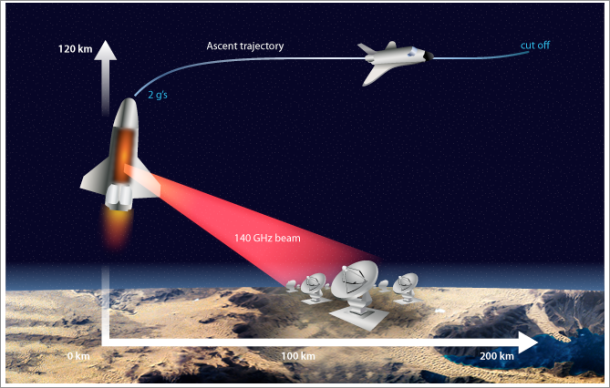
Today we launch satellites from locations at relatively low elevations. The Baikonur Cosmodrome sits 90 meters above sea level. Cape Canaveral sits on the edge of the Atlantic Ocean. The Guiana Space Center is another coastal site from which the European Space Agency launches its satellites. Jiuquan, where China launches its human space flight program sits 1,000 meters (3,300 feet) above sea level. Spaceport America, Virgin Galactic’s new commercial launch site sits 1,400 meters (4.595 feet) above sea level. To minimize the gravity well I wonder why we are not launching rockets from locations at much higher elevations. One could argue the top of mountains would be most suitable. And a mountain top near the Equator would prove to be ideal. Some engineers have suggested that launching from a mountain top would not only dramatically cut down on chemical rocket fuel requirements it would also limit the amount of stress the rocket would experience as it ascends. Current rockets throttle back during ascent to avoid structural damage from air resistance. This is referred to as Max Q or maximum dynamic pressure. In thinner air this would go away. It was during throttle up after passing through Max Q that the Space Shuttle Challenger in 1986 exploded.

As we experience the next 55 years in space it is clear that we will need to change the technology we currently use to make space more accessible from Earth and far more affordable. Advanced chemical-based launch systems may continue to get large payloads into near-Earth space but as the century unfolds where we go will depend on us changing this paradigm. Only then will space become an experience not for just a select few.
]]>Agriculture Updates
Artificial Intelligence and Fruit Flies
Bactrocera dorsalis, the oriental fruit fly, not to be confused with the tiny flies we see here in North America hovering around our ripening peaches and plums, is a major agricultural pest, laying eggs in over 125 types of fruit and vegetables. A single female lives for about 90 days and can lay 1,000 eggs during that time. The larvae tunnel through fruit and then drop to the ground where they enter a pupa stage. Each new generation from egg to mature fly takes less than a month.
To combat the damage these insects do, researchers in Taiwan are using artificial intelligence to predict where and when there is an outbreak of flies. Using 240 traps to attract the flies and infrared lasers to detect the adult insect as each enters a trap, scientists receive regular data updates. When the fly count reaches 1,024 over a ten period the artificial intelligence software sets off an alert. In analyzing the data being accumulated the system is now capable of predicting outbreaks with 88% accuracy.

Carbon Farming Initiative to Save Fragile Agricultural Land
Soil security means food security and Australia has launched the Carbon Farming Initiative (CFI) to give farmers and land managers carbon credits for storing carbon or reducing greenhouse gas emissions from their operations.
Almost 1.3 billion people live in rural areas on farms that are defined as fragile. These are lands defined as sensitive to soil degradation when disturbed. Plowing that breaks the surface may lead to wind or water erosion. Deforestation by burning contributes to atmospheric CO2 and declining yields over time as the soil is quickly depleted of mineral nutrients. In low elevation areas, subsurface water may leach soils making them too salty for agricultural production. And soils in high elevations when disturbed may rapidly erode.
The CFI is a payment scheme allowing farmers to earn carbon credits. The credits can be sold to pay for carbon storing activities that lead to better agricultural production. Such activities include:

Computer Update: Watson to Become Super Doctor
When IBM introduced Watson, its massive parallel processing intelligent computer technology to Jeopardy audiences in 2011, the computer demonstrated its ability to match and surpass human Jeopardy champions at knowing trivia. But winning a game show is not what IBM has in mind for Watson 2.0, the next generation of this technology.
IBM intends Watson to become an expert on many subjects and make its knowledge and assistance accessible on mobile smart phone systems. This means improving machine learning and adding voice and image recognition. The questions that IBM wants Watson to answer are ones that can be posed by a mobile phone user by voice. For example the user could point the smart phone camera to a rash and ask Watson to take a look and tell them what it thinks the rash may be. WellPoint Inc., a health benefits company in the U.S. hopes to use Watson this way by 2013 to assist nurses in managing treatment of complex patient cases.

Manufacturing Update: 3D Printer Goes to the Races
Use a 3D printer to build a race car. Are you kidding? Apparently not based on what a team of Belgian engineers recently accomplished with a race car called Areion. The entire vehicle body was built using 3D printing technology.
The race car, a single seater was tested thoroughly to ensure that the electronics and body could stand up to the environment including rain. The 3D shell took three weeks to construct. The car can reach speeds of 141 kilometers (88 miles) per hour. It can accelerate to 100 kilometers (62 miles) per hour in 3.2 seconds and is powered by 50-volt lithium batteries sending a charge to an 85 Kilowatt electric motor.Check out the specifications.

Space Update: A Working Space Elevator within the Next Decade?
LiftPort Group is a U.S. company that believes it can build a lunar space elevator for deployment within the next ten years. The founder of the company, Michael Laine, is a former NASA researcher. Laine states that we already have the technology in place to make such a project happen. You can watch a video that shows how the LiftPort would be built. It involves deploying a cable anchored to the surface of the Moon with the elevator extending to a platform in orbit around the Moon to ferry cargo and crews to the Moon without having to deal with the gravity well issues requiring chemical rockets and transporting of fuel. This would be the first phase in a multi-year project that would include a similar construct from the Earth to a geostationary orbiting platform above the planet. Currently the inventors are seeking capital on Kickstarter in a concerted effort to turn several years of research using tethered balloons and robot climbers as proof of concept into a first phase deployment on the lunar surface within the next ten years.

A Postscript
I’m still looking for more reader feedback and welcome your questions and comments. Readership continues to climb to well over 4,000. Thank you. You can also find us on Facebook, Google+, Twitter and StumbleUpon if you subscribe to any of these social media applications.
Once again thanks for dropping by. – Len Rosen
]]>
The authors acknowledge we live in “turbulent times” but the book focuses not on hand wringing, dire predictions, but on a positive future driven by rapid innovation leading to abundance. As I have stated in earlier blogs we are bombarded with warnings about sustainability and a bleak future. But we are the authors of our own defeat, as well as the inventors of our future success.
Here are some examples of what I mean:
In the 1970s it was predicted by experts that we would run out of oil in the early decades of the 21st century. Yet today we are awash in the stuff with no limit in sight.
In 1900 the average human life span globally was about 40. Today we are approaching 80, a doubling.
In the 1980s I was involved with a company that was documenting 90-baud transmission rates over land lines for countries in Africa. This technology represented the best we could do for Sub-Saharan countries that lacked modern telecommunications infrastructure. Yet today Africa has skipped land line infrastructure entirely and moved to mobile phones and mobile data networks. The growth has been astronomical since 2000, when mobile users represented 2% of Africa’s population. By 2009 penetration had grown to 28%, a growth factor of 14. And by next year, 2013, forecasters predict that 70% of Africa’s population will have access to mobile technology.
In the 1980s no one had heard of micro loans. Banks didn’t loan money to small business in places like Africa, Central and South America or South Asia. But today we have organizations like Kiva.org providing micro-funding for tens of thousands of Developing World entrepreneurs in increments of $25.
Techno-philanthropists didn’t exist in the 1980s either. But today people like Bill and Melinda Gates are pouring billions into projects to end diseases like malaria, or provide new educational models that use the power of the Internet and mobile devices to personalize learning beyond bricks and mortar classrooms.
For the authors of this book abundance is just around the corner. They see a world in 2050 with nine billion of us having access to clean water and clean air, nutritious food, affordable housing, personalized education, best practice medical care, and energy that comes from non-polluting sources capable of meeting our needs for centuries to come.
How will we get there?
The authors see us already rapidly ascending an accelerating path to achieve abundance for all humans on the planet. And much of what I write at this blog site speaks to this progress in so many fields of science and technology. For both the authors of “Abundance” and I believe that we have within our means the ability to create a very bright future for humanity and the rest of life on this planet.
Diamandis and Kotler set the stage with their modified Maslow hierarchy called the Abundance Pyramid (see below) and then go on to illustrate the advances we are making in all of these areas through technological innovation.

The Story of the Spirit of St. Louis
Diamandis, as I mentioned earlier, organized the Ansari X Prize that led to Burt Rutan’s sub-orbital SpaceShipOne achievement. He and Kotler write about the inspiration behind the X Prize. It’s an interesting story. Diamandis was inspired by the story behind Charles Lindbergh’s solo flight across the Atlantic Ocean in 1927. It begins with a French shepherd, Raymond Orteig, who emigrated to America before the First World War. He started as a waiter and worked his way up to eventually become a hotelier in New York City. Orteig’s hotel hosted aviators after the war and the stories they told inspired him to propose an idea to the Aero Club of America in 1919. His offer, a $25,000 prize for the first aviator to cross the Atlantic Ocean, non-stop, either from Paris to New York or the other way. He put an expiry date on the prize – five years. But with no takers after five years, he extended his offer for another five.
What you may not know is that Lindbergh, a fairly novice aviator when compared to others who attempted to win the $25,000, was preceded by several who failed in their attempts. Two perished taking off in overweight airplanes in 1926. In 1927 four more died making the attempt. Lindbergh, “the flying fool” according to the media of the time, succeeded where these others failed. And in winning Orteig’s prize launched trans-Atlantic air travel, the modern era of commercial aviation, and an industry worth today $300 billion dollars annually.

The Spirit of Competition Has No Limits
The lesson of Lindbergh is the inspiration that today is providing the fuel for solving all kinds of technological challenges. We have seen an eruption of incentive prizes to challenge individuals and companies to find new ways of doing things.
When I finished the book I started thinking about all the problems and challenges we face that through a prize might lead to novel solutions. Here’s a list of some of my prize ideas:
I invite you, my readers, to come up with and share lists of your own. Who knows, maybe this exercise in crowdsourcing will lead to some amazing breakthroughs here in the 21st century.
]]>Today our rockets use kerosene, hydrogen or solid combustible fuels combined with oxidizers to get off the Earth and into space. Given an unlimited amount of fuel on board these rockets can provide continuous acceleration but unlimited is impossible. So we always try to lighten the load when flying to space to keep the size of the rocket within reason. Our biggest rockets, Proton, Energia, Saturn, Titan, and Ariane-5 are monsters in size, weighing millions of kilograms. To achieve Earth orbit these rockets have had to carry enough fuel and oxidizer on board to reach speeds of 28,157 kilometers (17,500 miles) per hour. To escape Earth’s gravity the rockets have had to go at least 10,000 kilometers (6,200 miles) per hour faster. And to escape the gravitational pull of the Sun, our rockets have needed to attain speeds of 59,000 kilometers (approximately 36,500 miles) per hour. The way we have accomplished missions to-date has involved launching multi-stage rockets with the first stage containing the most fuel getting us out of the lower Earth atmosphere, a second stage getting us to Earth orbit and a third giving us the means to achieve lunar, interplanetary or solar trajectories. When we have had to go further we have used other planetary bodies to give our spacecraft a gravity assist. Venus and Jupiter have often played a part in accelerating spacecraft to achieve velocities that exceed 100,000 kilometers (62,000 miles) per hour or more.
To economize on the massive amounts of fuel we have needed we have had to keep our payloads very small. When we have sent humans into space they have gone up in modules as small as a shower stall with barely enough room for one let alone many travellers. We have had to shrink the electronics and economize on consumables making space faring a more than risky enterprise. It is downright dangerous. When we add distances beyond low-Earth orbit we compound the risk for any human crew aboard a spacecraft. If our destination is the Moon, approximately 380,000 kilometers (238,000 miles) our travel time is measured in a few days. We have successfully done this in the Apollo Program. But a destination like Mars, closest at 57 million kilometers (36 million miles), it would take our conventional rockets months to get there and get back and that means human space flight becomes problematic.
That’s why we need to look at alternative technologies for powering spacecraft while in space. And to help get more baggage up there to ensure our human spacefarers have enough food, water, oxygen and consumables on board we have to develop a substitute for the rocket technologies we currently use at launch. That means driving down the cost per kilogram of materials we send into space.
So let’s take a look at what is currently available, and what may be able to see on the horizon in the 21st century.
Current Alternatives to Getting Spacecraft into Low Earth Orbit
Airborne Launches
We launch our human payloads today on ground-based rockets. What if we launched from in the air? That’s the idea behind SpaceShipOne (seen below under the belly of its mother ship), the reusable suborbital ship, developed by Scaled Composites, that won the Ansari X Prize in 2004.

A larger version, SpaceShipTwo, will begin commercial suborbital flights within the next two years. But SpaceShipTwo is aimed at suborbital space tourism and not at launching large payloads into low-Earth orbit.
The developers of SpaceShipOne and Two are working with anther commercial operator, Stratolaunch Systems, with its plan to build a carrier aircraft that can be mated to rocket systems for launching payloads and humans into low-Earth orbit from the stratosphere. Stratolaunch plans include the disassembly of two Boeing-747-400 aircraft and then the combining of the two to create a stable airborne launch platform with an orbital mission range of over 2,000 kilometers (1,300 miles) .

Talk about floating an idea, airships as space launch platforms offer an alternative method of getting humans and payloads into low-Earth orbit. Airships can achieve higher release altitudes than jets ascending to elevations of 40 kilometers (25 miles). JP Aerospace, a California company, hopes to create a permanently manned station in the upper atmosphere that can be visited by cargo and passenger airships, a way station on the edge of space.

Rail Gun Launches
Today we have Mag-Lev trains. Why not use this technology for launching very large payloads and human crews into low-Earth orbit? The Startram Project hopes to do just that using taking existing Mag-Lev technology and building a Maglifter to reduce the cost of sending materials and humans into low-Earth orbit.
A Maglifter launch vehicle would run on an electromagnetic rail just like those used in Mag-Lev trains. The rail would be built on the side of a mountain or later as a free-standing structure supported by cables just like a suspension bridge.
There are two proposed alternatives for using Mag-Lev. In the first the launch vehicle, carried on a launch sled would reach speeds of 1,000 kilometers (620 miles) per hour before the launch vehicle with payload and rocket on board would ignite to accelerate to escape velocity.
In the second the track would be housed in a tethered vacuum tunnel to minimize heat stress on the launch vehicle and to absorb the shock waves created when the Mag-Lev would accelerate to hypersonic speeds of 9 kilometers (5.6 miles) per second sufficient to attain low-Earth orbit.

This type of technology has the potential of dramatically reducing payload costs from thousands to a few dollars per kilo making travel to and from outer space much cheaper to support and making it possible for many more humans to get into space.
Space Elevators
In the 19th century a Russian scientist speculated about building a “Celestial Castle” located in geosynchronous orbit around Earth and tethered to an Earth-bound castle. The scientist was Konstantin Tsiolkovsky, the father of Russian space science. The idea was further expounded upon by a Soviet engineer, Yuri Artsutanov, who wrote a non-technical article in 1960 describing a tethered satellite permanently fixed in space that would lift payloads into space at a fraction of the cost of rockets. Arthur C. Clarke, the noted science fiction writer popularized the idea later in one of his stories, “The Fountains of Paradise” in 1978.
Is a space elevator possible or just fantasy?

So all of the technologies described above exist for us to consider. We can begin to build these alternatives to chemical rockets. This can be done through private enterprise and through private-public partnerships, for it is the partnership model that has led to the success of SpaceX in this last week, an encouraging new approach to the conquest of space.
Finally, once we drive down the cost of getting materials and humans into space we will then be in a position to build the infrastructure in low-Earth orbit that will lead to the creation of faster transportation technologies to get us to more remote destinations in reasonable amounts of time. We will explore that subject in our next installment on space in the 21st century.
As always your questions, comments and ideas are welcome.
]]>

