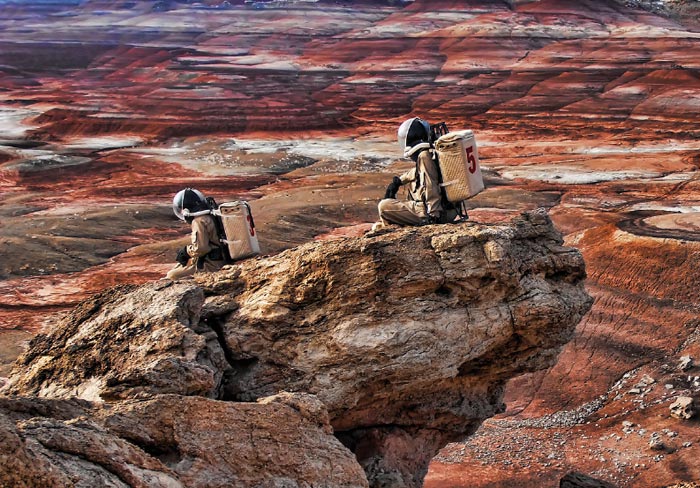
For those of us who evolved here within the protective bubble of Earth, outer space, the Moon, and Mars are foreboding environments. We wouldn’t stand a chance of surviving without bringing a micro version of the contents of Earth bubbles along with us. And even then, external forces could lead to our early demise.
Establishing a permanent human presence in space let alone on the Moon and Mars would indeed be a lot easier if we could be pre-adapted to handle the environment. When Charles Darwin observed how species adapted to their environments or died out by way of natural selection, the rules of nature and probability determined outcomes. This is the Earth-based evolution model.
A modern version would be selection by unnatural means using tools like CRISPR or engineered stem cells to enhance humans to adapt to low gravity and exoplanet and lunar environments. Re-engineered humanity would be capable of tolerating high-radiation environments. Genetically engineered traits would change us to make the odds of our survival much better.
Not to be outdone by those committed to conquering the environment of space, there are those here on Earth who suggest we do the same to humans living here as we face a changing planet because of global warming. Instead of dispensing with fossil fuels, we would genetically alter ourselves to make us climate-change resistant.
Is it realistic for Elon Musk to endeavour to establish a permanent human presence on Mars in his dream to save the species should an asteroid wipe out life on Earth even while knowing that we are ill-adapted to survive the environment of the Red Planet?
Is living in an Earth bubble on another planet, a moon, or a Deep Space habitat our human destiny? Some people believe if we can get to a place like Mars we could begin terraforming it to turn it into an Earth twin. Musk has proposed setting off thermonuclear bombs on Mars to warm the planet, unleash its subsurface and polar ice cap water, and the oxygen trapped in its oxidized red soils. He has also proposed to use a satellite network to create an artificial magnetic field to block solar and cosmic radiation.
The human body cannot handle space. When astronauts were first chosen for NASA’s Mercury program they were an elite group in top physical shape. They were subjected to all kinds of torture tests. The Mercury missions were short. The Gemini that followed were longer. And the Apollo missions lasted the duration of a lunar voyage and back.
Today, after more than two decades of human habitation of the International Space Station (ISS) we know now that we don’t adapt. Instead, exposure to low-Earth orbit space changes DNA, flattens eyeballs to impair vision, disrupts sleep patterns, decalcifies bones, reduces muscle mass, weakens hearts, causes brains to swell, and compromises immune systems.
Add to that the radiation from cosmic rays and the Sun. In low-Earth orbit which is really in the high atmosphere of Earth, the ISS crews are relatively shielded from space-based radiation. But a solar storm in Deep Space, on the Moon or Mars, would cause acute radiation sickness. And unlike the shielded ships of Star Trek, at present, there is no technology to protect us in space.
Again, if we could re-engineer our human DNA, we might be able to mend ourselves when exposed to radiation, or for that matter, any other damage to our bodies that could occur in space. So, maybe, a new version of ourselves could become spacefaring.
But what about dealing with the mental side of outer space travel and living in isolated settlements on the Moon or Mars? Imagine being confined within a small spaceship, no bigger than a house trailer for a six to seven-month voyage to Mars. What will be the mental toll on humans undergoing such a journey? And upon arrival on Mars, where crews will largely be confined to live within an Earth-bubble equivalent, what other mental crises will these humans face?
This isn’t colonization as practiced in the past here on Earth. On Mars, the soil will be barren containing perchlorate chemicals that our current plants cannot tolerate. The air outside the Earth bubbles we build will be unbreathable. The low gravity will weaken bodies adapted to Earth’s gravity. This is not the equivalent of Europe’s discovery of the Americas which already were richly populated by native civilizations. This is at best dangerous, and at worse, suicidal.
The romanticism of space has been brought to us by the writers of science fiction. But unless we change physically to have a chance to survive conditions worse than any found on Earth, there will be no happy endings to those bitten by the outward urge bug that is motivating people like Musk, NASA and others to send humans to other celestial bodies.
And yet, at a recent conference held at Biosphere 2 in the Arizona desert, the mood of attendees was optimistic about going to the Moon, Mars and beyond. When the audience was asked “Where do we go from here?” after hearing all the things that could go wrong, enthusiastically shouted, “To the Moon.”
]]>2013 – start of the crew selection process with over 70,000 applying for the initial 4 spots;
2015 – after applicants are narrowed down training starts (it will be continuous to 2022) at two sites on Earth (one in a desert location, the other in an arctic environment) that will simulate the Mars One settlement;
2016 – demonstration launch to Mars of a lander to prove the technology’s viability, as well as launch of a communication satellite with 4 times the data bandwidth of the current NASA Mars Reconnaissance Orbiter providing a 24/7 link between the two planets;
2018 – the search for the colony site begins with launch of a rover with accompanying trailer for use later in moving modules to the colony site. The rover will have tools on board for preparing the site as well;
2018 – launch of a second communication satellite placed in an L5 Lagrange position to ensure continuous communication between Earth and Mars even when the Sun gets between the two planets;
2020 – six missions will deliver two living modules, two life support systems and two supply units guided by the rover to the colony site;
2021 – six additional cargo units will land on Mars and will be transported and assembled at the colony site with life support systems fully connected, extraction systems for producing oxygen and water deployed and operational, nitrogen and argon extraction system become operational and habitats including inflatables shielded by rovers excavating and depositing Martian soil as cover;
2022 – Mars One transit vehicle launched into low-Earth orbit followed by transit habitat and Mars lander. Assembly crew puts the spaceship together. Two additional propellant stages are launched and connected and finally the first crew is transported to the completed ship and then launched on a 210-day voyage to the planet;
2023 – Mars One crew reaches the vicinity of Mars and enters Mars Lander for descent to the planet. The crew remains in the Lander for two days to adjust to Martian gravity, then deploys Mars space suits to leave it. The rover provides transport to the settlement which is entered through the installed airlock. Mars One crew then gets to work completing deployment of the solar arrays, hooking up the living modules and setting up food production;
2023 – additional cargo units for the second mission arrive and are picked up and installed by the crew to establish redundancy and prepare for an expanded settlement. Redundancy designed to sustain a crew of up to 16 settlers;
2024 – the second Mars One crew begins a journey to Mars on a 240-day trajectory arriving in 2025;
2025 – additional cargo units to support a third mission arrive on Mars where the 8 settlers will prepare the colony for the next group to arrive;
2026 – the third Mars One crew will begin its journey to the planet to be followed by additional settlers every two years thereafter.

Is the Mars One roadmap viable? According to Robert Zubrin, President and Founder of the Mars Society, a non-profit organization that has advocated the human exploration and settlement of Mars, the Red Planet has a wealth of resources that can be exploited by human and robotic crews. For example, in equatorial regions, where temperatures are more benign, the soil of Mars contains 5% water. In polar regions that number rises to 60%. That means there is plenty of water from which to extract oxygen for breathing. The water can also be a source of hydrogen for fuel. And of course it can be used to irrigate plants which certainly will have the CO2 they need considering the Martian atmosphere, although tenuous, is largely composed of that gas.
The equator on Mars gets sunlight equivalent to that which Norway receives here on Earth. Plants that grow in Norway in natural light, therefore, should be able grow on Mars. Mars also has nitrogen in abundance which can be used for fertilizer. Other resources that make Mars viable for humans includes a motherlode of raw materials from which to fabricate infrastructure. This includes the water and CO2 which can be used to make plastic, and iron oxides and silicon oxides for iron, steel and glass.
As we have seen from the performance of Spirit and Opportunity, the two Martian rovers that preceded Curiosity, the photovoltaics developed here on Earth work reasonably well on Mars. Improved solar cell efficiency and solar concentrators make sense for Mars. The resources to build and maintain fuel cells is readily available there as well. And evidence of a subsurface water table means the planet generates geothermal heat which will likely be exploited very quickly by any human Martian habitation.
So once we get our first humans on Mars there is no immediate challenge that Mars One cannot overcome. That is not the case however when we talk about getting the infrastructure to Mars so that there is a place for humans to go to when they arrive. From our history of Martian exploration getting to the planet has been fraught with failure. More than half of the spacecraft we have sent to the Red Planet have ended up in mission failure. One missed milestone in the Mars One project and it will be set back for months if not years.
Mars is a long way to go to build our first off world space colony. The trip today takes six months. We have yet to develop the technology to shorten the time frame. And humans have only experienced low-Earth habitation so far where distances are short and the margin of safety far greater than any voyage to Mars. And our only extra-planetary experiences involving humans so far have taken us to the Moon, where our visits were short term. Yet the Moon contains many similar resources to those found on Mars including water. So one would think if we are to establish a Solar System colony anywhere that the Moon would be the place we go first.