Astroculture studies plant behaviour in extreme environments. It involves technological innovations such as the building of closed-loop life support systems. Instead of soil, plants are grown using novel media like aeroponics and hydroponics. On the ISS, artificial intelligence-enabled sensors monitor the health and growth of plants. The advances made since the first ISS-produced lettuce have encouraged attempting to grow other plants which is a good thing because you use more energy to eat a lettuce leaf than you gain from its consumption.
So what is being grown on the ISS today besides lettuce (the Romaine variety)? So far the list includes:
The first Romaine lettuce consumed by ISS astronauts occurred in 2015. Radishes were harvested and eaten in 2020 and Pak choi in 2021. None of the above will provide food self-sufficiency for spacefaring humans. At best, we have side dishes and are a long way from food self-sufficiency in low-Earth orbit (LEO) and on the Moon.
The systems in place today include:
Veggie is a temperature-controlled closed system with programmable lighting that features a Nomex and Kevlar growth medium in which seeds are embedded. The latest improvements to Veggie include PONDS, the Passive Orbital Nutrient Delivery System that automatically feeds and waters plants. Veggie was first introduced on the Space Shuttle, In 2014 it was added to the ISS.
APH stands for the Advanced Plant Habitat. It was introduced to the ISS in 2017. The system uses the Plant Habitat Avionics Real-Time Manager, software designed to provide a nearly self-sufficient system for growing plants in space. APH can be monitored from the ground to minimize crew involvement in maintenance.
On board Tiangong, the Chinese space station, its taikonauts have grown lettuce, cherry tomatoes and green onions. China reports it uses two pieces of equipment to assist in cultivation and integrated into the space station’s ECLSS (Environmental Control and Life Support System).
In Andy Weir’s 2011 novel The Martian, an astronaut in 2035 is left behind when a storm causes fellow crew members to make an emergency evacuation leaving him presumably dead on the surface. He manages to survive and with what remains of the habitat creates an indoor farm where he grows potatoes with cuttings from food reserves that he plants in the Martian soil which he fertilizes with human waste.
NASA plans to do what Weir’s astronaut achieves with a lot more technology. The Agency want missions to the Moon and Mars to become partially self-sustaining for food and medicine. With the latter, NASA has been experimenting with genetically modified tobacco and ten traditional medicinal plants chosen from Chinese and Middle Eastern sources that it is growing in LEO.
NASA is partnering with the University of Guelph’s Controlled Environment Systems Research Facility, in Ontario. There they are working on making future space crews more food self-sufficient. Gioia Massa, a life sciences project scientist at NASA’s Kennedy Space Center in Florida, notes that the work in Guelph and other facilities will have profound implications for people here on Earth as well as for a future space station, lunar or Martian colony.
Massa sees the astroculture challenges that this research solves for space will have a meaningful impact here on Earth as humanity deals with climate change, sea level rise, groundwater contamination, extreme weather events and soil exhaustion.
Massa believes that part of farming’s future will include growing food in controlled environments like those needed for outer space. He sees these as being scalable to have applicability for environmentally controlled indoor agricultural operations on Earth that could be key to solving future global food security.
On January 13, 2025, I was sent a Stellar Market Research press release which inspired me to look again at this topic. In the release Stellar states that the 2023 space agriculture market was valued at U.S. $5.32 billion. It projects growth to $12.7 billion by 2030, at a compound annual growth rate (CAGR) of 18.2% “driven by advancements in agricultural technologies, rising interest in long-duration space missions, and increasing investments in space exploration.”
Among the advances being made, the press release mentions bio-regenerative life support systems (BLSS) for space habitats similar to the artificial ecosystem that was Biosphere.
If you are not familiar with the two Biosphere experiments, the first Biosphere-1 involved a crew of 8 in 1991 who sealed themselves inside for a planned two years. Biosphere-1 included a mini ocean, wetland, tropical rainforest, savannah, and desert. It was meant to be a self-sustaining ecosystem in a very big bottle, an environment that produced enough oxygen, sequestered carbon dioxide (CO2), purified water, recycled waste, and food. In the end, it failed. Why? The conclusion was that it was built too small to sustain 8 humans. The material choices were wrong. The concrete walls sucked up too much CO2 not leaving enough for plants. The glass ceiling created a wet hothouse that led to ecosystem imbalances and failures. The desert got too wet. The environment was overrun by fauna that contributed nothing to enhancing sustainability. Ants and cockroaches seemed to love it. Not much else.
To make amends and correct the deficiencies of the failed Biosphere experiment, ongoing global research on BLSS is being done at places like the Vietnam Academy of Science and Technology, Thailand’s Geo-Informatics and Space Technology Development Agency, Japan Aerospace Exploration Agency (JAXA), Singapore’s AgriFood Tech Hub, the European Space Agency (ESA), SpaceX, the China Aerospace Science and Technology Corporation (CASC), and NASA.
The next generation of space stations is right around the corner and soon will be the beneficiaries of the work being done at these institutions and agencies today. Hence, the forecast for this emerging market is optimistic.
]]>On Earth bees and other insects play a critical role in the spread of pollen vital to plant propagation. But how can we bring bees to Mars or the Moon? We can create closed self-sustaining greenhouse environments for raising plants. But we can’t easily reproduce the gravity of Earth that essentially provides the counterweight to insect-winged flight.
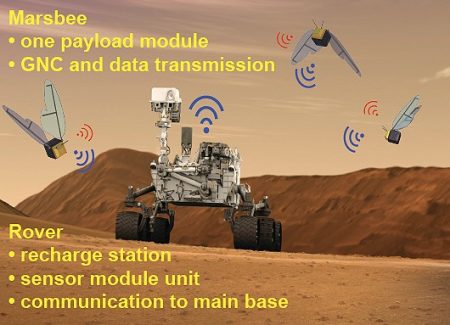
NASA is looking at Marsbees but not for plant propagation, but rather for exploring the outdoor environment of Mars. Marsbees won’t be a genetically modified bumblebee. They will be robots about the size of Earth’s bumblebees but with much larger wingspans to be able to fly in the thin Martian atmosphere.
One of 25 of the latest NASA-funded NIAC Awards for 2018 is entitled Marsbee. Proposed by the team lead, Chang-kwon Kang, at the University of Alabama in Huntsville, this joint effort combining U.S. and Japanese researchers is working on the invention of a micro-flapping winged robot designed to fly in low-density atmospheres. What Marsbees will look like is a cross between an Earth bumblebee and a cicada. The body size will be similar to the former. The wing size will be akin to the latter. Each Marsbee will contain an integrated package of sensors and wireless communication. A mobile base will act as a recharging station and communication relay. The Marsbees will be sent out in swarms to explore the Red Planet sending back data to the base station on Mars.
The challenge isn’t in the Marsbee body but in designing wings that are insect-like but able to have sufficient aerodynamic properties to work in the thin Martian atmosphere. If the wings are designed right then the power requirements of the Marsbees will be negligible. Design considerations include a torsional spring at the wing root to store wasted energy allowing the Marsbee to flap just like an Earth bumblebee.
The first phase of the newly-funded project will determine wing design, optimal weight, and aerodynamic performance. Testing will be done in a vacuum chamber containing air density equivalent to that found on Mars. The researchers should be able to test various designs to see which is most capable of maneuvering, dealing with takeoff and landing, and other flight dynamics.
Proof of concept will then lead to further funding by NASA of the onboard instrumentation that will make up the body of each Marsbee.
Of course, the Marsbee envisioned in this project will be of no use in solving the challenge of propagating plants on Mars or the Moon for that matter through sexual reproduction as it occurs here on Earth. These are not bees that can fly from flower to flower. For that scientists will have to come up with an invention that is far different. Since plants in these low-atmosphere to no-atmosphere, and low-gravity environments, will need closed life support facilities, it may be possible to import genetically modified symbiotic insect partners to help. It is either that or the creation of nanorobot equivalents to insect helpers to make off-Earth agriculture work.
Is there an alternative to insect-assisted sexual reproduction that can help us establish robust plant life to support humans in space? Can we genetically alter plants here on Earth that use sexual reproduction to become regenerative without insect helpers?
There is no doubt humans will not survive off-Earth without plants. They are essential for life support, for food, oxygen, the removal of carbon dioxide, and for water recycling. So we need another type of Marsbee other than the one for which NASA just provided funding. Previously I wrote about Eijiro Miyako, a Japanese chemist whose work at the National Institute of Advanced Industrial Science and Technology led to the development of a tiny drone insect equivalent. Will a robotic device like this Miyako bee fly around the greenhouse environments of future Mars settlements?
For this purpose NASA’s Veggie uses a “cut-and-come-again” technique to repeatedly harvest leaves from edible plants while leaving the core intact. This allows for continuous regeneration of the plant and harvests every 10 days.

Seeds used are contained in what is described as pillows. Each pillow includes seed, fertilizer and nutrients sufficient to produce a crop. Right now the ISS farm is small but NASA anticipates incorporating entire modules dedicated to growing food crops.
But how much lettuce can a crew eat before the novelty and lack of vegetable and fruit varieties wears thin?
What is in the works to introduce space-grown animal protein? We know that human bodies are affected by the micro gravity of space. Bones get thinner. Muscle mass is lost. Our circulatory systems get lazy and our heads swell. Would the same thing happen to animals we bring into space?
Humans have been putting animals into space since the dawn of the Space Age. Russia’s first space traveler was a dog. Since then the menagerie has included chimpanzees, worms, ants, honey bees, fruit flies, crickets, butterflies, spiders, mollusks, frogs, mice, rats, and even a quail. The latest Japanese experiment has brought fish to the ISS for testing how they react to micro gravity. A school of Medaka, a small freshwater fish common to Japan’s rice paddies, was sent to live on board. These Medaka were special, genetically modified to make two different cell types glow when exposed to different wavelengths of light. In their natural state Medaka are as transparent as glass. I remember having a small school of them in a fish tank when I was younger. You could see their skeletons and internal organs as they swam around in the tank.

The ISS Medaka were remotely observed from the Tsukuba Space Center in Japan. The tank in which they lived was bathed in two different fluorescent lights to observe cell behaviour. The two cells studied began to multiply at faster rates than observed on Earth. The explanation, the Medaka contained genes that expressed themselves differently when exposed to micro gravity. The changes happened almost instantaneously The observations are reported in a new study which you can read in Scientific Reports.
Another experiment begun in 2014 had Russia deliver to the ISS a European Space Agency module called Expose-R2. It contained 46 living species of plant and animal life from bacteria, algae, fungi, lichens, and mosses, to archaea (i.e., amoebae) and arthropods. The module was left outside the ISS for 18 months. the object was to learn the effect of cosmic and solar radiation as well as the vacuum of space on terrestrial life. Within the module a pressurized chamber simulated conditions at the Martian surface. Expose-R2 returned to Earth in June of last year.

The Medaka on board ISS were not meant to be a food source. And neither have any of the other animals brought aboard on human space missions. And the initial study on the changes in Medaka physiology present a problem for NASA, other space agencies and commercial space operators who plan for permanent human occupation of space. Aquaponics has been considered to be the solution to a space diet that would include animal protein. It would combine plants and fish in a closed environment. The system would produce food yielding plants at the top of the system, and food yielding fish from the bottom. But would this work in micro gravity? Based on the physiological changes to the Medaka on ISS we have a lot more to learn before we can successfully create a sustainable aquaculture as a food source for long-duration space missions.
Maybe NASA and others heading into space should consider growing meat protein in labs and serving hamburger on board.
]]>
SpaceX Continues to Successfully Test Reusable Rocket Technology
It is certainly worth watching this latest test of SpaceX’s Grasshopper. This is the 6th test flight in the program and this time Grasshopper reached more than 1,000 feet into the air before making its controlled descent to a launch pad in McGregor, Texas. Grasshopper stands 10-storeys high. It incorporates the first stage of the Falcon 9, the rocket used by SpaceX for Dragon supply flights to the International Space Station. The difference is the Grasshopper only uses one of the Merlin engines while Falcon, as its name suggests, has nine.
This latest leap follows five previous flights each progressively higher. The difference this time was the addition of a suite of on board navigation tools for precision landing, essential if Grasshopper is to be used the way SpaceX intends, as a point-to-point reusable rocket launcher. Of course what SpaceX is demonstrating has been achieved by NASA in the past with the Apollo program LEM (Lunar Excursion Module) performing a controlled descent to the Moon’s surface. But what makes SpaceX’s efforts so interesting is these controlled descents are happening in the much more demanding environment of Earth with its deeper gravity well and thick atmosphere.

NASA announces 2020 Rover to Do What the Viking Landers Did in 1976
NASA has been skirting the issue of whether there is or was life on Mars for far too long. In 1976 it sent two Viking landers to the Martian surface and the on board Label Release experiment provided readings which some scientists state showed evidence of life on the Red Planet while others denied it. Since then NASA has sent a variety of landers and rovers to look for “evidence of an environment conducive to life” – in other words signs of free flowing water. Spirit, Opportunity, Curiosity and Phoenix have all provided the sought for evidence. At some point in the past Mars was warmer and wetter than it is today, and at some point in the past atmospheric oxygen existed on the planet.
Well it appears that NASA is finally going back to doing the type of testing that was aboard the Viking landers and do it with a rover based on much of the current design of Curiosity. By incorporating the previous design platform NASA will save a considerable amount of money in preparing the rover. When it gets to Mars the as yet to be named rover will sport astrobiology testing in an on board science laboratory, and advanced sampling technology capable of core drilling and caching of samples for later return to Earth. The 2020 mission will follow two planned European-led missions to Mars which include an orbiter and rover planned for 2016 and 2018. It took ten years for Curiosity to be realized so NASA has its work cut out for it to complete this next project in time for the 2020 launch.

Much Hyped Mars One Initiative Says Radiation Exposure Shouldn’t Be A Problem
When Curiosity flew to Mars it provided a detailed record of cosmic radiation exposure raising many questions about how safe a human flight to the planet would be. The report produced by NASA showed that the spacecraft received doses that would be potentially lethal to a human crew.
But the Mars One project is taking this report in stride. It intends to establish a permanent human settlement on the Red Planet in 2023. Why isn’t it worried about cosmic radiation? Because its Martian colonists will only be on a one-way trip. There is no return mission. Also the Mars One spacecraft will have better shielding than Curiosity providing 10 to 15 grams per square centimeter (2.3 to 3.4 ounces per square inch), equal to a 10 to 15 centimeter (4 to 6 inch) layer of water surrounding the crew quarters. In addition, in the event of a coronal mass ejection from the Sun the spacecraft will include an internal chamber providing two times greater protection. That translates to about half of the radiation exposure experienced by Curiosity.
On the surface of Mars, the Mars One colonists will live in shielded habitats covered by up to 5 meters (16 feet) of Martian soil which would provide the same level of protection we experience here on Earth. And colonists who go outside the habitats will experience radiation exposure equivalent to high altitude mountain climbers here on Earth. They should be safe if excursions are limited to no more than a couple of hours per day.

U.S. Congress to Consider Establishing Apollo Lunar Landing Sites National Historic Parks on the Moon
There isn’t enough for Congress to do right now for those of us here on Earth so it has looked upward to space to enact legislation to create national parks on the Moon. Two Democrat congressional representatives, Donna Edwards and Eddie Bernice Johnson have introduced Bill HR 2617 that if passed will establish national historic park sites on the Moon to commemorate each of the Apollo landings, protecting the sites from future missions by private enterprise to exploit lunar resources.
In 2011 NASA published a series of recommendations to protect and preserve historic U.S. lunar artifacts. Their recommendations included not just human landing sites but also those of Surveyor, Apollo‘s robotic predecessor, and impact sites from early lunar probes like Ranger. Among the challenges in establishing the size of national parks on the Moon is the amount of area involved. For example Apollo 11‘s entire landing site (seen below) can easily be contained in a small historic park. But Apollo 17, with its three-day mission that involved extensive travel by the two-astronaut team, would require a much larger area of the lunar surface being set aside for preservation. Every footprint and every piece of equipment would be historically preserved.
The bill calls for making the Apollo 11 landing site a United Nations World Heritage site. If it passes that National Park System in the U.S. will be required within a year to establish Apollo parks on the Moon. Now if we can only sit down and try and solve these pesky problems down here on Earth.

The Future of Agriculture in Space Will Include Robots
University of Colorado students at Boulder are demonstrating the use of robots in space agriculture as part of a project looking at plant production technology for Deep Space habitats. With NASA as sponsor they have developed the Robotic Gardening System. The technology rotates plants under LEDs to simulate the daily movement of the Sun. A robotic arm continuously tends to the plants while sensors and probes check nutrients, soil conditions and moisture levels. The robotic arm is capable of cutting vegetation and harvesting fruit.
All of this reminds me of Silent Running, a 1972 film about an astronaut who along with his robot companions is asked to destroy the last reserve of Earth forests on board a space habitat. Like the forest on the Valley Forge, the spacecraft in the movie depicted below, NASA’s ultimate goal is to create a self-sustaining closed ecosystem in space providing human crews with both food and a bit of nature to accompany them in the otherwise sterile technology-laden world in which they would live and work.

A Postscript
A question for those of you who read this blog faithfully. I am considering writing several books based on the material that appears here at Techso Mogro blog. What I’m asking you to provide is feedback on subject areas which would be of greatest interest to you should I proceed. For example I have posted 165 blogs concerning energy, 176 on the environment, 114 on medical science and 104 including today’s posting on space. Which of these is of greatest to you my readers? I would love to hear from you.
Once again, thanks for dropping by and for your many questions and comments both here on the blog site as well as the lively discussions appearing on LinkedIn and the World Future Society.
— Len Rosen
]]>