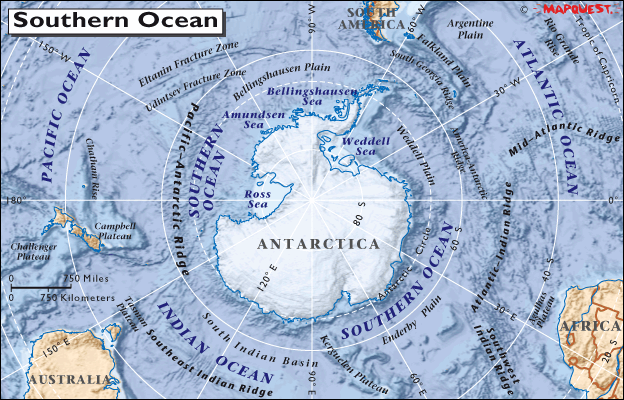
East Antarctica of late has become an interesting contributor to our understanding of continental ice melt. In particular, the Denman Glacier which contains enough ice to raise sea levels 1.5 meters (almost 5 feet) sits atop an Antarctic land basin that at its deepest point is 3.4 kilometers (2.1 miles) below sea level. Since 1979 the glacier has retreated more than 4.8 kilometers (3 miles) and lost 268 billion tons of mass. As it melts, the subsurface melt from the Denman can flow in two directions. Some can go into the Southern Ocean surrounding Antarctica, while the rest can flow downhill into the ice-covered canyon that lies beneath the glacier.

This unusual circumstance has become a concern for glaciologists and climatologists who recognize that the melting in two directions will lead to the opening of a passage for the water of the Southern Ocean to flow under the glacier inland. It’s not if but when this happens, the Denman could experience a dramatic and irreversible retreat.
Studies of the Southern Ocean that sits along the edges of the Atlantic, Pacific, and Indian Oceans, has been absorbing heat from the atmosphere at an accelerated rate. In fact, research shows that since 2006 the majority of global ocean heat content related to atmospheric warming is in the Southern Ocean. That warming is not distributed equally throughout the water column. For example, the upper 1,000 meters (3,280 feet) of the Southern Ocean on the fringe of its neighbouring oceans have warmed at a rate of between 0.1 and 0.2 Celsius (0.18 to – 0.36 Fahrenheit) per decade since 2006. Surface waters of the Southern Ocean further to the south, in contrast, have been cooling slightly while water along the seafloor, known as abyssal water, abutting the Antarctic continental shelf have been warming at a rate of 0.05 Celsius (0.09 Fahrenheit) per decade over the same period.
It is not known whether what is being observed is a multidecadal variability, but there appears to be a strong correlation between increasing ocean heat content, and atmospheric warming above Antarctica and its surrounding seas.
To illustrate, in February of this year, Argentina’s Marambio research station, on an island off the Antarctic Peninsula, recorded a daytime high of 20.75 Celsius (69.35 Fahrenheit), the first time the continent experienced an above 20 Celsius daytime temperature. This occurred in an area considered to be the fastest-warming place on Earth with average temperatures 3 Celsius (5.4 Fahrenheit) higher than 50 years ago. Compare that to the overall warming of the planet at 0.8 Celsius and we are talking about a 375% greater mean rate of warming.
If the warming of both atmosphere and ocean continues then the retrograde bed of the Denman is likely to be the place where we will witness the first major collapse of a 24,000 square kilometer (9,266 square mile) ice sheet. NASA-scientist, Virginia Brancato, who has been studying the Denman, describes it as “the most vulnerable spot” in East Antarctica.
Even more troubling is the fact that scientists until recently thought of West Antarctica as the unstable part of the continent. It turns out that ice instability today is consistent across the entirety of the southern continent.

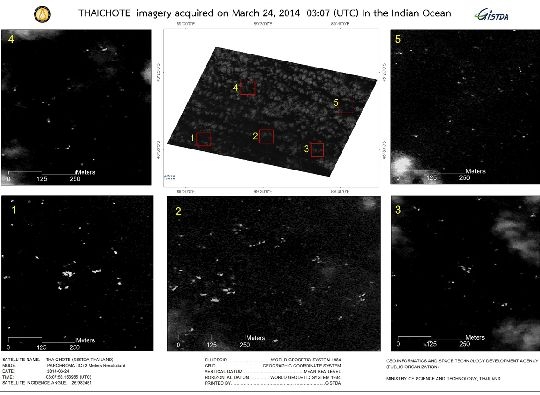
Seeing this type of floating garbage in satellite images just blows me away. How can we humans treat the ocean as a garbage dump when we draw much of our food from it?
And when one New Zealand-based aircraft in its search for Flight 370 spots 70 pieces of garbage in a 4 hour period you know that what we are seeing in the satellite images is just the tip of a very deep ice berg of trash.
We don’t see what is suspended in the water column below the surface either when observing the oceans from space or when flying over them in an airplane. Nor do we see the trash at a micro level, the degraded pieces of detritus that gets ingested by the life of the ocean from plankton to fish to whales to seabirds.
Everything from discarded bottles and cans to plastic bags, to fishing lines and nets, you name it, we’ve left it in the ocean. The plastic breaks up from wave action and sunlight getting smaller and smaller until it is almost microscopic in size. Does that make it safer for the environment? Emphatically no! It becomes a toxic brew that gets ingested by almost every creature in the ocean food chain. Discarded fishing lines entangle sea turtles, seals, penguins, whales, sharks and seabirds.
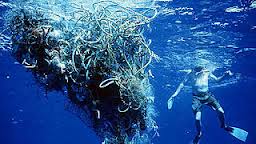
One research scientist who performed dissections on dead seabirds reported in one case an animal that ingested 175 pieces of plastic, probably the cause of death. One bird had even swallowed a glow stick. Apparently some fisherman use them to attract fish.
Back in 2012 a study was released based on findings of a French research vessel, the Tara, that conducted a 2-1/2 year, 112,000 kilometer (70,000 mile) voyage to study marine ecosystems. In its report it noted that the Southern Ocean, once considered the most pristine sea environment on the planet was filled with fragments of plastic to the tune of 50,000 per square kilometer, comparable to the global average. So even in as forbidding a place as the Southern Ocean which circles Antarctica, our waste had arrived, an area of the planet whose waters tend to remain isolated from water currents to the north. And that is where the current search for Flight 370 is focused. We may never find evidence of its demise, but in the search we have made all of us aware of just how extensive our degradation of the ocean environment has become.