What goes on under the surface of the water has always been a mystery not only in a scientific sense but also as a generalized collection of data available to the public. The innermost workings of our underwater world play a huge role in what goes on above the surface.
Sonar technology was first created to give ships a means to visually navigate and detect objects under the surface using a combination of simultaneous pulses of sound and corresponding echoes as opposed to only listening for external sounds of nearby underwater objects. Now that sonar has progressed far enough to offer vast insight into the biological composition of unmapped bodies of water, humanity can benefit from this knowledge.
Advancements and Capabilities
In recent years, sonar technology has incorporated GPS and the Navico Operating System. These two additional tools make exploring bodies of water easier than ever before. Other enhancements include radar, Automatic Identification Systems (AIS), realtime weather, integrated audio and advanced imaging using a wide selection of screen sizes. Many sonar GPS units come preloaded with data covering popular bodies of water all over the United States and Canada so users have instant visual access without having to do mapping on their own.
Sonar GPS combos are powerful pieces of equipment. The technology not only provides a biological map but also a detailed physical one, unlocking many of the secrets lying beneath the water surface. Equipped with Sonar GPS explorers can map out much more than the water depth and temperature/ They can also get an accurate picture of the entire water column from the surface to sea and lake floor looking at multiple biological factors and receiving a variety of visual displays of the findings. From mineral capacity and water chemistry to identifying unexplained pockets of cool water far beneath the surface. and the finding of new underwater currents this is technology that goes far beyond finding out where the local fish are hanging out.
The Future of Underwater Exploration
Imagine the possibilities that come with being able to discover and dissect underwater landscapes from lakes to the deep ocean using not only surface vessels but also deep diving drones and underwater robots. It means fewer secrets and a better understanding of our water world. It’s no longer technology to find shipwrecks or fish populations. Now it can help to locate and identify rare, mystifying creatures never seen before. And it can give us a vast new level of knowledge about lake and ocean chemistry as well as the topography of previously uncharted places beneath the sea. The accumulated knowledge includes new data on underlying deep ocean currents, circulation within the water column, carbon trap capacity, and the location and biodiversity of hydrothermal vents is greatly impacting our understanding. We now have the ability in real-time to monitor the changes in the ocean that have a corollary impact on climate and ecosystems above the ocean.
The ocean is the largest carbon sink on the planet. Almost a third of human-generated carbon dioxide gets absorbed by seawater. Investigating the impact of atmospheric carbon and the role the ocean plays in overall climate will help us mitigate and adapt to the changes. The technology being deployed to achieve this includes a variety of underwater sensors and beacons which track changes in water climate and provide vast amounts of new information creating an accurate picture of the planet’s health. And it is this technology focused on underwater discovery that is leading to a better understanding of our water world”s health.
In fact, however, people born without sight or who have developed blindness can see using sound allowing them to interact with our sighted world in ways never thought possible. In this blog we will explore how technology contributes to giving the blind sight through sound, and how some of us can actually switch on our brains to become echolocators.
Generating Sound Through a Device to Visualize the World
I started thinking about writing this blog after reading an article on EyeMusic, a device that converts images into music as recently reported in the journal, Restorative Neurology and Neuroscience.
EyeMusic doesn’t use t echolocation but it does use sound generated by a sensory device that lets the blind see using music. Images are converted into musical phrases called soundscapes. Different musical instruments represent different colours.
EyeMusic soundscapes span five octaves. Musical phrases that ascend or descend provide horizontal cues. High or low-pitched notes determine vertical space. Listen to some of the sample sounds created by the device to get a sense of what it creates.
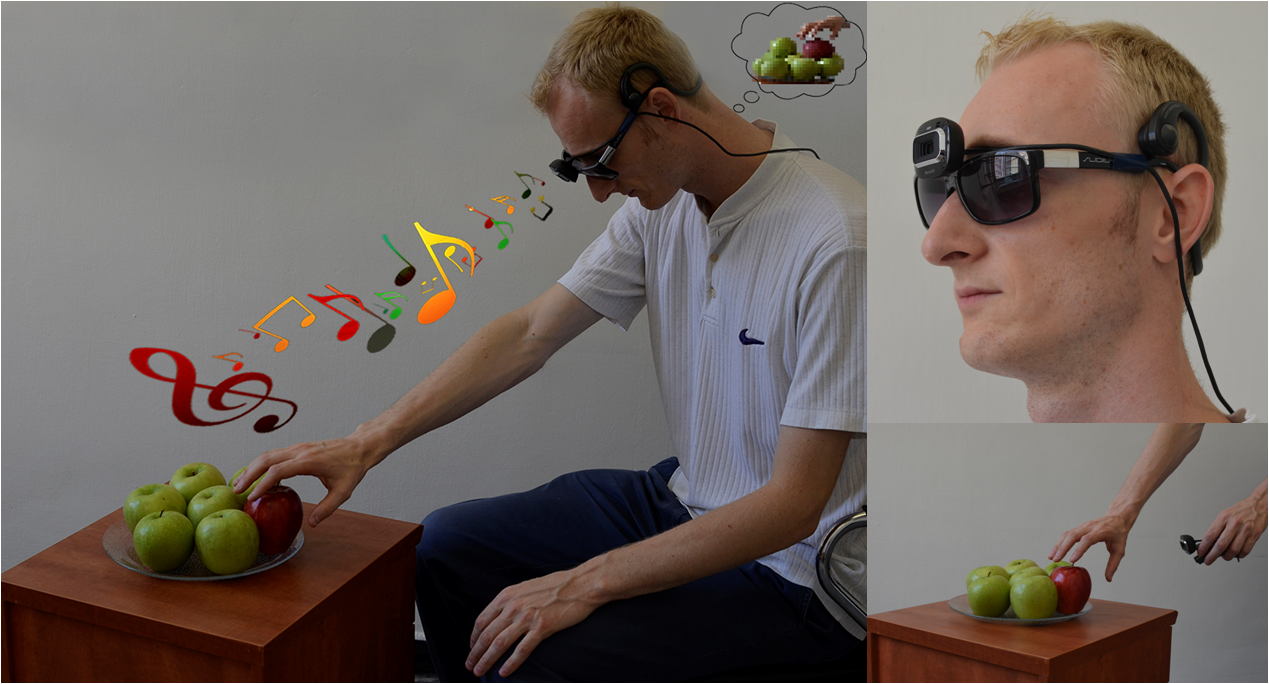
EyeMusic, although not echolocation, does mimic the results. Which brings me to the question, can humans learn to echolocate?
Humans can Echolocate
In an article that appeared in Science Daily in 2009, researchers reported humans developing echolocation to identify objects around them without sight. The study, done at the Superior Polytechnic School of the University of Alcala de Henares, near Madrid, Spain, analyzed using palate clicks, sounds made by placing the tip of the tongue behind the front teeth and moving it backward, to see. Where dolphins produce up to 200 clicks per second, the human subjects in this study demonstrated the capability to do 3 or 4. But even with a limited number of clicks the researchers found that humans trying echolocation could demonstrate the ability to visualize objects in space.
In trying echolocation they had many things to learn including:
The study showed that humans could train themselves to begin echolocating within a couple of weeks sensing such large objects as another person or a tree in front of them.
Other studies have shown that blind echolocators use the visual parts of their brains to process the clicks and echoes they create. In the May 2011 edition of the journal, PLoS ONE, researchers at the University of Western Ontario’ Centre for Brain and Mind, in London, Ontario, published results that showed blind people doing activities otherwise thought impossible through echolocation. Using MRI imaging of the brain, researchers played echolocation recordings of different objects back to blind echolocators who in listening to the clicks and echoes could identify them by sound. As a control sighted people were used in the study as well and demonstrated no echolocation capability whatsoever.
Can Different Echolocating Species Communicate With Each Other?
The answer is no. A good example of the complexity of echolocation can be found in dolphins. Every dolphin pod has its own unique set of clicks and whistles. This allows dolphins within the pod to share a rich vocabulary of sounds. But individual dolphin pods share only a small number of clicks and whistles with other pods. These sounds are limited to indicating distress or danger.

We humans do very similar things when we try to communicate with other human groups that speak a different language. We use the full range of body motion for communication but dolphins bodies lack arms to point and heads that can nod. Some of our words have common derivative origins so that the sounds are similar enough to be recognized. So that’s what dolphins do but their body language is done with tails and fins and through swimming motions and clicks and whistles replace words.
Dolphins and bats cannot talk to each other even though they both use high frequency sound to visualize their worlds. Interesting the physiology and chemistry indicates convergence between the species but they are captives of very different environments. As a result bat echolocation through air images objects up to 3 meters (10 feet) away. But dolphins and whales echolocate objects through water as far away as 100 meters (330 feet) or greater. That’s because sound travels much farther and up to four times faster through water than air.
]]>