Are Li-ion-powered cars’ days numbered? Tesla doesn’t think so and has continued to perfect the technology by increasing energy density and range with better heat management features while lowering the per-unit cost. As a result, Tesla has been lowering prices on existing models coming off the production lines while developing more affordable future EVs to attract current owners of fossil-fuel-powered vehicles.
The next generation of battery some manufacturers believe will be lithium-metal which uses an electroplated lithium-metal anode instead of the graphite one used in Li-ion.
Lithium-metal batteries have the potential to double the range of EVs. Recent work at Stanford University which I described in Part 1 of this two-part look at EV promise and challenges, shows that discharging a battery after use and letting it rest for an hour with no current running through will overcome one of the perceived weaknesses of lithium-metal. That’s because the batteries degrade rapidly if subjected to a high cycle of charging and discharging without a rest.
If the Stanford discovery catches on, will lithium-metal replace Li-ion as the standard? Some expert industry watchers believe that in two years, lithium-metal will be featured in many EVs.
What about solid-state batteries? The world’s largest automobile manufacturer, Toyota, has been late to the starting gate in the EV market, having developed and perfected hybrid vehicles that use a combination of electric and gasoline-powered motors. Rather than becoming just another Li-ion EV player, Toyota hopes to leapfrog the competition by moving to solid-state-battery-powered EVs by 2027 or 2028.
How do these three battery technologies compare? Check out the key differences below:
]]>In April I wrote about BYD, a Chinese electric vehicle (EV) manufacturer, that is using sodium-ion (Na-ion) battery packs instead of lithium-ion (Li-ion) in some of its models. In its latest report, IDTechEx, out of Cambridge in the United Kingdom, states that although Na-ion batteries are not the answer to all battery-power applications, they do provide a complimentary addition to battery packs used not just in EVs but also for backup power within utilities and factories.
IDTechEx points to several small factory pilot projects already being planned or built with a capacity of over 100 Gigawatt hours (GWh) within the next three years. These can be found in the UK, the US, France and China (see chart below). India is the site of what will be a 2 to 3 GWh factory that is planned to open in 2024.

The advantages of developing Na-ion battery storage cannot be underestimated. The capacity to grow because of material availability makes these batteries attractive when compared to Li-lon.
IDTechEx forecasts that the average cost per Na-ion battery cell will drop from the current US $87/kilowatt-hour (kWh) to $40/kWh by 2030. Na-ion energy density is not equal to Li-ion with the weight-to-energy density ratio higher than the latter impeding widespread adoption. But for use in commercial energy and grid storage, where size and weight are far less of an issue, Na-ion batteries should take off. Other advantages include they are faster to charge, more resilient in cold temperatures and more tolerant to heat. This makes them a good option for backup storage in utilities and as a power source for factories and buildings.
The first time I wrote about solid-state battery technology was back in 2014. Solid-state batteries when first released were seen as a good low-power, long life cycle solution for medical and remote sensing applications.
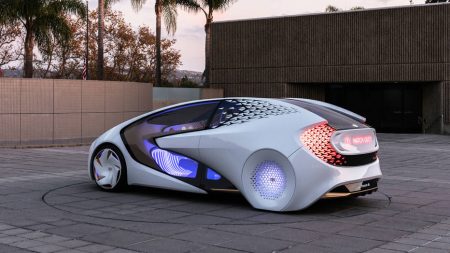
In 2017, Toyota, the world’s largest automobile manufacturer, announced it was planning to put a solid-state battery-powered EV on the road by 2022. That deadline passed without explanation. Toyota has been late to the EV game having put much of its low-carbon emission investments into hybrid systems that combined battery and small internal combustion engine (ICE) models. (Full disclosure: I drive a Toyota Venza hybrid which combines a Li-ion battery pack with an ICE. My previous car was a hybrid RAV4 which used a Nickel-cadmium battery pack combined with an ICE.)
What makes solid-state batteries so attractive to the automobile industry? They are lightweight, have no liquid electrolyte, have higher energy density, and don’t overheat which is a common concern for Li-ion storage technology. They also charge faster (10 to 20 minutes) than Li-ion, provide a greater operational range, and last longer.
In Toyota’s latest announcement in partnership with Panasonic, the companies have announced a technological breakthrough which reduces the size, weight and cost while providing an extended range of up to 1,200 kilometres (745 miles).
The only disappointment in the latest Toyota “breakthrough” announcement is that its solid-state powered models will be introduced in 2027 and 2028. In the interim, the company is continuing to make improvements to its Li-ion battery packs and plans to launch a line of EVs with an operational range of approximately 1,000 kilometres (621 miles) using this technology in 2026. An interim strategy is the launch of hybrid models containing small solid-state battery packs by 2025.
Toyota is not alone in pursuing solid-state battery-powered EVs. BMW plans to have a working prototype model by 2025. Nissan plans to introduce solid-state-powered EVs in 2028. And Ford, Volkswagen, Mercedes, BYD and others are all in hot pursuit as well. Meanwhile, Tesla, the company that made EVs a thing, is slow-walking solid-state technology, pursuing instead an enhanced Li-ion battery of their design.
]]>
Lithium-ion remains predominant because it is relatively cheap to produce and has economies of scale in its favour. But lithium, nickel, and cobalt are increasingly more expensive. And sourcing these minerals is increasingly being impacted by geopolitical strains on supply chains. Batteries using iron or aluminum, in the long run, could prove to be much cheaper and yet we have seen little in the way of efforts to move to these solutions.
Not all batteries are suitable for transportation applications. Iron-based ones for example fit the bill as storage backup for utilities feeding the electrical grid. This is a technology that can be added to an existing power plant to feed into the grid during peak periods. The current state-of-the-art performance comes from a Massachusetts-based company, an MIT spinoff, called Form Energy. Its battery prototype can feed the grid for up to four days before being fully discharged. And the cost per kilowatt-hour is only $20 USD.
New transportable battery innovations using more abundant materials include:
And then there are lithium-metal solid-state batteries which promise to be safer, faster charging and last longer than existing lithium-ion technology.
This type of battery has been around for a while but the main shortcoming of the technology has been durability. The batteries using ambient temperature ionic liquid electrolytes form dendrites over time that interfere with the flow of electrons between the anodes. The results are short circuits. The cure appears to be raising the operating temperature of the battery and switching out the electrolyte. At 110 Celsius (230 Fahrenheit) degrees this new version of the aluminum-sulphur battery doesn’t form dendrites.
The cost of this new battery works out to be about one-sixth that of lithium-ion. A 75 Kilowatt battery pack would come in at $1,200 USD which works out to about $15 USD per kilowatt-hour. Compare that to lithium-ion at $137 USD per kilowatt-hour.
The only drawback to aluminum-sulphur storage technology is the battery must be sealed to ensure no contact with liquid water or water vapour occurs. A leak could cause hydrogen sulphide to form, a poisonous and highly inflammable gas.
The big pluses besides cost per kilowatt-hour are that these batteries have faster recharge rates than lithium-ion and can endure the same number of discharges and recharges as those in electric vehicles (EVs) today.
The reason there is enormous interest in solid-state batteries is two-fold:
Work at the University of Houston, the University of Colorado, and at QuantumScape, a company located in San Jose, California, has led to the development of solid-state alternatives to lithium-ion. In Houston, the research team has invented a solid oxysulphide glass electrolyte in a sodium-sulphur battery. In Colorado, a similar solid ceramic-glass electrolyte has been invented. And in San Jose, QuantumScape claims to have developed the first lithium-metal solid-state anode-less battery.
The advantages of solid-state batteries include higher energy density, lower battery costs per kilowatt-hour, greater vehicle range between 50 to 100% more per charge, and faster recharge times (half the time of superchargers being used with current lithium-ion-powered EVs. In a nutshell, a switch to solid-state batteries answers all the major anxieties that gasoline-powered vehicle drivers have when commenting on why they are not ready to get an EV.
The automobile manufacturers of the world are all jumping on board. Ford and BMW have invested in Solid Power, the company spun out of the University of Colorado. Volkswagen is invested in the Houston technology. General Motors, Toyota, Daimler, Honda, Mitsubishi, Nissan, SAIC Motors, and BMW are working with QuantumScape. All of these solid-state battery developers are talking about a timetable to start delivering the technology to manufacturers by 2024 or 2025.
]]>Today’s lithium-ion (LiON) technology has limits: range, recharge rates, and recharge cycles. For example, a Tesla Model S has a range limit of 400 kilometers (250 miles) before recharge. With a fast charger, it can take 30 minutes for a full recharge. That’s pretty much state of the art for EVs today.
On the other hand, there are solid-state batteries which can extend range dramatically while recharging much faster. A solid-state battery of similar output to Tesla’s LiON could extend the car’s range two to three times. That battery would be smaller and lighter as well.
Other solid-state advantages:

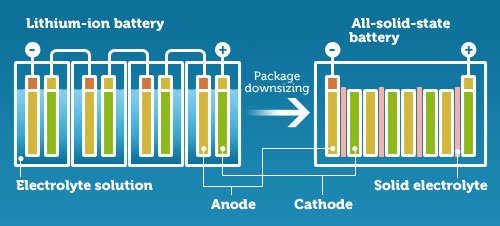
Solid-state batteries can be made using the following materials:
And they come in two varieties:
Lithium-phosphorus-oxynitride, also known by the acronym, LiPON is a material suitable for thin film solid state. These batteries are ideal for watches, other wearables, and cell phones. After 40,000 charge cycles, a typical LiPON battery will lose a mere 5% of capacity. That means LiPON technology can last from 40 to 130 times longer than comparable LiON.
Garnet-oxide is a material suitable for bulk solid state. It can produce the same energy output as current LiON technology using a much smaller footprint while at the same time retaining capacity over many more charge cycles.
In all cases, solid-state recharges much faster than LiON. The batteries Toyota expects to use in its 2022 EV models will recharge in 5 minutes (about the same amount of time it takes today to fill a gasoline-powered vehicle fuel tank.) The batteries will retain 100% charge capacity over a minimum 1,200 recharge cycles outperforming LiON by 400%.
When you consider Toyota has not been a big adopter of LiON technology it is not surprising that the company is choosing a different route in the evolution of its EVs. The leap to solid-state will be dramatic. But in the interim, the company intends to continue producing its existing Prius and other brand-hybrid cars, a hydrogen-fuel-cell car, and in 2019 will begin manufacturing LiON-powered EVs in China.
At the Wearable Technologies Conference held in Munich, Germany, earlier this year, a senior technologist from Applied, Leo Kwak, described the company’s work on solid-state thin film batteries, smaller, lighter, more flexible, with faster recharge and double the cycles of current lithium-ion technology.
The technology to make this possible is what Applied is shipping to manufacturers so that they can begin building solid-state battery technology integrated within their devices. Batteries made this way use a solid rather than liquid electrolyte. There are many applications from wearable electronics like smart watches to batteries for electric vehicles. Unencumbered by the weight and form factor restriction of a liquid electrolyte the batteries can be smaller, lighter, and malleable, capable of being shaped to meet almost any industry requirement.
Until recently solid-state batteries have primarily been used in remote sensing devices and medical implants where low-power requirements are needed. These are batteries that feature long cycle life and low leakage rates so they tend to last as long as the electronic device they power. The caveat up until now has been the battery cost. Lithium-ion has been cheaper. But with this new manufacturing process Applied can provide device manufacturers with a solid-state battery that is laid down using thin-film vacuum processes. And Applied isn’t going to the battery manufacturers with their technology. Instead it is shipping it direct to the device manufacturers. That’s because the thin-film vacuum processes they use to manufacture the circuitry in their devices can now also be used to create the battery to operate it.


