SOFCs can use a range of fuel sources including ethanol and natural gas to initiate the generation of electricity. In the Nissan configuration the e-Bio component reforms an ethanol-water mix to create the hydrogen. The fuel can be sourced from corn, and sugar cane. And SOFCs are highly efficient power generators producing driving ranges equivalent to gasoline and diesel-engine cars. Nissan claims that a single bioethanol fill up will allow the car to travel up to 600 kilometers before a pit stop. Refueling is no more complicated than stopping at a local gas station.
Nissan believes that creating a bioethanol fuel delivery system should be relatively easy. The ethanol-water blend is much safer than gasoline or diesel and therefore easier to transport and store.
But if the car uses bioethanol isn’t carbon dioxide a byproduct of the combustion? Nissan points to the fuel source, corn and sugar cane, stating that these crops represent a carbon sink making the vehicle net carbon neutral.
The image seen below appears in the press release issued by Nissan.
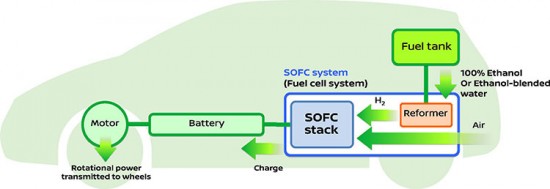
If the company can work out the bugs, establish the fuel infrastructure, and scale up production, this technology could prove to be a real game changer. The company did not announce when it expected to deliver its first eBio-SOFC model.
]]>Fuel cells, which resemble the jewel cases used to store CDs and DVDs (see picture below), individually don’t produce a lot of power. But when stacked together they become significant generators of electricity and an alternative source of energy for home use. With this in mind the Fraunhofer Institute along with Vaillant, a heating manufacturer, set out to build a reliable and safe residential system that could used piped in natural gas as the initial fuel source to power and heat homes.
The end result a unit that is smaller than most conventional furnaces and that generates on average about one kilowatt of power. That type of power output in Germany is equated with the average consumption of a family of four. The current field test includes a small number of homes. But there are plans in the works for a small production run to increase installations to 150 both in and outside Germany. Currently the cost for one of these units is very expensive. But as manufacturing ramps up this impediment to adoption should decline.
Each unit consists of a solid fuel cell stack with the electrolyte made from ceramic material. The material can operate at temperatures up to 850 Celsius (1,562 Fahrenheit) degrees. When natural gas is introduced to the fuel cell stack it gets converted to a hydrogen-rich gas. Oxygen ions, not electrons, are transferred within the stack in a process called cold combustion.

For homes this type of energy source would mean the only connection required would be to a natural gas source. The house would be able to generate all the electricity it needs without relying on power from the grid. It will be interesting to see how and when this becomes commercially available.
]]>
The term battery covers a wide range of technologies. A battery can be the flat lithium cell running your wristwatch (for those who still wear one) or your mobile phone. A battery can be the “A” battery in your flashlight, “AA” in your electric toothbrush, “AAA” in a penlight, or the battery in your tablet, notebook, gasoline-powered, hybrid or electric car, or a compressed air storage, chemical or molten salt technology found in continuous solar power stations.
The commonalities for all these “batteries” is – we need to make them more efficient, we need to extend their power capability, we need them to last far longer, and we need them to be less chemically toxic.
Three recent battery technology announcements caught my eye:
1. Boulder Ionics, a company in Colorado, is developing ionic liquids, salts that are molten below 100 degrees Celsius (212 Fahrenheit), for use as electrolytes. Ionic liquids could replace conventional electrolytes shrinking battery form factors and doubling capacity. Instead of the concrete block sized battery in your gasoline-powered car, you would have a battery about the size of a flashlight.
Using ionic liquids could improve lithium-ion storage capacity by a factor of 10. So that battery in your laptop could run continuously for days rather than hours.
In addition to the efficiency gain that Boulder Ionics’ technology brings, it has also improved on the manufacture of ionic liquids making them in greater quantity and cheaper than conventional electrolytes. The industry at large has always known about the potential of ionic liquids but shied away from them because to manufacture them took days to get sufficient production volume. But Boulder Ionics has developed a continuous rather than batch process making ionic liquid electrolyte in six minutes rather than three days. Instead of requiring a large chemical plant to make ionic liquid for 100,000 electric cars, Boulder Ionic can do this in a space no larger than a living room in an average home.
Ionic liquids do not evaporate and can be exposed to the air, which brings us to the second technology announcement.
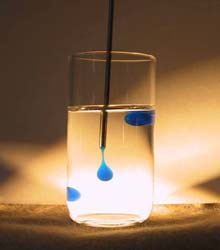
2. Metal-air batteries rely on the oxidation of metal when exposed to oxygen in the air to generate energy. Fluidic Energy, an Arizona-based start up, is using ionic liquids in a metal-air battery that will produce 11 times the energy density of current lithium-ion technology and at one-third the cost. The company recently received a $5.13 million research grant to help it get this technology up and running.
Traditional metal-air batteries use water-based electrolytes that can evaporate when exposed to air. This causes the batteries to fail. In addition water is far less electrochemically efficient, and when subject to excessive cold or heat can freeze solid or boil away. But with ionic liquids all those deficiencies go away. Ionic liquids survive as a liquid in sub-zero and above the water boiling point temperatures.
Metal-air batteries using ionic liquids become practical replacements for current lithium batteries when there is sufficient volume of the stuff available for production. Boulder Ionics is now making that possible. What it will mean is energy storage in electric cars that will, on a single charge, allow you to travel 700 to 800 kilometers (400 to 500 miles). And it will mean that the battery you will use to achieve this will be no bigger than your gas-powered car’s lead-acid battery.
3. Our last technology announcement concerns solid oxide fuel cells (SOFC). These are fuel cells that contain electrolyte sandwiched by two porous electrodes. Pacific Northwest National Laboratory in the state of Washington is building SOFC technology to power individual homes and neighbourhoods. These fuel cells achieve up to 57% efficiency, significantly higher than industry standards between 30 and 50%.
The goal is to create distributed power sources rather than large centralized power plants while addressing reduced carbon emissions. The SOFC technology that Pacific Northwest has developed includes micro-channel technology, tiny looping channels each narrower than a paper clip that are etched into a heat exchanger. The heat exchanger allows the fuel cell to recycle heat generated by the interaction of the two gases within the fuel cell in a closed loop system making it far more efficient. The development team expects to achieve 60% efficiency with a few more adjustments and then develop capacity to decrease SOFC costs.
