The disadvantages to using perovskites in solar energy are quickly disappearing. The remaining ones include:
But perovskite made solar cells have an enormous upside with predictions that in time will see conversion to energy efficiencies exceeding the best that silicon solar cells produce.
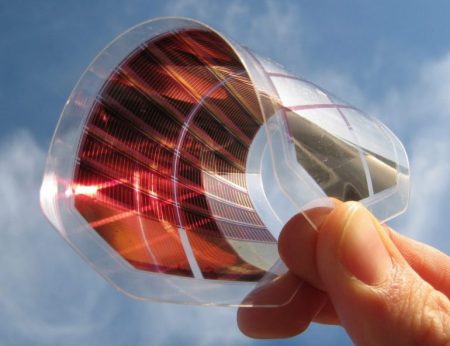
And speaking of technologies about to further disrupt our world, Peter Diamandis shares with us the observations of Ramez Naam, Chair of Energy & Environmental Systems, Singularity University. Naam is the author of the Nexus series, a science fiction trilogy about our future world in a post-human age. He has also written The Infinite Resource: The Power of Ideas on a Finite Planet. Diamandis interviewed Naam to get his perspective on three major disruptive innovative forces: solar power, batteries and electric vehicles (EVs). Hope you enjoy.
Creating an Abundant Solar Economy
In 88 minutes, 470 exajoules of energy from the sun hits the Earth’s surface, as much energy as humanity consumes in a year. In 112 hours – less than five days – it provides 36 zettajoules of energy. That’s as much energy as is contained in all proven reserves of oil, coal and natural gas on the planet. If humanity could capture 1 part in 1,000 (one-tenth of one percent) of the solar energy striking the Earth – just one part in one thousand – we could have access to six times as much energy as we consume in all forms today.
These staggering numbers, in combination with an exponential decline in photovoltaic solar energy costs ($ per watt price of solar cells), put us on track to meet between 50 percent and 100 percent of the world’s energy production from solar (and other renewables) in the next 20 years. Solar is already undercutting coal and natural gas in sunny geographies. Take a look at the plummeting costs.

Over the last 30 years, solar module prices have dropped by a factor of 100. Critically — a new solar price record was set in Chile just a few weeks ago at $0.0291 per Kilowatt hour – 58% less than the price of natural gas from a new plant!
And this is just the beginning. How cheap can it get?
The graph below shows that, if solar electricity continues on its current demonetization trajectory, by the time solar capacity triples to 600GW (by 2020 or 2021, as a rough estimate), we could see global unsubsidized solar prices that are roughly half the cost of coal and natural gas.

This is without factoring in the cost of air pollution and carbon pollution emitted by fossil fuel power plants.
Battery Technology Reaching an Inflection Point
Of course, one limitation of solar is that it’s only available during the day. We’ll need breakthroughs in battery technology to transition fully into a solar economy. The good news is that battery technology and energy storage are also hitting an inflection point.
Here are five trends shaping the future of battery technology and energy storage:
The real key here is that we are going to see a mindset shift in the near future. It will just be accepted that every home will be powered by a combination of batteries, rooftop solar and EVs (i.e. Tesla’s vision)… and we’ll gawk disapprovingly at the idea of driving an explosive, expensive and environmentally damaging gas vehicle.
EVs Gaining Speed
EVs are taking the transportation industry by storm. Within the next two decades, EVs will undoubtedly be the cheapest and most widely used vehicles on the market.
Take a look at the chart below. By roughly 2030, EVs with a 200+ mile range are going to be cheaper than the cheapest car sold in the U.S. in 2015.

The primary factor driving this decreasing cost is that EVs are inherently simpler devices only possessing 10% of the moving parts of gasoline-powered vehicles (cheaper to build, cheaper to maintain). Every major car manufacturer is working on EVs. The number of models has grown from 2 in 2010 to over 25 today. Just four months ago, Tesla Motors shattered expectations with the biggest one-week launch of any product ever by taking 400,000 advanced orders for its $35,000 Model 3 (implying $14 billion in future sales). Ford has followed suit, investing $4.5 billion in EVs with plans to add 13 EVs and hybrids by 2020, making more than 40% of its lines electrified.

Naam describes these three technologies as the trifecta of disruptive forces hitting the energy industry today and over the next twenty years. And it all starts with the enormous energy resource represented by the sun and the technological advancements to make harvesting this energy economically feasible. It means a paradigm shift to abundant, cheap energy for everyone on the planet. Now how will that impact labour? That’s a subject for another day.
]]>Biomedicine Update: New Insertable Robot to Enhance Minimally Invasive Surgical Procedures
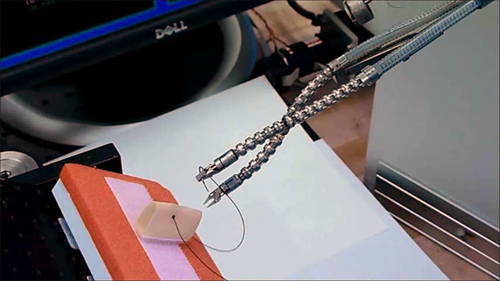
The Insertable Robotic Effector Platform, IREP for short, seen in the picture below, has been licensed to Titan Medical, a Canadian company focused on advancing robotic surgical technologies. An invention coming out of a collaboration between Columbia and Vanderbilt Universities in the United States, the IREP is the world’s smallest single-port surgical robotic device capable of performing laparoscopic procedures. IREP has two arms, a 3D vision system that has two controllable miniature cameras that provide real-time visual feedback for surgeons. The robot arms look like miniature snakes and the device can be easily mounted in a surgical suite because it is much smaller than other surgical robotic tools.
Energy Update: Is Shale Gas Production a Bubble Ready to Burst?
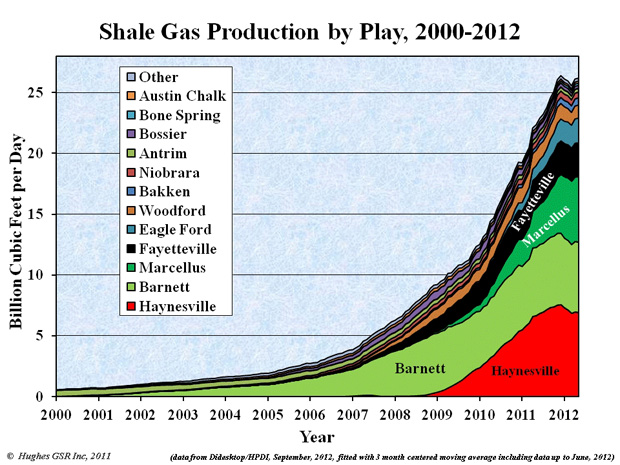
One of the knocks on fracking has always been the quick depletion that seems to happen soon after a new gas or oil well is drilled. In the U.S. it seems that shale gas has reached a plateau and that the 100-year supply may prove to be an inaccurate assessment of what can be forced out of the ground through fracking. The U.S. today uses 24 trillion cubic feet of natural gas per year. Based on current proven reserves including fracked fields there may be less than 20 years of reserves if consumption remains flat. Shale gas production in the U.S. earlier this year was at 27 billion cubic feet per day. But that production has leveled even with new fields coming on stream. Part of the problem goes back to my first comment. Shale gas well production tends to drop by 50% or more after the first year. As fossil fuels go, gas is the cleanest, but the United States may not have the grace period it has been talking about if these fields continue to encounter significant production drops. Either the technology improves to bump up yields or alternatives will have to be found to meet future energy demands.
Energy Update: Solar Costs Going Down
How much has solar energy technology gone down in cost? In the last two years solar has gotten 60% cheaper. Compare that to wind which has seen the technology reduce its costs per Kilowatt by 15-20%. Why is solar getting cheaper? Because the cost of solar panels continues to drop while the conversion efficiency of photovoltaics continues to improve. That means smaller panels can yield more energy. In August, residents in Boston were told they will pay less for electricity produced from solar than from other sources under a program called Solarize Massachusetts. Is cheaper solar rates a reflection of the drop in the cost of solar technology? Yes and No! Massachusetts is implementing cheaper solar electricity rates to encourage more clean energy investment in the industry. What is surprising is the cost of producing solar is appearing to be competitive with non-renewable alternatives.

Mining Update: Ending Mountaintop Mining for Coal a Priority of the EPA
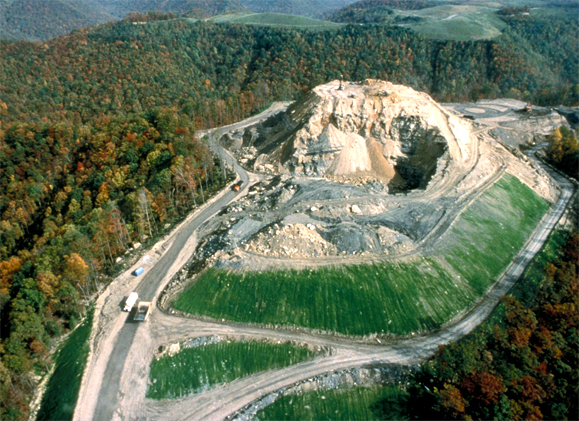
Of all mining practices in Appalachia mountaintop mining is the most environmentally destructive. Yet the coal industry continues to push to get permits to blow off the tops of mountains to expose seams for excavation. What mountaintop mining continues to do is destroy natural habitats and wildlife, change the course of mountain stream and the quality of water in them, pollute valley bottoms with tons of debris, and introduce chemical toxins into wells and drinking water sources. That is why the Environmental Protection Agency in the United States is trying to reverse a permit originally awarded to Mingo Logan in 2007, a subsidiary of the second largest coal producer in the U.S., Arch Coal. It is interesting when you visit the Arch Coal website and read the page on “How We Mine” you don’t see any examples of mountaintop mining practices. I guess it wouldn’t give them an environmentally responsible look. And when you read the company’s vision although they use the phrase “environmental stewardship” it takes on a whole new meaning when you see one of their mountaintop mines in operation or look at the level of selenium in local water supplies.
Space Update: India Joins the Space Race with an Ambitious Set of Missions
In 2008 India successfully launched its first unmanned lunar probe, Chandrayaan-1, placing a satellite in lunar orbit and hard landing a probe on the Moon’s surface. It received very little notice here in North America but it established India as a space faring nation. Today the Indian Space Research Organisation, or ISRO, is expanding its exploration of near-Earth and deep space with 58 space missions planned for the next decade and beyond. Missions include sending robot to land and explore the moon, an Indian-made global positioning satellite network called IRNSS, new satellites for communication, Earth observation and imaging, solar observation, studies of extra-solar objects, all to be launched with a new family of rockets capable of deeper space missions and heavier payloads. In 2013 India will launch its first mission to orbit Mars. And last but not least, India intends to join the U.S., Russia and China with its own human space flight program. “Baaharee duniaayaa” is Hindi for “outer space” and India intends to take a leadership role in the 21st century.

A Postscript
Once again I have to thank the many thousands who continue to visit Techso Mogro each month. Lots of you have become subscribers which is great. Keep on sending me your questions and comments. They inspire me to investigate and report back with even greater diligence. Let me know if there is a topic, not yet covered by Techso Mogro blog that you would like to see. If you have written an article that fits within the themes of this blog then let me know. Guest articles are welcome! And thank you again for continuing to drop by.
– Len Rosen
]]>A recent study published in the April 2012 edition of Environmental Research Letters, the Journal of the British Institute of Physics, and entitled The Long-Term Effect of Increasing the Albedo of Urban Areas, looks at proposals to make cities more sunlight reflective by painting roofs white and using light-coloured materials in paved areas. The authors, Hashem Akbari, H. Damon Matthews and Donny Seto, of Concordia University in Montreal, argue that pavement and roofs represent more than 60% of city surfaces. Dark roofs and asphalt are solar energy traps responsible for much of the heat effect cities experience. Called the heat island effect, cities are much warmer than their surrounding rural settings. This extra heat contributes to increased energy usage for air conditioning. The heat also plays a role in urban smog leading to increases in human respiratory diseases. And finally the heat is the primary cause of weather-related deaths effecting both young and the elderly frail.

The authors argue that reflective surfaces create a high albedo reducing the rate of heat absorption in urban surfaces. If you are not familiar with the term albedo, in scientific terms it is the fraction of light striking a surface that gets reflected from that surface. Objects with high albedo tend to be light. Objects with low albedo tend to be dark. Snow and ice have high albedo. That’s why the presence of snow in winter conditions contributes to further atmospheric cooling. The absence of snow, however, lets the uncovered land surface absorb light, convert it to heat and warm the air above it, a low albedo effect.
To obtain high albedo and reduce the heat island effect in urban areas the authors argue that a simple white coat of paint would provide an immediate cooling effect. They propose as cities renew infrastructure that paved areas use materials that are light-coloured which will increase their reflectivity.
It should be understood that with only 0.05% of the world’s land masses covered by cities a dash of white paint won’t do anything to mediate global atmospheric warming but it sure can help keep your urban neighbourhood a little cooler in the summer.
Solar Energy You Can Paint On Your House
University of Southern California researchers have created a liquid containing solar cells made from nanocrystals. Richard Brutchey and David Webber’s research is featured in Dalton Transactions, an international journal for inorganic chemistry. The solar nanocrystals are four nanometers in size. You can fit 250 billion of them on the head of a pin. In liquid they can be painted or printed on to a surface and represent a much cheaper way to produce solar energy.

The solar nanocrystals are not as efficient in generating electricity as current photovoltaic silicon wafers but their abundance makes up for this. By making the liquid suspension an efficient conductor the nanocrystals can build tiny bridges among them to transmit electricity. The liquid can be painted on almost any surface material and the result solar panel can be shaped to fit anywhere.
The researchers used cadmium, a highly toxic substance, in creating their nanocrystals. They are now looking at less toxic materials to create their solar cell paint, coming soon to a big box hardware store near you.
]]>
Sebastien Guenneau heads up a research team at the University of Aix-Marseille and France’s Centre National de la Reserche Scientifique (CNRS). The team intends to develop prototype thermal cloaks for microelectronics that diffuse heat around a protected area. They have published their findings in Optics Express, in an article entitled, Transformation Thermodynamics: Cloaking and Concentrating Heat Flux. This type of heat shield would have many applications within microelectronics and space science. The reverse, focusing heat on a small volume would be used for enhancing the power and heat production for the solar energy industry.

Current thermal protection technologies include the reinforced carbon panels, ceramic tiles and resins used by the Space Shuttle, the plastic foams we see in the insulation used in commercial products like coolers, the aerogels that NASA has used in Martian rovers. How does “thermal invisibility” compare?
Whereas the materials described above absorb and diffuse the heat from its source, this new technology deflects it around the object rendering it invisible to the heat source. The French research team is working with PVC-type polymers, silver and gold with a prototype near completion.
]]>