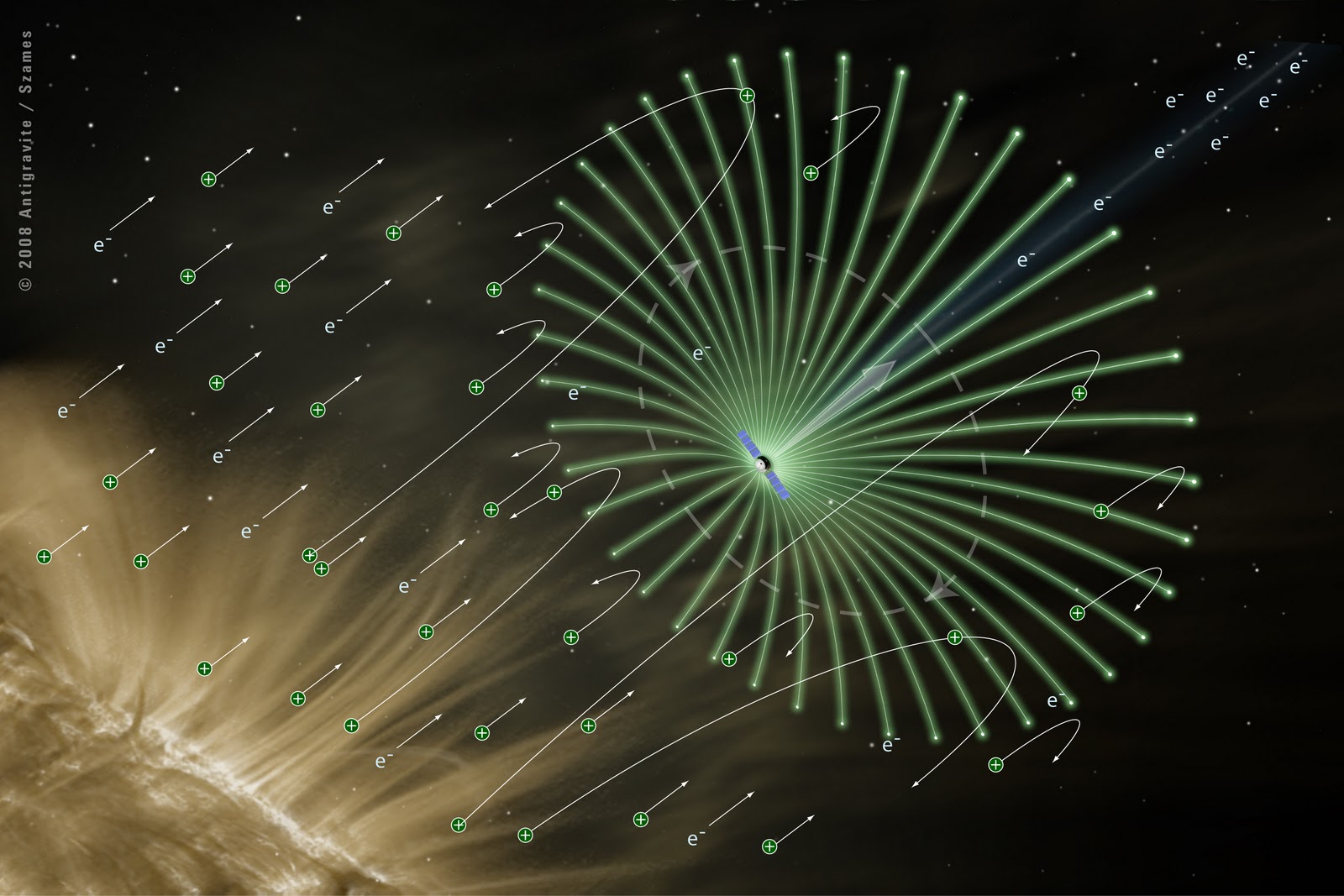
Called the ESAIL or electric sail, I wrote about this technology a year ago. It is far different from conventional solar sails which use the pressure of photons of light to push a spacecraft. The ESAIL, on the other hand, converts light into an electrical charge. It does this by extending a lattice of wires away from the spacecraft to capture and convert individual photons to an electrical charge. The amount of acceleration remains small at 1 mm/s^2. Over time, however, the accumulated thrust will achieve a velocity approaching 20 kilometers (12 miles) per second. At that speed the spacecraft will reach Uranus in 6 years.
The Uranus spacecraft consists of three parts: the ESAIL with solar panels and tether reels with extension wires, the main body of the spacecraft with on board chemical propellant for adjusting the spacecraft trajectory, and a communications component to stay in touch through the Deep Space network with Earth tracking stations.
The ESAIL concept was first proposed in 2006 and has subsequently been developed by a team of Finnish engineers. It currently is being tested on an existing European Space Agency satellite, the ESTCube-1. A second test is planned for this year with the launch of the Aalto-1 communications satellite.
The proposed technology is described in a paper entitled Fast E-sail Uranus Entry Probe Mission.
Related articles across the web
]]>NASA plans to use solar-electric propulsion in this mission, an engine similar to the one on board Dawn, the robotic spacecraft that visited Vesta and is now on its way to Ceres in the Asteroid Belt. The propulsion system will establish the NEA in a stable orbit for future visits by astronauts.
As I have stated in the past I’m not sure what NASA is smoking these days but the video is interesting as is the website where NASA further defines the mission.
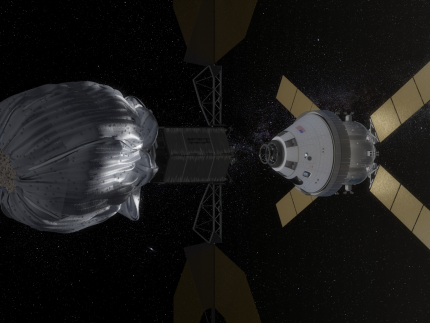
One justification comes from a NASA spokesperson who has wrapped this mission in the sacred cloak of saving civilization from near-Earth objects that could collide with the planet such as the one over Chelyabinsk on February 14 of this year. The rationale would be to build and demonstrate a technology solution for identifying, targeting and capturing Earth-threatening space rocks and moving them out of harms way.
What are we expecting in terms of new technology from such a mission? NASA intends to build what they are calling high-powered solar-electric propulsion (SEP) for the purpose of achieving rendezvous, capture and redirect, and state that without this technology the mission would not be possible. Once demonstrated SEP would be used for future telecommunications satellites and other Deep Space mission objectives.
So what is SEP? You may know it by its other name, ion propulsion, a system that NASA has successfully demonstrated with Dawn, the robotic spacecraft that recently visited Vesta and is now on its way to Ceres in the Asteroid Belt. So if we have already shown that ion propulsion works what needs further testing? Is there something different about the SEP planned for the mission to capture an asteroid?
It appears there is because calling it just SEP is actually a misnomer. What NASA intends to deploy is a hybrid chemical-SEP system. Chemical rockets would lift heavy payloads of components from the gravity well of Earth to low-Earth orbit. You couldn’t use SEP to do that. Once fully assembled and fueled SEP would be deployed to push the spacecraft into higher and higher orbits. This would be a slow process that would take several months. Once the spacecraft reached its destination point in Deep Space a chemical rocket with capsule and humans aboard would set off from Earth to rendezvous and dock. There are several potential scenarios that might ensue. The SEP robotic spacecraft could capture the asteroid on its own and bring it to the rendezvous point. Or the two together could use chemical thrust combined with SEP to set off for a rendezvous and capture of the asteroid. Return to Earth would involve an initial chemical rocket burn plus SEP to generate additional thrust. Will the SEP used for this mission differ from Dawn? Quite significantly! It will be much larger using more efficient solar panels and ion thrusters capable of putting out hundreds instead of tens of kilowatts.
What advantage will be gained by developing the chemical-SEP hybrid? The use of chemical rockets to get to low-Earth orbit will give NASA the best bang for the buck, while the deploying of SEP once in orbit will eliminate the need to carry large payloads of chemical fuel for use in spaceflight. This should save a considerable amount of money.
In addition assembling spacecraft for human occupation in low-Earth orbit rather than launching them fully assembled from the Earth surface will give NASA the capability to build heavier, better shielded human space habitats that can initially exploit SEP technology for travel, and later on magneto-plasma or even nuclear-powered propulsion systems.
So “catch a falling star” or in this case “asteroid” may help NASA catapult human voyagers to Mars and the Deep Space beyond. Let’s see if they get the money from Congress to move ahead.

]]>

